

The Airbus Beluga is a specialised cargo aircraft built by Airbus to transport oversized aircraft components between its manufacturing facilities across Europe.
Based on the Airbus A300-600, the original Beluga, officially called the A300-600ST (Super Transporter), entered service in September 1995. It was designed for one job: moving massive parts, such as wings and fuselage sections, that no standard freighter could accommodate.
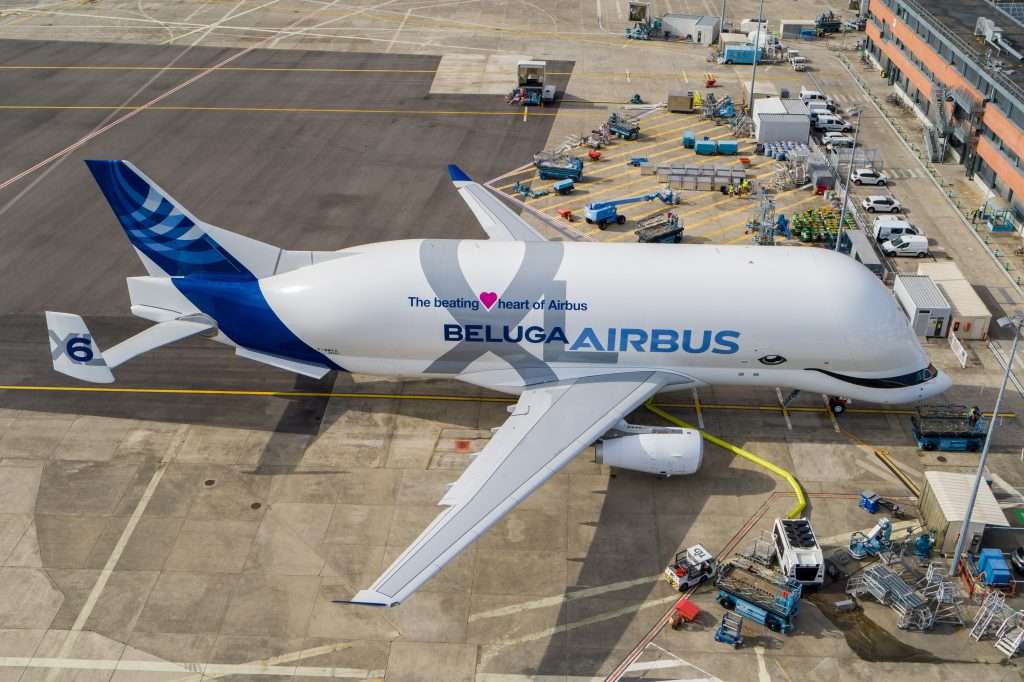
A second-generation BelugaXL followed in 2020, based on the A330-200 and offering 30% more payload capacity. As of early 2026, the ST fleet has been retired, and six XLs now handle all of Airbus’s internal logistics.
What Is The Beluga?
The Beluga gets its name from the beluga whale, and the resemblance is hard to argue with. Its enormous, bulbous upper fuselage sits above a standard-looking lower section, giving it a silhouette unlike anything else in the sky. The nickname became so widely used that Airbus eventually adopted it officially.
What makes the Beluga so unusual is the sheer scale of what it needs to carry. Airbus builds its aircraft across multiple countries. Wings are manufactured in Broughton, Wales. Fuselage sections come from sites in France, Germany, and Spain.
Final assembly happens in Toulouse and Hamburg. Moving those components by road or sea would be impractical for large structures and incompatible with production schedules. The Beluga is the solution.
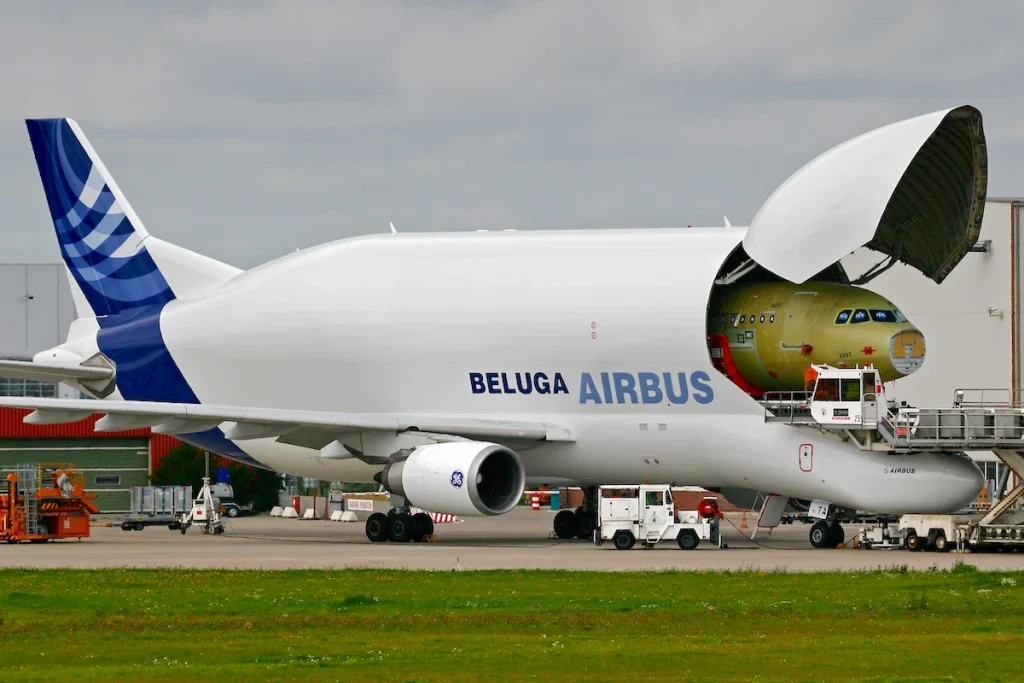
Its most distinctive feature is the nose-loading door. The entire front of the aircraft swings upward, allowing cargo to roll straight into the hold without navigating complex internal routing. This makes loading and unloading considerably faster than a conventional side or rear-door freighter.
Why Airbus Built It
Airbus’s problem dates back to the 1970s. As the manufacturer grew, it needed a way to move large components between its dispersed European production sites. The initial solution was a small fleet of converted Aero Spacelines Super Guppies, widebody aircraft originally designed for NASA and used by Airbus under licence. They worked, but they were ageing, increasingly expensive to maintain, and limited in what they could carry as Airbus’s aircraft grew larger.
By the early 1990s, Airbus needed something better. Rather than converting another manufacturer’s aircraft, it built one of its own, using the A300-600 as the foundation.
The wings, engines, landing gear, and lower fuselage were largely unchanged from the standard A300. The upper fuselage was entirely redesigned, creating a horseshoe-shaped structure 7.7 metres wide to accommodate the oversized loads.
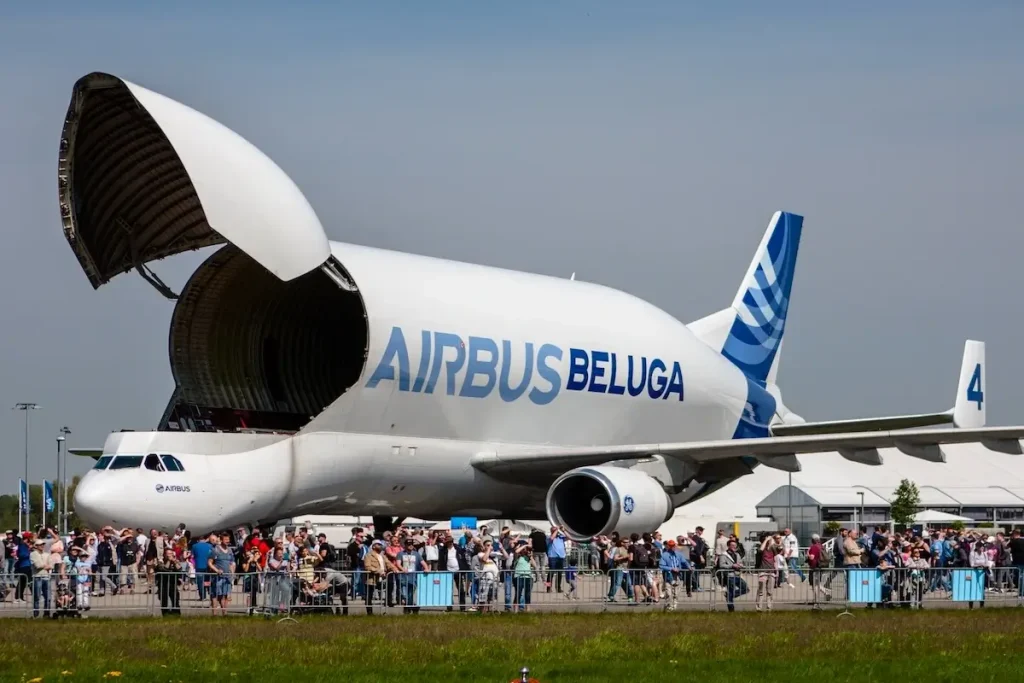
Construction on the first aircraft began in September 1992. It made its maiden flight on 13 September 1994 and entered service the following year. Five were built in total, and they served Airbus’s production network for 30 years.
BelugaST vs BelugaXL
The BelugaST served Airbus well, but by the 2010s, production ramp-ups for programmes like the A350 were pushing the fleet to its limits. The five aircraft were flying five times daily, six days a week, logging around 10,000 hours in 2017 alone. Critically, the BelugaST could carry only one A350 wing at a time. The BelugaXL was built to address that.
| Specification | BelugaST (A300-600ST) | BelugaXL (A330-700L) |
| First service | September 1995 | January 2020 |
| Based on | Airbus A300-600 | Airbus A330-200 |
| Max payload | 47 tonnes | 51 tonnes |
| Cargo hold length | 37.7 m | 63 m (max cargo length) |
| Cargo hold diameter | 7.4 m | 8.8 m |
| Range (full payload) | ~1,650 km | ~4,000 km |
| Fleet size | 5 (all retired by 2027) | 6 (full fleet in service) |
| Engines | GE CF6-80C2 | Rolls-Royce Trent 700 |
The BelugaXL’s fuselage is 6.9 metres longer and 1.7 metres wider than the BelugaST. That extra width is what allows it to carry two A350 XWB wings simultaneously, a task that previously required two separate flights. Its cargo hold has the largest cross-section of any aircraft currently in service, with a maximum internal diameter of 8.8 metres.
The XL also flies further. Where the BelugaST had a range of around 1,650 kilometres at full payload, the BelugaXL can cover up to 4,000 kilometres with 51 tonnes aboard, according to Airbus specifications. That added range makes it more flexible for serving all 11 destinations in the Airbus European network.
Specifications
The BelugaXL is powered by two Rolls-Royce Trent 700 turbofan engines, each producing around 71,000 pounds of thrust. It cruises at Mach 0.69 up to a service ceiling of 35,000 feet. Maximum takeoff weight is 227,000 kg, with an empty weight of around 127,500 kg.
The cargo hold volume exceeds 2,200 cubic metres, making it the most capacious cargo aircraft by internal volume. However, it can’t match the payload weight of aircraft like the Boeing Dreamlifter or the Antonov An-124.
Turnaround time is one of the XL’s key operational advantages. At dedicated Airbus loading facilities, a BelugaXL can be loaded and unloaded in around 70 minutes, keeping parts moving quickly between production sites.
Cargo And Routes
The Beluga fleet connects 11 Airbus production and assembly sites across Europe, running around 60 flights per week. The core routes link Toulouse and Hamburg, the two main final assembly locations, with component manufacturing sites in Broughton (wings), Saint-Nazaire (fuselage sections), Bremen, Getafe, and several other facilities.
Beyond aircraft parts, the Belugas have carried an unusual range of cargo over the years. A BelugaST transported the Eugène Delacroix painting “Liberty Leading the People” from Paris to Tokyo in 1999. The fleet has also carried satellites, helicopters, space station modules, and industrial machinery.

In 2022, Airbus launched a commercial charter service called Airbus Beluga Transport, offering the BelugaST fleet’s capacity to third-party customers in sectors including space, energy, and humanitarian logistics. That venture was short-lived. Airbus ended commercial service in January 2025, citing a lack of market demand and competition from other large cargo operators.
Fleet Future
The BelugaST is now finished as an operational aircraft. The final BelugaST mission took place on 17 September 2025, ending a 30-year career. The remaining airframes are being withdrawn by 2027, with several being repurposed. One BelugaST arrived at Airbus’s Broughton facility in January 2026 to be converted into a STEM education centre for students.
The BelugaXL fleet, all six aircraft in service since June 2024, will carry Airbus’s internal logistics for the foreseeable future. Airbus Transport International, the wholly-owned Airbus subsidiary that operates the fleet, expects the BelugaXL to log around 9,500 flight hours annually by 2027 as aircraft production rates continue to climb.
The aircraft can also operate on sustainable aviation fuel blends of up to 50%, a capability Airbus has highlighted as part of its broader sustainability commitments.

There’s no current plan to build a BelugaXL successor. The six-aircraft fleet is designed to handle Airbus’s transport needs well into the future, and given the development cost and complexity involved in building something this unusual, a third-generation Beluga is likely decades away if it happens at all.

ABOUT THE AUTHOR
Daniel Fowkes is a Melbourne-based aviation analyst and journalist with over a decade of industry experience. As founder of Dj’s Aviation, he delivers trusted analysis on aircraft, airline strategy and global aviation trends for djsaviation.net
Related Articles




Stay Informed
Get the latest aviation news, analysis and route updates delivered to your inbox.
We respect your privacy. Unsubscribe at any time.
Enjoyed this story?
Make us your go-to for aviation news
Add us as a preferred source on Google and see our latest stories first in Top Stories.
Add Us On Your News FeedRelated articles
· Airlines
· Airbus A380
Would The Airbus A380 Work In India?
Bryan Shelmon
24/09/2026
· Aircraft
· Airbus
· Airlines
Airbus’ Forgotten A350-800 Order
Bryan Shelmon
24/09/2026
· Aircraft
· Airbus
· Routes
Airbus A321XLR Route Map: How One Jet Opens Thin Long-Haul Market
Bryan Shelmon
23/09/2026
· Analysis
· Airbus
· Aircraft
· Boeing
Airbus A350-1000 vs Boeing 777-9: The Next-Gen Widebody Matchup
Bryan Shelmon
22/09/2026