

After much deliberation, Boeing has confirmed that a long-awaited new commercial aircraft will be built in its traditional home of Washington.
Developments surrounding the new aircraft follow an agreement with some 33,000 employees working in Washington state, home to Renton and Everett.
The tentative agreement involves unions representing workers and comes with substantially increased relief from a wage jump reported at 25% to other benefits such as health care.
However, in addition to the positive ramifications for employees, Boeing also confirmed that its next commercial jet will be built in the region.
The agreement explicitly states that the company will commit to a new commercial airplane and all derivatives during the program’s life within the union’s jurisdiction in Puget Sound and Portland.
This will include all program elements, including final assembly, wing fabrication, assembly, major components such as interiors and wires, part fabrication, delivery operations, and subassemblies.
However, there is a significant catch for this new commercial airplane: The board of directors must launch the program within four years. Otherwise, this is all seemingly voided.
A commitment to launching the program within four years doesn’t necessarily mean the aircraft will begin flying anytime soon; rather, Boeing needs a firm commitment for all this to take shape.
What Is Boeing’s Next Aircraft?
But what next aircraft will be released as part of Boeing’s commercial airplane portfolio?
Before this announcement, Boeing had long been studying a new middle-of-the-market airliner that would replace the 757, adequately known as the NMA; some dubbed it the 797.
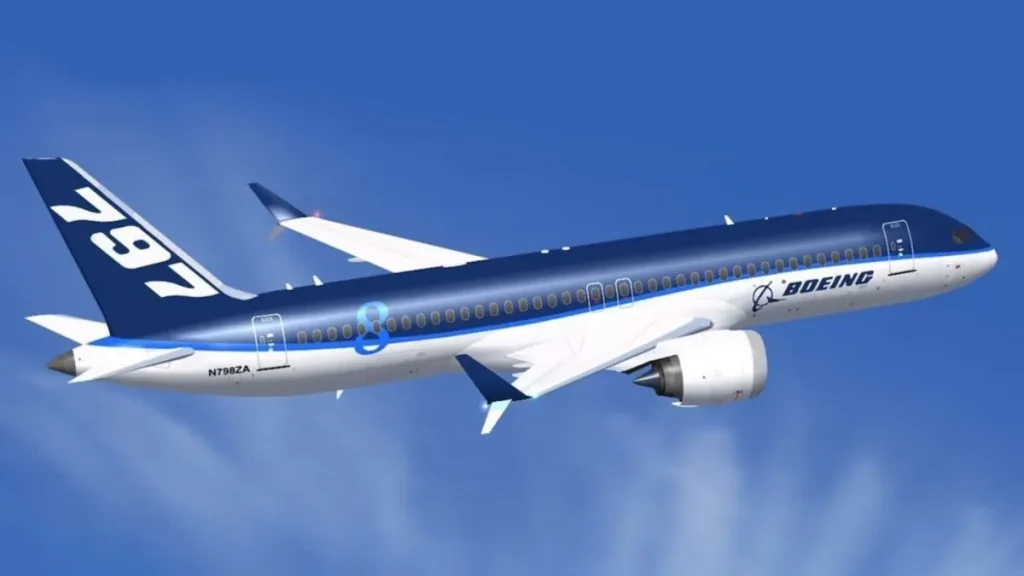
This NMA would answer airlines’ calls for an ideal jet to slot between types such as the MAX and 787, and some airlines and lessors were screaming out for it.
However, as time progressed, Boeing didn’t move ahead with an NMA, seemingly confirming publicly that it would return to the aircraft later.
In reports from the likes of Reuters, however, and lacking confirmation from Boeing, the aircraft being touted is a 737 replacement with still uncertainty on the direction, at least publicly when the labour deal was announced.
Why Boeing Canned The 797
Why did Boeing seemingly cancel the 797? Well, the planemaker’s decision-making was influenced by the lack of technological development.
Yes, Boeing believed that its next aircraft would desperately need new-gen tech and be a worthy upgrade on what was currently on the market.
However, towards the end of the 2010s, especially into the early 2020s, the consensus was that Boeing didn’t have what it believed it required to move ahead with the next-gen type.
Ultimately, Boeing said it would put the project on the back burner until the 2030s, most likely in a bid to reevaluate at this time point what available technologies would look like and whether airlines would require such a type.
By making this decision, Boeing essentially ceded ground to Airbus in this sector, allowing for the propelling of the A321XLR and other derivates to be highly successful and without true competition, as Boeing had nothing of similar stature.
Furthermore, while the MAX was often pitted against the A321neo in the form of the 737-10 at the time Airbus was able to launch, build, and certify a new A321XLR, the high-capacity 737-10 has yet to be certified.
This middle of the market has often been quoted as seeing demand well in excess of 1,000 units, with some forecasting 3,000 units in a lifetime. Thus, many onlookers believed Boeing missed the boat with an NMA.
An Important Future For Boeing
The upcoming years are essential for Boeing as it not only tries to repair its reputation and implement new strategies to improve its culture but also must compete with Airbus in the future.
The future is one of the most talked-about topics. How will Airbus and Boeing move ahead with their commercial aeroplane division, and more importantly, what will be released?
Generally, the consensus for Boeing is that they have to hit the nail on the head with their next plane, whether an NMA or 737 replacement.
However, this is easier said than done. Boeing will need to invest a lot in the next aircraft, and there’s still a very good possibility none of this will go ahead due to two major roadblocks that need overcoming.
One, Boeing must see the new labour agreement approved at a September 12 vote. Following this, Boeing must move ahead with such a new commercial airplane project in four years, which would bring us close to 2029. If announced at this point, it would launch formally with customers in the 2030s.

ABOUT THE AUTHOR
Daniel Fowkes is a Melbourne-based aviation analyst and journalist with over a decade of industry experience. As founder of Dj’s Aviation, he delivers trusted analysis on aircraft, airline strategy and global aviation trends for djsaviation.net
Related Articles



Stay Informed
Get the latest aviation news, analysis and route updates delivered to your inbox.
We respect your privacy. Unsubscribe at any time.
Enjoyed this story?
Make us your go-to for aviation news
Add us as a preferred source on Google and see our latest stories first in Top Stories.
Add Us On Your News Feed