
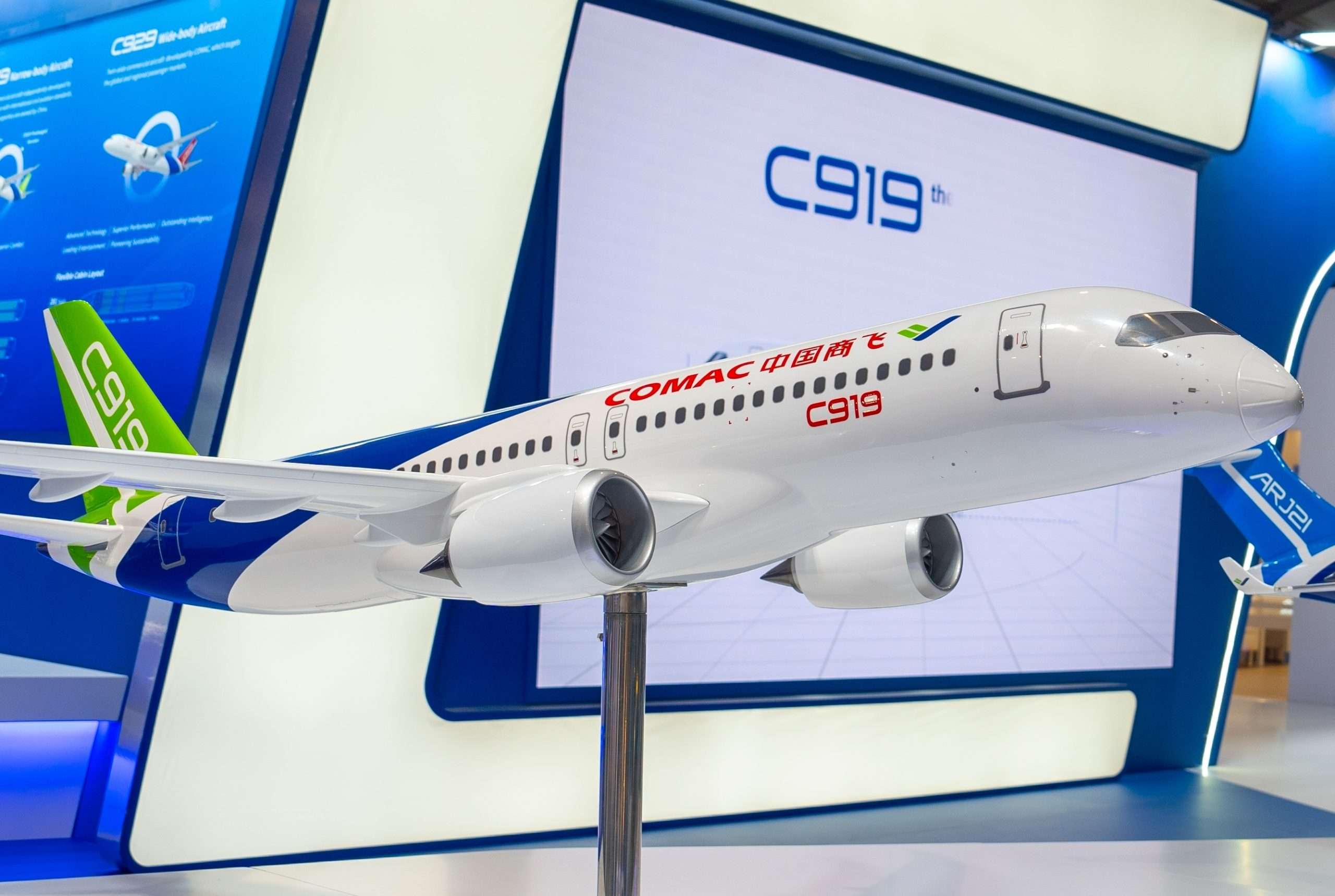
China now has its own commercial jet, called the COMAC C919. Developed by the Commercial Aircraft Corporation of China (COMAC), the C919 is a narrow-body, single-aisle airliner designed to compete with the Boeing 737 MAX and Airbus A320neo in the short to medium-haul market.
It seats between 158 and 168 passengers in a standard configuration, has a maximum range of around 5,555 kilometres (3,000 nautical miles), and has been in commercial service in China since May 2023. Whether it can seriously challenge the Western duopoly, however, is a much more complicated question.
Where the C919 Came From
COMAC was founded in 2008, and the C919 programme was announced shortly after. China’s ambition was straightforward: build a modern, domestically developed jetliner that could reduce the country’s near-total dependence on Boeing and Airbus aircraft.
The first prototype rolled out in November 2015, made its maiden flight in May 2017, and received its type certificate from China’s Civil Aviation Administration (CAAC) in September 2022. The first production aircraft was delivered to the launch customer, China Eastern Airlines, in December 2022, with commercial passenger services beginning the following May.

That timeline spans roughly 15 years from programme launch to revenue service, which is long by any standard. For context, the Airbus A320neo took around four years from launch to entry into service. The delays reflect the sheer scale of the challenge COMAC faced in building not just an aircraft, but an entirely new industrial capability from scratch.
How It Compares on Paper
The C919 sits in the same broad market segment as the 737 MAX 8 and A320neo, but the specs tell a story of meaningful gaps. Here’s how the three aircraft compare:
| Specification | COMAC C919 | Boeing 737 MAX 8 | Airbus A320neo |
| Typical seats (2-class) | 158 | 162 | 150–180 |
| Max seats | 168 | 210 | 194 |
| Range | 5,555 km (3,000 nm) | 6,570 km (3,550 nm) | 6,300 km (3,400 nm) |
| Length | 38.9 m | 39.5 m | 37.6 m |
| Wingspan | 35.8 m | 35.9 m | 35.8 m |
| Engine | CFM LEAP-1C | CFM LEAP-1B | CFM LEAP-1A |
The range gap is the most telling figure. At its maximum, the C919 falls around 700 to 1,000 kilometres short of both Western rivals, which limits the routes it can serve without a stop. The maximum seat count is also noticeably lower, which affects economics on high-density routes.

The engines are worth a closer look. All three aircraft use variants of the CFM LEAP family, but they’re not interchangeable. The LEAP-1C fitted to the C919 is a heavier variant than the -1A on the A320neo, and some analysts have estimated the C919 burns around 10% more fuel per seat than its Airbus counterpart, which adds up quickly over thousands of flight hours.
The Engine Dependency Problem
The reliance on Western-supplied engines is probably the single biggest structural vulnerability in the C919 programme. Despite being marketed as a domestically developed aircraft, the C919 depends on CFM International, a joint venture between GE Aerospace and France’s Safran, for its powerplant.
When US-China trade tensions escalated in 2025, the US government temporarily suspended sales of LEAP-1C engines to COMAC. The suspension was lifted a few months later, but the episode demonstrated just how exposed the programme is to geopolitical disruption.

COMAC has been working on an indigenous engine through the Aero Engine Corporation of China, but developing a competitive turbofan from scratch is an enormously complex undertaking.
Most estimates suggest a genuinely competitive Chinese engine is still at least 15 years away. Until then, the C919 remains dependent on components it cannot fully control. For more coverage of how supply chain and programme pressures shape modern airliner development, head to Dj’s Aviation.
The Certification Wall
Even setting aside the engine question, the C919 faces a significant obstacle to international growth: it has no certification outside China. CAAC’s approval is sufficient for domestic Chinese operations, but international airlines require either EASA or FAA validation before they’ll consider an aircraft for their fleets.
COMAC had initially hoped to secure EASA certification by the end of 2025. That target has since been pushed back substantially. EASA’s executive director confirmed in spring 2025 that the process would take between three and six more years, putting the earliest possible European certification somewhere between 2028 and 2031. As of early 2026, COMAC is not pursuing FAA certification.

The reasons are partly technical. EASA must independently validate the aircraft’s design and integration rather than simply accepting CAAC’s findings, and flight evaluation work still needs to be completed. There’s also an institutional dimension.
The trust regulators extend to established manufacturers like Airbus and Boeing has been built over decades. COMAC is still in the early stages of that relationship. The ongoing work on the Boeing 737 MAX programme shows that even established manufacturers face prolonged regulatory battles. COMAC’s challenge, though, is of a different order entirely.
The Home Market Is Enormous
None of the above means the C919 is a failure. China is the world’s largest domestic aviation market, and the case for the C919 within its own borders is strong. China Eastern has committed to 105 aircraft, while Air China and China Southern have each ordered 100. The combined order book sits at over 1,000 aircraft according to COMAC’s own figures, though independent corroboration of the exact breakdown is limited, given that many orders come from state-affiliated entities.
With US-China trade tensions causing some Chinese carriers to pause Boeing deliveries, demand for domestic alternatives has strengthened considerably. Production remains modest, with COMAC targeting around 30 deliveries in 2025 and aiming for 150 per year within five years. For comparison, Airbus produces well over 600 A320 family aircraft annually. The production gap is significant, but the direction of travel is upward.

COMAC has also announced plans for a family of variants. A shortened version, the C919-600, targets 130 to 160 seats, while a stretched variant capable of carrying up to 210 passengers is also in development. If those aircraft arrive alongside improvements to range and fuel efficiency, the competitive picture will look meaningfully different in a decade’s time.
Why Western Manufacturers Aren’t Panicking Yet
The honest answer is that Boeing and Airbus face no meaningful competitive threat from the C919 outside China in the near term. Without EASA or FAA certification, the aircraft simply cannot operate commercially in most of the world.
Even in markets that don’t strictly require those certifications, international airlines tend to treat them as a baseline standard. Lessors face similar constraints, since an aircraft confined to one country’s domestic market is a far less liquid asset.
The geopolitical context matters too. US export controls have already shown they can disrupt the supply of LEAP engines. There are also documented concerns around technology transfer and intellectual property. For a lessor or airline weighing the C919, those risks sit alongside more conventional questions about parts availability, maintenance network depth, and long-term residual value.
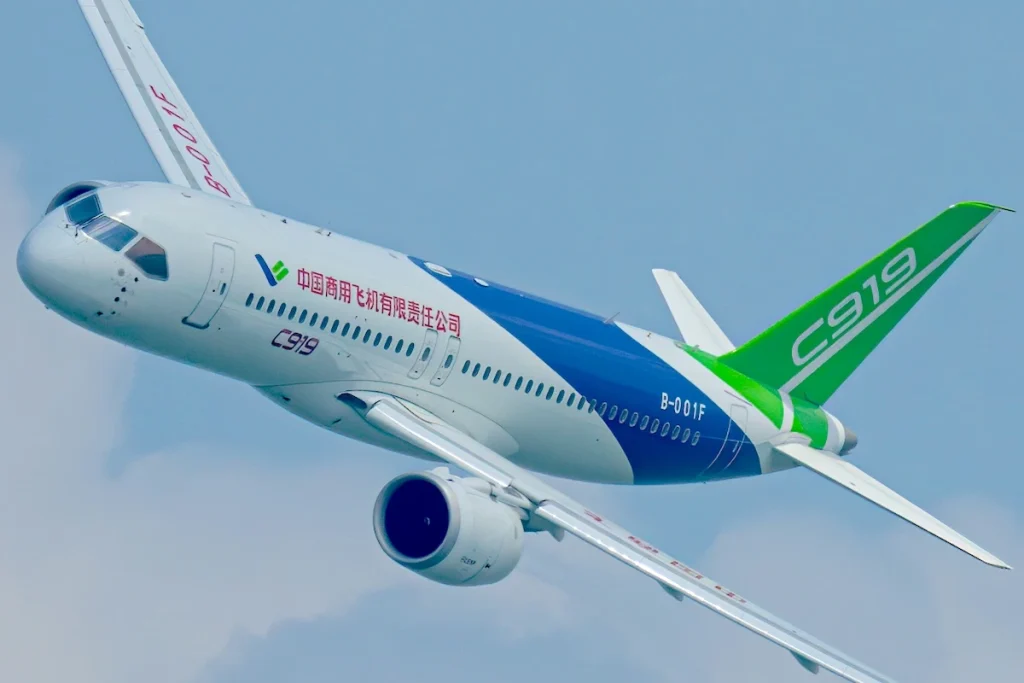
Full manufacturer specifications for the C919 are available directly from COMAC at english.comac.cc/products.
The C919 is a genuine industrial achievement and a credible aircraft for China’s enormous domestic market. As a challenger to Boeing and Airbus on the global stage, it still has a long way to go.
The certification wall hasn’t been scaled, the engine dependency remains unresolved, and the production ramp-up has years of work ahead. China’s aviation ambitions are real, and they’re long-term. For now, though, the duopoly remains largely intact.

ABOUT THE AUTHOR
Daniel Fowkes is a Melbourne-based aviation analyst and journalist with over a decade of industry experience. As founder of Dj’s Aviation, he delivers trusted analysis on aircraft, airline strategy and global aviation trends for djsaviation.net
Related Articles



Stay Informed
Get the latest aviation news, analysis and route updates delivered to your inbox.
We respect your privacy. Unsubscribe at any time.
Enjoyed this story?
Make us your go-to for aviation news
Add us as a preferred source on Google and see our latest stories first in Top Stories.
Add Us On Your News Feed