
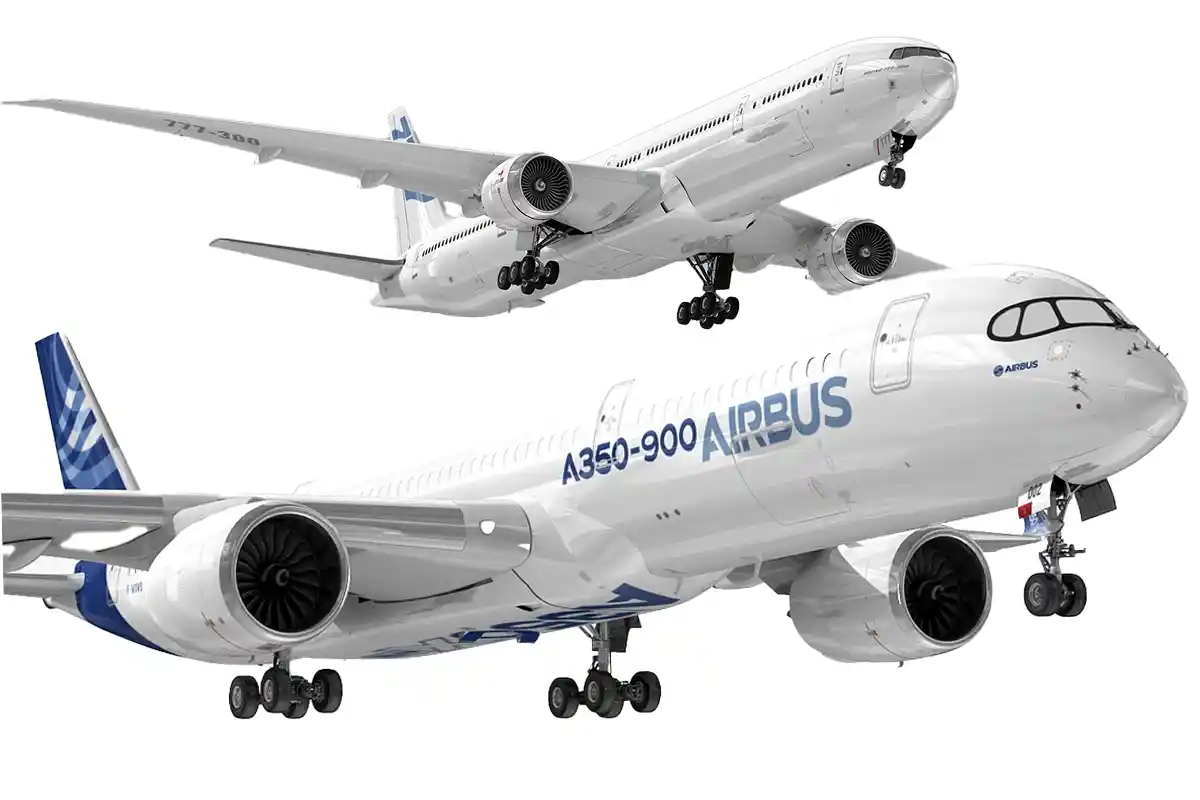
Pick any long-haul route map, and you’ll find one of these two aircraft parked at the gate. The Airbus A350-900 vs Boeing 777-300ER debate has shaped widebody fleet planning for a decade, and it’s far from settled.
Airbus builds the newer, lighter airframe, while Boeing’s Triple Seven still out-hauls it on seats and cargo. Here’s how the two actually stack up, using figures straight from Airbus and Boeing’s own technical data.
Key Insights
- Range: The A350-900 flies further, up to 15,750 km in its High Gross Weight variant versus the 777-300ER’s 13,890 km.
- Capacity: The 777-300ER seats more: 350 to 425 in a two-class layout, against the A350-900’s typical 332 to 352 in three classes.
- Efficiency: The A350-900’s composite airframe and Trent XWB engines deliver roughly 25% lower fuel burn than the aircraft it replaces.
- Power: The 777-300ER uses the GE90-115B, which is still officially the world’s most powerful jet engine.
- Outcome: Airbus wins on range and running costs; Boeing wins on raw capacity and cargo hold volume.
What are the Airbus A350-900 and the Boeing 777-300ER?
What Is the Airbus A350-900?
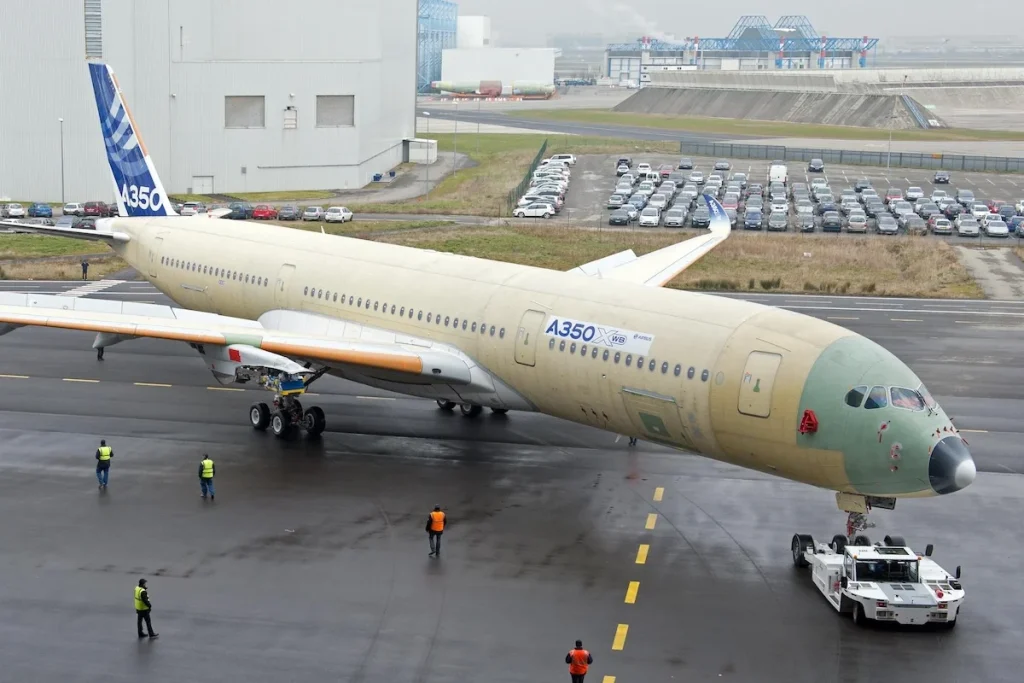
The A350-900 is the baseline model of Airbus’s A350 family, first flown in June 2013 and certified by EASA and the FAA the following year. Qatar Airways took delivery of the first jet in December 2014 and put it into commercial service in January 2015. It was Airbus’s answer to a market that suddenly wanted twin-engine widebodies capable of flying routes that used to need four engines.
Airbus builds the A350 around a fuselage that’s more than 70% advanced materials by weight, 53% carbon-fibre composite plus titanium and modern aluminium alloys. That construction is the whole point of the aircraft: a lighter airframe, lower fuel burn, and a cabin that can be pressurised to a lower altitude because composites don’t fatigue the way aluminium does.
What Is the Boeing 777-300ER?

The 777-300ER is the extended-range, stretched member of Boeing’s original 777 family. It entered service in 2004, more than a decade before the A350, and quickly became the backbone of long-haul widebody fleets at Emirates, Cathay Pacific, Air France and Turkish Airlines. Boeing describes the 777 programme as three decades of “proven, long-range success,” and the -300ER variant is the reason. It’s the best-selling model in the family by a wide margin.
Where the A350-900 leans on composites, the 777-300ER leans on brute mechanical power. Its raked wingtips, strengthened airframe, and enormous GE90-115B engines were bolted onto a proven 777 platform rather than designed from a clean sheet, which is exactly why Boeing could get it flying years before Airbus had an answer ready.
How Do the Airbus A350-900 and Boeing 777-300ER Compare in Size and Dimensions?
The 777-300ER is larger in almost every dimension that matters. According to Boeing’s own technical specifications, the 777-300ER measures 73.9 metres nose-to-tail, compared with the A350-900’s 66.80 metres. That’s a 7-metre difference.
Wingspan is near-identical at 64.8 metres for both jets. Height splits the difference too: the 777-300ER stands 18.5 metres tall, about 1.4 metres taller than the A350-900’s 17.05 metres, largely down to its six-wheel main landing gear bogies, needed to spread the extra weight of a heavier airframe.
Weight is where the gap really opens up. The 777-300ER’s maximum take-off weight reaches 351,530 kg, while even the heaviest A350-900 variant tops out at 283,000 kg. Boeing’s aircraft carries an extra 68 tonnes of structure, fuel, and payload capacity at full weight.
Which Aircraft Carries More Passengers, the A350-900 or the 777-300ER?
The 777-300ER wins on headline seat count. Boeing quotes 350 to 425 seats in a two-class configuration, and airlines running dense layouts have pushed that towards 396 or higher.

Airbus quotes the A350-900 at 332 to 352 passengers in a typical three-class layout, with a maximum certified capacity of 440 seats if an airline stripped out all premium cabins. So on paper, the two aircraft can be configured to similar maximums, but in the real-world three-class layouts most full-service carriers actually fly, the 777-300ER’s bigger fuselage cross-section and higher weight allowance let it carry noticeably more people, more cargo, or both.
How Far Can the Airbus A350-900 and Boeing 777-300ER Fly?
This is where the newer aircraft pulls ahead decisively. Airbus’s High Gross Weight A350-900 variant is rated to 8,500 nautical miles (15,750 km), and the Ultra Long Range variant (flown by Singapore Airlines on its Singapore-New York service) stretches that to 9,700 nautical miles (18,000 km) non-stop. Boeing’s 777-300ER, by contrast, is rated up to 7,500 nautical miles (13,890 km).
That roughly 1,900-kilometre gap is the difference between an airline needing a technical stop and flying a route non-stop, and it’s a big part of why several carriers have used the A350-900 to open new city pairs rather than just replace an older jet on an existing one.
Which Aircraft Is More Fuel-Efficient, the A350-900 or the 777-300ER?
Airbus states that the A350 family delivers a 25% improvement in fuel burn, operating costs, and CO2 emissions compared with the previous generation of competing aircraft, a comparison based on the jets the A350 was designed to replace, including older 777 variants. The 777-300ER is a mechanically excellent aircraft, but it’s a 2004-era design running 2004-era aerodynamics, and that generational gap shows up directly on the fuel bill.
How Do the Engines of the A350-900 and 777-300ER Compare?
The A350-900 runs two Rolls-Royce Trent XWB-84 engines, each rated at 84,000 lb of take-off thrust. The 777-300ER runs two GE90-115B engines from GE Aerospace, exclusively built for this aircraft and its stablemate, the 777-200LR. At 115,300 lb of certified thrust, the GE90-115B still holds the title of the world’s most powerful jet engine, having briefly hit 127,900 lb during a 2002 test run that earned it a Guinness World Record.
More thrust isn’t automatically more efficient, though. The Trent XWB is a newer-generation engine built specifically to squeeze more work out of every kilogram of fuel, which is a big reason the lighter, less powerful A350-900 still comes out ahead on burn per seat.
How Do Composite Materials Affect Efficiency?
A composite structure does two jobs at once. First, it’s lighter than the equivalent aluminium structure, so the aircraft needs less thrust to move the same payload the same distance. Second, because carbon-fibre doesn’t suffer metal fatigue the way aluminium does, Airbus can pressurise the A350 cabin to a lower altitude (6,000 feet versus roughly 8,000 feet in an all-aluminium fuselage) without the structural penalty that would come with doing the same thing on an older airframe. That lower cabin altitude means more oxygen in the air that passengers breathe at cruise.
Which Aircraft Offers a Better Passenger Experience?
Airbus has built its A350 marketing almost entirely around cabin comfort, and the engineering backs it up. The A350’s cabin is 5.7 metres wide, around 25 cm wider than the Boeing 787 and comparable to the 777’s. Airbus also quotes noise levels five decibels quieter than competing twin-aisle cabins, plus a HEPA-filtered air system that fully refreshes cabin air every two to three minutes.
The 777-300ER’s cabin experience depends heavily on which airline you’re flying and how they’ve configured it. Cathay Pacific’s 777-300ER cabin and a budget carrier’s dense nine-abreast layout on the same aircraft type feel like different planes entirely. The A350-900’s cabin, by contrast, tends to feel more consistent across operators because Airbus’s Airspace cabin architecture is more tightly specified from the factory.
How Much Do the Airbus A350-900 and Boeing 777-300ER Cost to Own and Operate?
Neither manufacturer publishes a reliable public price tag any more. Airbus dropped catalogue list prices altogether, arguing that they no longer reflected real transactions, and Boeing hasn’t updated its own published figures since 2023. As aviation valuation specialists have told AFP, “catalogue prices were a complete work of fiction”. Large orders typically come with discounts that can run to 50% off the sticker figure, depending on fleet size, financing arrangements and the competitive tension between Airbus and Boeing on any given deal.
What’s not disputable is the ongoing cost picture: the A350-900’s lower fuel burn and newer-generation maintenance intervals generally give it an edge on trip cost, while the 777-300ER’s decade of in-service data and enormous existing fleet give airlines cheaper access to spare parts, trained maintenance crews and used aircraft on the secondary market.
Which Airlines Fly the Airbus A350-900 and the Boeing 777-300ER?
Singapore Airlines, Qatar Airways, Cathay Pacific, and Air France operate some of the largest A350-900 fleets in the world, and all four also run substantial 777-300ER fleets alongside them, suggesting airlines increasingly see the two jets as complementary rather than strictly competing. Emirates remains the largest operator of the 777-300ER by a wide margin, having built almost its entire long-haul widebody strategy around the type.
Both manufacturers are already working on what comes next. Airbus is reportedly studying a stretched A350-2000, while Boeing’s answer is the 777X programme, headlined by the 777–9, a jet that borrows composite wing technology directly from the A350 playbook while keeping the 777’s core airframe. It’s the clearest sign yet of which technology direction has won this generation, even before the older Airbus A380 programme wound down for good.
Airbus A350-900 vs Boeing 777-300ER: Full Specification Comparison
| Specification | Airbus A350-900 | Boeing 777-300ER |
| First flight / entry into service | 2013 / 2015 | 1997 (777-300) / 2004 (-300ER) |
| Typical seating (3-class / 2-class) | 332–352 | 350–425 |
| Maximum certified seating | 440 | ~550 (structural max, rarely used) |
| Overall length | 66.80 m | 73.9 m |
| Wingspan | 64.75 m | 64.8 m |
| Height | 17.05 m | 18.5 m |
| Maximum take-off weight | Up to 283,000 kg | 351,530 kg |
| Range | Up to 15,750 km (18,000 km ULR) | Up to 13,890 km |
| Cruise speed | Mach 0.85 | Mach 0.84 |
| Engines | 2x Rolls-Royce Trent XWB-84 (84,000 lbf) | 2x GE90-115B (115,300 lbf) |
| Airframe materials | 70%+ advanced materials, 53% composite | Primarily aluminium alloy |
Neither aircraft is objectively “better” once you factor in what an airline is actually trying to do with it. The A350-900 comfortably wins the efficiency and range argument, which is why it keeps launching new ultra-long-haul routes. The 777-300ER wins on raw capacity, cargo volume and the depth of its in-service track record, which is why airlines are still ordering used examples well into the 2020s.
For the full picture on where both programmes go from here, keep across the latest aviation news as Airbus and Boeing push their next-generation widebodies through certification.

ABOUT THE AUTHOR
Daniel Fowkes is a Melbourne-based aviation analyst and journalist with over a decade of industry experience. As founder of Dj’s Aviation, he delivers trusted analysis on aircraft, airline strategy and global aviation trends for djsaviation.net
Related Articles




Stay Informed
Get the latest aviation news, analysis and route updates delivered to your inbox.
We respect your privacy. Unsubscribe at any time.
Enjoyed this story?
Make us your go-to for aviation news
Add us as a preferred source on Google and see our latest stories first in Top Stories.
Add Us On Your News Feed