
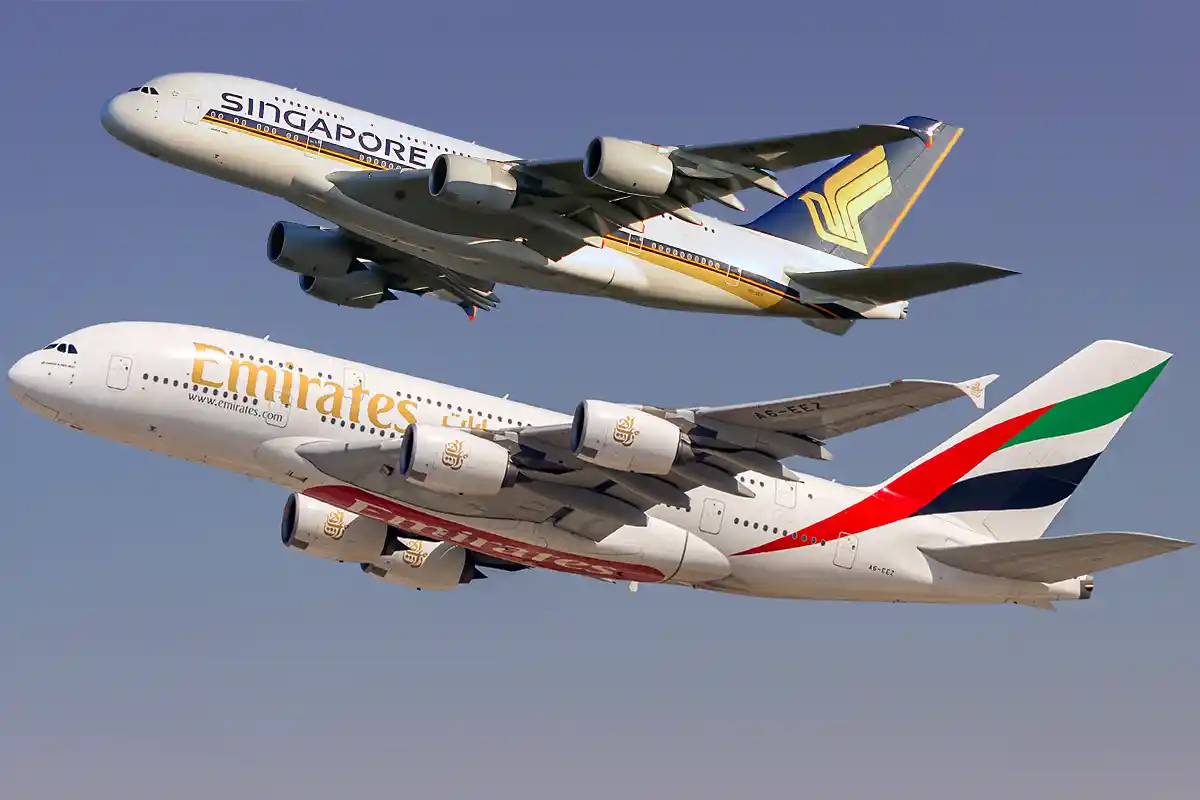
Premium Economy on Singapore Airlines and Emirates can make the journey as exciting as your final destination.
Travellers seeking an upgraded flying experience will get their money’s worth when travelling on either of these airlines. They specialise in long-haul routes and make the passenger’s journey seamless with unrivalled luxury without the large price tag of flying business class.
If you’re deciding whether to choose premium economy on Singapore Airlines or Emirates, these details will help you decide.
Two Different Premium Approaches At Singapore Airlines and Emirates?
Premium Economy Class is the mid-tier cabin between economy and business class. It’s available on both Emirates and Singapore Airlines, offering travellers more options for how they want to fly while catering to a range of travel budgets. This class is especially useful on long-haul flights, where better comfort and service improve the experience of spending long hours in the sky. As one of the top premium class airlines in the world, here’s what travellers can expect.
Singapore Airlines ranks in the top 5 Premium Economy Class Airlines. Booking a premium economy seat puts you near the front of the aircraft, with larger seats measuring nearly 50cm wide and offering close to 100cm of legroom. The 20cm seat recline, adjustable headrest, and leg and footrest let passengers find the perfect position for comfort on a long flight. Seats are arranged in a 2-4-2 configuration.
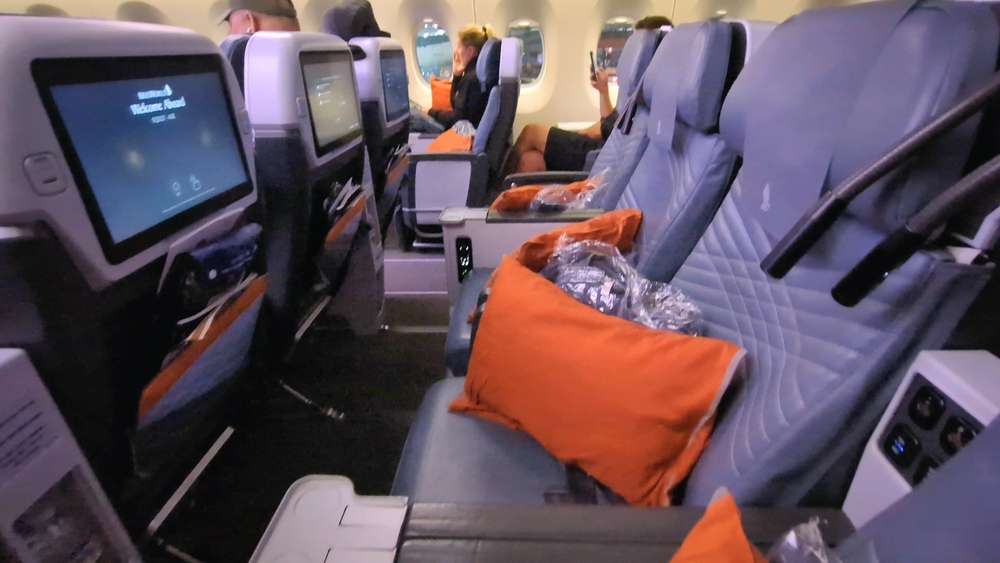
Premium Economy on Singapore Airlines also has upgraded seatback entertainment compared to economy class. It features a 33cm screen stocked with more than 2,900 hours of movies, TV shows, games, audiobooks, and other in-flight visuals. In-flight Wifi is also free for all passengers, which is standard on Singapore Airlines.
Emirates is ranked as the most expensive premium economy class, but delivers one of the most luxurious flying experiences outside of business class. Seats feature plush leather and decorative trims. The pattern details are inspired by the Ghaf Tree, the UAE’s national tree. Seat size and functionality are similar to Singapore Airlines: 50cm wide, 100cm legroom, and 20cm recline, with adjustable head, leg, and footrests.
Emirates’ seatback entertainment is also comparable, with 33cm full-HD touchscreen TVs with over 4,500 channels. The downside is that Wifi is limited unless you have Silver tier or higher on the Emirates Skywards loyalty program.
Both airlines offer amenity kits for the flight, which include sleep masks, slippers, and other toiletries.
Fleet and Cabin Strategy Compared
While the design and layouts of Premium Economy on Emirates and Singapore Airlines are comparable, their overall strategies differ significantly. It’s what sets the two flying experiences apart.
Singapore Airlines introduced the premium economy class cabin in 2015. It’s featured on its Airbus A350, A380, and Boeing 777 widebody aircraft, which it uses for long-haul flights. Its main goal for premium economy is to provide a personalised experience for passengers.
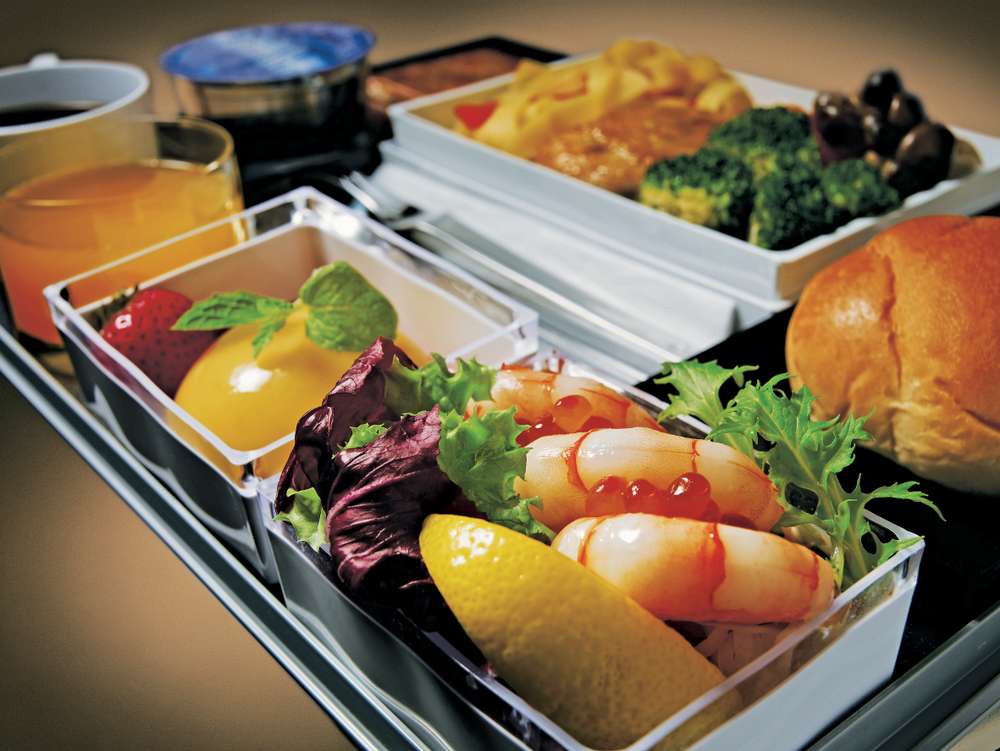
The dining experience is world-class for the entire aircraft, but premium economy travellers get upgraded with champagne service, an expanded dining menu, and meals served on china. One of the best benefits is the “Book the cook” service. Travellers can pre-order a specialised main course and note their dietary restrictions before the flight so that it’s ready to serve on your travel day.
Emirates launched its premium economy class in 2022. It features premium economy across its entire widebody fleet: the Airbus A380 and A350, and Boeing 777. It even retrofitted older aircraft to include the new cabin. Emirates’ goal in its Premium Economy cabin is to create an unmatched luxury flying experience. This is seen in the meticulous cabin design and personalised service. This luxury justifies the higher price tag, which can be more than double an economy ticket.
Ultra-Long Haul Versus Global Hubs For Travel?
Premium Economy Class significantly boosts operations for Singapore and Emirates. Their route strategies focus on long-haul flights, so enhancing the flying experience is an excellent way to boost customer satisfaction and grow demand for long-haul journeys. The geographic positioning of the airline hubs impacts how they operate.
Emirates has the advantage of being at a geographic intersection between major travel destinations. Its hub is Dubai International Airport (DXB), which is ranked the busiest airport for international travel. It uses this hub to connect passengers to Asia, the Americas, Africa, and Europe. It can fly from Dubai (DXB) to London (LHR) in 7.5 hours; to New York (JFK) and Sydney (SYD) in under 14 hours nonstop. These major business hubs drive demand for premium economy class, where luxury is more a perk than a necessity.
Singapore Airlines is based at Singapore Changi Airport (SIN). This Asian hub is less centralised and requires longer flight times to reach major hubs. It operates daily nonstop flights to London (LHR) with a 14-hour flight time. It even has the world’s longest flight between Singapore (SIN) and New York (JFK/EWR) in 18-19 hours. Enduring flights this long make comfort a priority to keep passengers happy and minimise fatigue on arrival.
Which Airline Is Known For Its Premium Standard More and Why?
An ultra-long flight on Singapore’s longest route would be nearly impossible in standard economy class, so it launched a special all-premium configuration on its A350-900ULR aircraft, designed for ultra-long-range routes. A typical premium economy class cabin features 24-36 seats. This aircraft has 94 premium economy seats, plus 67 business class seats.
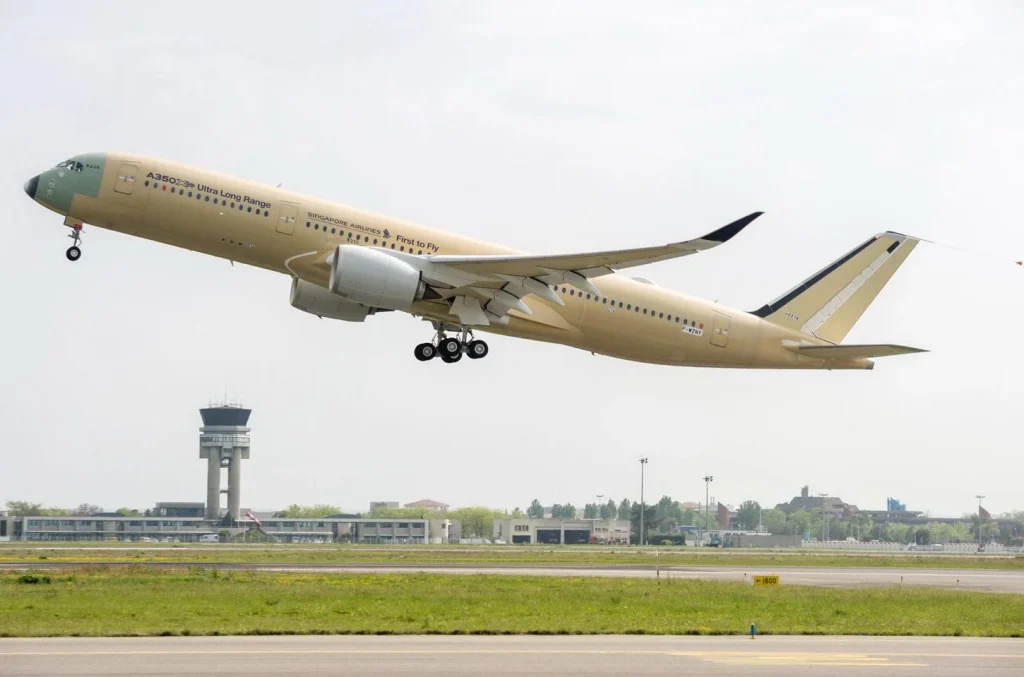
Singapore Airlines deploys the A350-900ULR on routes to the United States. Its route schedule includes New York (JFK and EWR) in 19 hours, Los Angeles (LAX) in 16 hours, and San Francisco (SFO) in 15 hours.
Singapore Airlines briefly stopped direct flights to the US in the early 2010s because rising fuel costs made the quad-engine A340-500 less economical. Adding the A350-900ULR to its fleet allowed it to resume these routes in 2018, making long-haul flights more fuel-efficient and more profitable with premium cabins.

ABOUT THE AUTHOR
Bryan Shelmon is an aviation journalist with 10 years of experience covering commercial aviation, private aviation, airports, aircraft and wider industry news. Based in the Detroit metropolitan area, he has contributed to publications including Lonely Planet, Matador Network and Visit Detroit.
Related Articles




Stay Informed
Get the latest aviation news, analysis and route updates delivered to your inbox.
We respect your privacy. Unsubscribe at any time.
Enjoyed this story?
Make us your go-to for aviation news
Add us as a preferred source on Google and see our latest stories first in Top Stories.
Add Us On Your News FeedRelated articles
· Airlines
Allegiant Air Buys Six More 737-8s From Boeing
Daniel Fowkes
26/10/2026
· Airlines
Emirates vs Qatar Airways: The Gulf Superhub Rivalry Compared
Bryan Shelmon
26/10/2026
· Airlines
Riyadh Air Is Moving Away From Riyadh
Daniel Fowkes
26/10/2026
· Airlines
Emirates Isn’t Worried At All
Daniel Fowkes
25/10/2026