
Airline Guide · Premium Long-Haul Carrier
Emirates Airlines
Emirates Airlines is the flag carrier of the United Arab Emirates and the largest airline in the Middle East, connecting the world through its Dubai hub. Dj's Aviation covers the latest Emirates Airlines news, fleet movements, route changes and policy updates across its global long-haul network below. Check back regularly for Emirates Airlines news today and the latest Emirates Airlines update on fleet, routes and product changes.
IATA EK
ICAO UAE
Founded 1985
Aircraft 266
Latest News Emirates Airlines

Emirates Airlines
Airline Fact File
IATA / ICAOEK / UAE
FoundedMarch 1985 (first flight 25 Oct 1985)
HeadquartersGarhoud, Dubai, UAE
PresidentSir Tim Clark
Chairman & CEO (Emirates Group)Sheikh Ahmed bin Saeed Al Maktoum
OwnershipWholly owned by the Investment Corporation of Dubai (ICD)
AllianceNone (independent, with bilateral codeshares)
LoyaltyEmirates Skywards
Fleet (passenger)266
Aircraft typeAirbus A380, Airbus A350, Boeing 777 (all wide-body)
Destinations140+ cities across six continents
Aircraft lines
Primary hubs
DXB
History & Founding
Emirates Airlines was founded in March 1985 with backing from Dubai’s ruling family, after the royal Air Wing provided two Boeing 727-200s for the airline’s first aircraft. The carrier leased a Boeing 737-300 and an Airbus A300B4-200 from Pakistan International Airlines to get started, and on 25 October 1985, Emirates operated its first flight, from Dubai to Karachi, using an Airbus A300B4-200.
From modest beginnings with just two aircraft, Emirates grew at roughly 30% a year through its early years, with the 1991 Gulf War (during which Emirates was one of the only airlines to keep flying), helping cement its reputation and secure valuable slots at London Heathrow shortly afterwards. The airline built its business model entirely around Dubai as a single global hub, connecting passengers between six continents via one of the world’s busiest international gateways rather than flying point-to-point.
On 3 August 2016, Emirates suffered its first and only hull loss when Flight 521, a Boeing 777, crash-landed at Dubai International Airport during a botched go-around. All 382 passengers and 18 crew survived, though an airport firefighter was killed during the rescue effort. The airline has otherwise maintained a strong safety record across four decades of operation, and in recent years has committed billions of dollars to cabin retrofits, new aircraft and connectivity upgrades as it works through delivery delays on its record-breaking Boeing 777X order.
Fleet
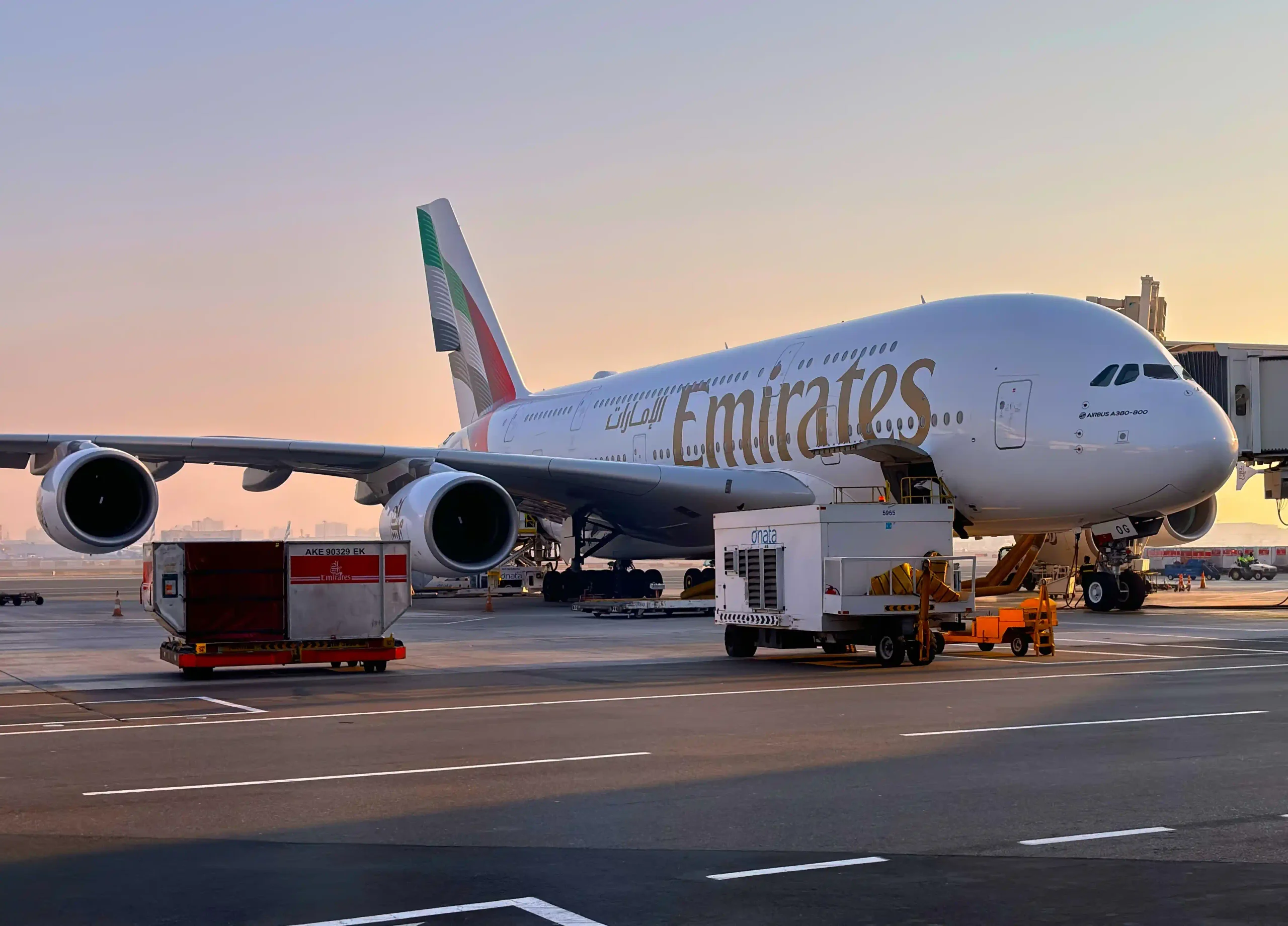
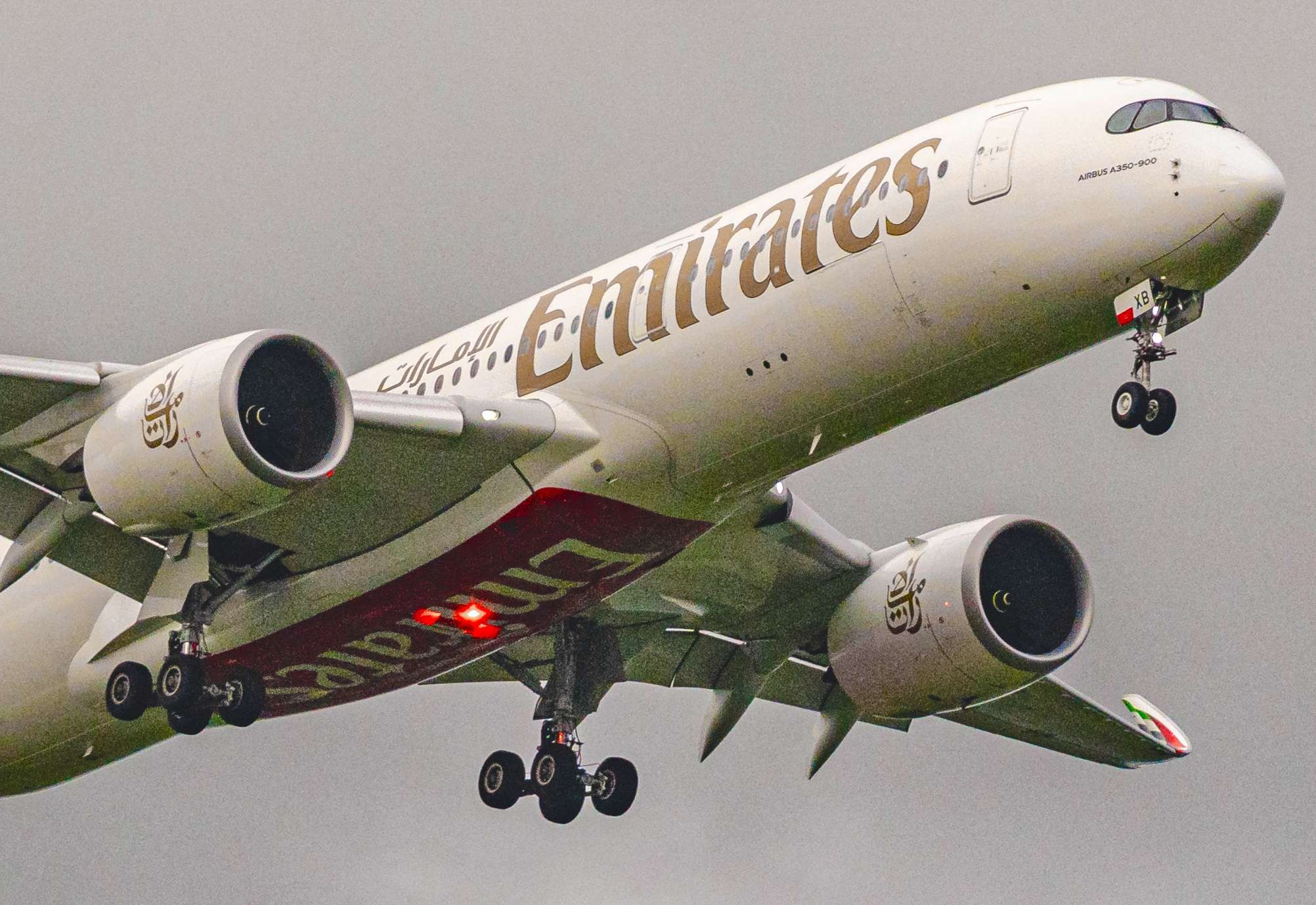
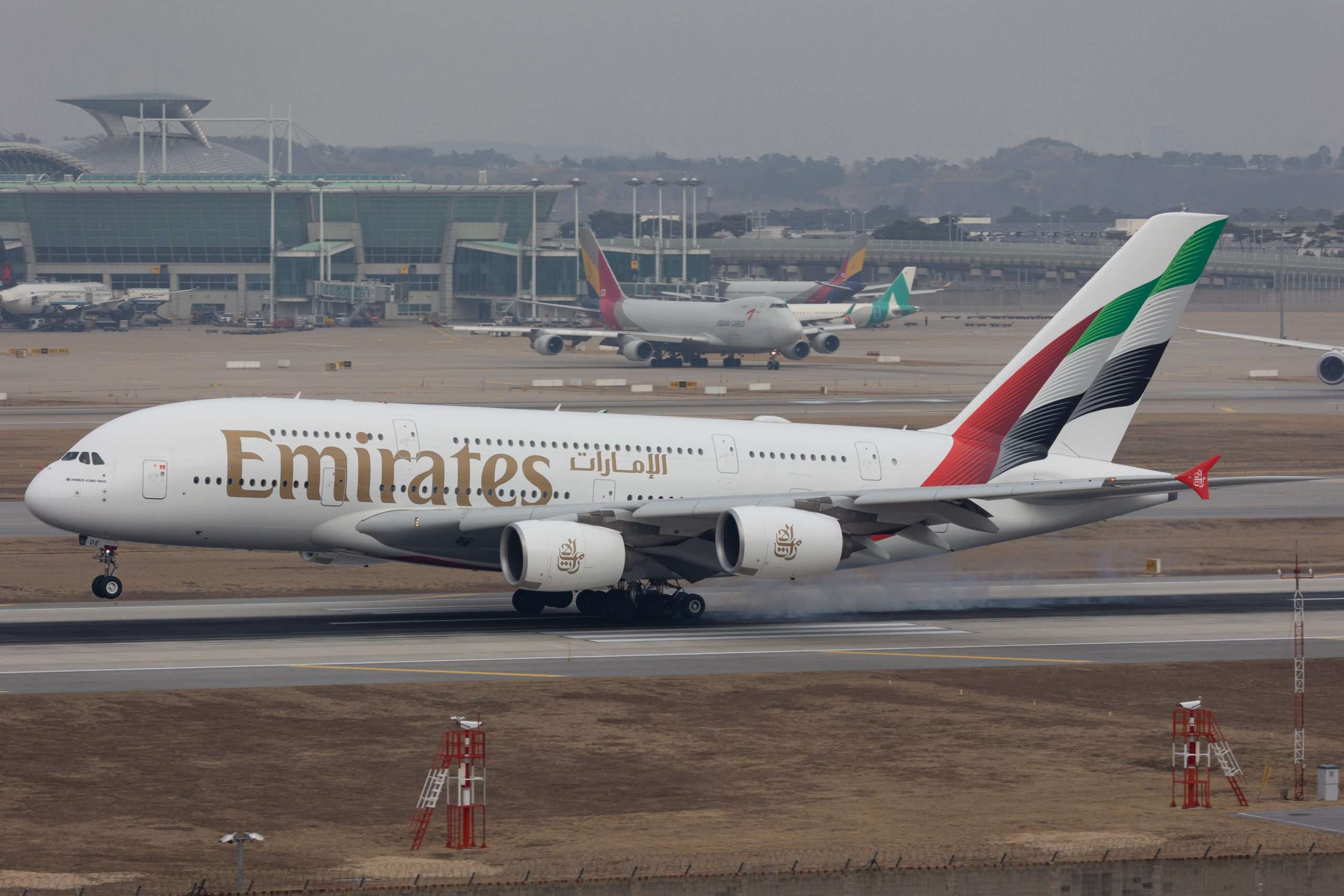
Emirates Airlines operates one of the youngest and most distinctive fleets in commercial aviation, an all-wide-body mix of the Airbus A380, Airbus A350 and Boeing 777, with no narrow-body aircraft in mainline service since 1995. It is by far the world’s largest operator of both the Airbus A380 and the Boeing 777, and the two types anchor its long-haul, high-density network.
Emirates intends to keep flying the A380 until at least 2041 despite the type being out of production, and is midway through a $5 billion, 219-aircraft cabin retrofit programme covering both its A380s and 777s. The Airbus A350 began joining the fleet in 2024, with dozens more on order, while the Boeing 777X (Emirates’ launch order for 150 aircraft) remains delayed and is not expected before 2027.
Type
Role
In Fleet (approx.)
Fleet numbers approximate as of mid-2026 and include aircraft undergoing cabin retrofit.
Route Network
Unlike low-cost point-to-point carriers, Emirates Airlines has built its entire network around a single global hub. Passengers travelling almost anywhere in the world are typically routed through Dubai International Airport, which allows Emirates to connect city pairs (from the Americas to Australia, or Africa to Asia) that would otherwise have no direct service. This hub-and-spoke model, combined with the size of its A380 and 777 fleet, gives Emirates outsized capacity on long, thin routes that few other carriers can profitably serve.
Dubai International (DXB) is Emirates’ sole hub and one of the world’s busiest airports for international passengers. The airline’s home base, Concourse A, was purpose-built for the A380 and features dedicated First and Business Class lounges, as well as direct boarding gates.
Hub Area / Market
Role
Emirates' dedicated home terminal at DXB
A380 flagship concourse; First & Business lounges
Boeing 777 and regional operations
Codeshare and additional wide-body operations
Highest-frequency long-haul market; multiple daily A380 services
Key US gateway market
Australia–New Zealand long-haul anchor routes
High-frequency South Asia network
Safety Record & Incidents
Emirates Airlines has generally maintained a strong safety record over four decades of operation, completing its IATA Operational Safety Audit (IOSA) with zero findings and consistently ranking among the safest major international carriers. Like any long-established airline, however, it has had its share of incidents.
Financial Results
Emirates Airlines has become the world’s most profitable airline in recent years, powered by strong long-haul demand, high premium-cabin load factors and its position as the dominant carrier through Dubai. As a wholly government-owned company, Emirates does not disclose figures in the same format as listed carriers, but its annual results are published in detail.
Metric
Value
US$34.9 billion (up 6% year-on-year)
US$5.8 billion (up 20%)
US$5.2 billion (up 14.9%)
53.7 million (up 3%)
Investment Corporation of Dubai (ICD); not publicly traded
US$1.6 billion declared to ICD
Operational Performance
Emirates’ hub-and-spoke model concentrates almost all of its operations through Dubai, which brings efficiency advantages but also means disruption at DXB can ripple across the entire network. The airline has invested heavily in premium product, cabin retrofits and connectivity to differentiate itself in a competitive long-haul market.
Fleet & Cabin Modernisation
Facing a multi-year delay to its Boeing 777X order, Emirates Airlines has committed to keeping its Airbus A380 fleet flying at scale well into the 2030s rather than retiring it early, while simultaneously introducing the newer Airbus A350 on selected long-haul routes.
Cabins & Product
Emirates Airlines operates a four-cabin structure across its long-haul network, positioned firmly at the premium end of the market:
Change & Cancellation Policy
Emirates’ fare rules vary by fare brand across Economy and Business Class, ranging from restrictive to fully flexible:
Fees & Charges
Emirates Airlines includes a checked bag on every fare (unusually generous compared with many long-haul competitors), but the allowance depends on route and fare type via one of two systems: the weight concept (most routes) or the piece concept (flights to/from the Americas and Africa).
Item
Weight Concept (most routes)
Piece Concept (Americas & Africa)
No single checked bag may exceed 32 kg regardless of route. Emirates Skywards Silver, Gold and Platinum members receive additional baggage allowance on top of their ticketed limit; check emirates.com for current terms specific to your route.
Pet Policy
Emirates Airlines does not allow regular pets in the cabin. Dogs and cats must travel either as checked baggage in the cargo hold or via Emirates SkyCargo, depending on size, weight, breed and destination country rules.
Check-in & Boarding
Emirates’ boarding process is structured around cabin class and Skywards tier status rather than open seating, reflecting its premium-focused network:
Emirates Skywards Loyalty Programme
Emirates Skywards is the airline’s frequent flyer programme, tracking two separate currencies: Skywards Miles for redemption, and Tier Miles for status, both earned based on fare, route and cabin class flown.
Customer Reviews & Reputation
Emirates’ reputation centres on its premium long-haul product (particularly the A380 First Class Shower Spa and Onboard Lounge), though passenger reviews of service consistency have become more mixed in recent years.
Emirates Airlines News — Stay Updated
Follow Dj’s Aviation for the latest Emirates Airlines update coverage, and all comprehensive aviation news including fleet changes, route launches, cabin retrofits, financial results and policy announcements. Check back for Emirates Airlines news today as new developments break.



Related News
Aircraft News
Latest Airlines News
Carrier strategy, fleet moves & financial updates
Aircraft News
Latest Aircraft News
Programmes, retrofits & next-gen narrowbodies
Route News
Latest Route Updates
New launches, cuts & network shifts
Freight Orders & Delivery
Latest Freight Orders & Delivery News
Cargo conversions, orders & deliveries