
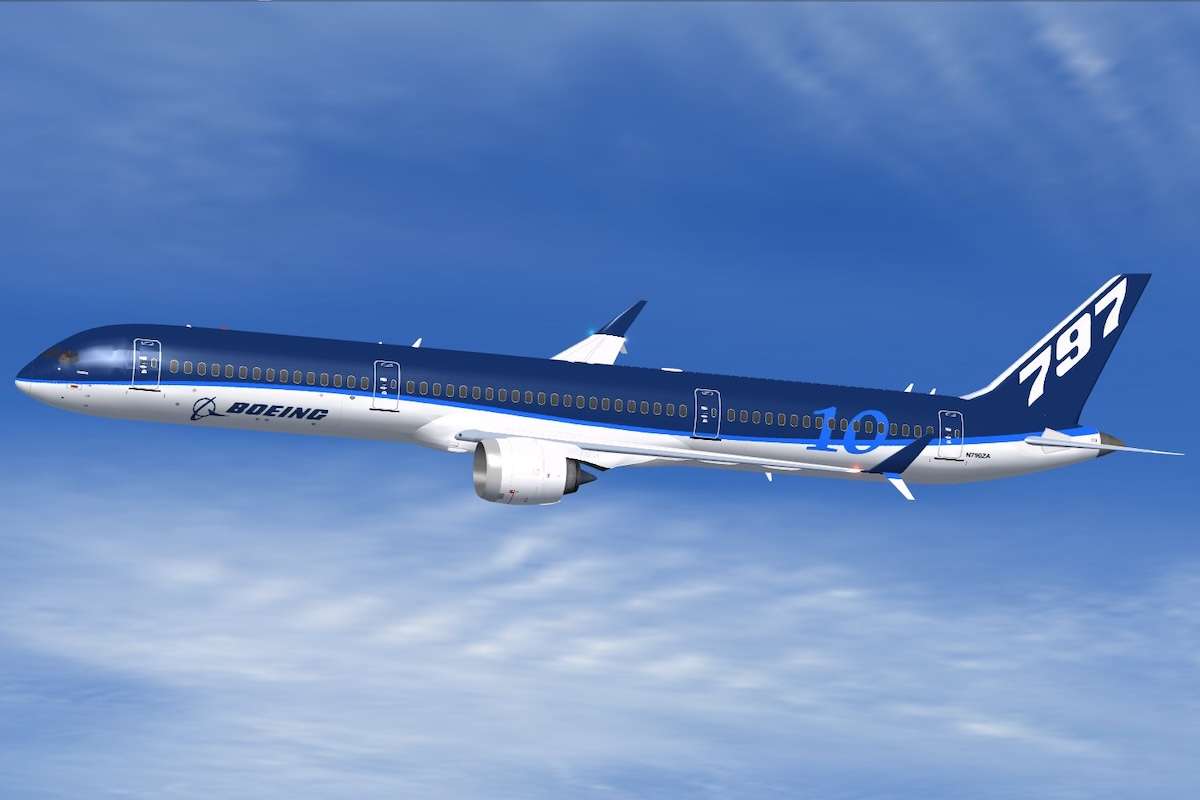
Boeing’s much-discussed and always of interest new mid-sized airplane, often dubbed the 797, now looks ever so slightly further from the company’s next clean-sheet design under study.
In comments shared by CEO Kelly Ortberg with Aviation Week, he said that the focus is probably more on the next-generational single-aisle family aimed directly at succeeding the 737 MAX rather than having the NMA as a priority,
Discussions about the next-generation jet are something the business is circling around, trying to determine which direction is best. With that in mind, direction remains highly subject to change, and any new model will still be a decade or more away from entering scheduled passenger service.
Boeing Puts Priority On Single-Aisle
The current product strategy sees the need for a next-generation narrowbody, and even the NMA concept as something that remains up in the air, one absolutely guaranteed to be needed at some point, and that’s the evolution to the 737 MAX.
Growing reports have shown that Boeing quietly began this year the formal early work on a 737 MAX replacement, with key talks with Rolls-Royce and a new senior product leader who would help steer the program in the right direction internally.
However, these comments do not rule out the NMA never coming into the light. Boeing, however, will not be rushed to counter the Airbus A321XLR, launched in 2019 to target the mid-range sector, when the American planemaker had its hands tied by multiple crises and was unable to respond.
Ortberg says that they’ll do what the market says, but more importantly, when they are ready and that the decision they’re in the process of making will last near half a century if executed correctly and hold great importance in the next phase of the manufacturing that most fronting it won’t see conclude in their lifetime.

As a result, there’s no panic response to simply make a decision that puts competition at the forefront, something the business did with its MAX launch as Airbus raced ahead with its A320neo. That decision would come back to bite.
While nothing has been confirmed direction-wise yet, the next new jet certainly feels, internally, more like a successor to the 737 and less like a standalone NMA. That doesn’t rule out the possibility of both being somehow incorporated, like the A321 with the XLR or other derivatives and stretches in the past.
The Boeing NMA (797) In 2026
The concept of a twin-aisle, mid-market airliner capable of serving the 220- to 270-passenger market in 2026, as the 2020s draw to a close, still piques the interest of airlines around the globe.
What was designed as a model that would bridge the gap between the 737 and 787, while also replacing the ageing 757s and 767s with something cheaper to operate. Boeing also considered offering something far more capable than a single-aisle, without having to push carriers to make the jump to a widebody.
Airlines like Delta, United Airlines, Qantas, and even Qatar Airways gave this NMA serious consideration in the 2010s; some even looked to place orders in the hundreds. Despite the strong interest, the launch of the NMA never came during this decade, and when the planemaker was engulfed in woes, the commitment to a new, innovative plane was the least of priorities.
Now, the industry has changed. Airbus moved quickly, as it was more stable, with the launch of the A321XLR, which allowed it to offer customers long-range capability with a narrowbody that covers routes operated by the 757/767, even with less capacity, at a much lower cost, and with minimal changes required.

Boeing, however, still doesn’t have anything that can compete with this. Instead, it continues to battle certification delays for the 737 MAX and 777X, which have plagued its finances and margins. It is also looking to build its own production of multiple aircraft programs.
At the beginning of the decade, it was confirmed that the NMA had essentially been shelved and was to be revisited later. Analysts argued that Boeing had missed the boat because of its own woes, as well as for failing to implement current technologies that would’ve left it a step too far behind by the time it launched with customers.

ABOUT THE AUTHOR
Daniel Fowkes is a Melbourne-based aviation analyst and journalist with over a decade of industry experience. As founder of Dj’s Aviation, he delivers trusted analysis on aircraft, airline strategy and global aviation trends for djsaviation.net
Related Articles




Stay Informed
Get the latest aviation news, analysis and route updates delivered to your inbox.
We respect your privacy. Unsubscribe at any time.
Enjoyed this story?
Make us your go-to for aviation news
Add us as a preferred source on Google and see our latest stories first in Top Stories.
Add Us On Your News Feed