

Qatar Airways was one of the few airlines heavily interested in buying the prospective Boeing 797.
The new mid-market airliner studied in the 2010s aimed to bridge the gap between the 737 MAX and the 787 while providing an adequate platform to replace the 757 and 767.
With the aircraft deemed perfect for Qatar Airways, why was it so interested? Was it alone, and what happened to this aircraft?
Qatar Airways’ 797 Interest
Qatar Airways’ interest in the Boeing NMA, dubbed the 797, came in 2019, when the airline’s Chief Executive Officer, Akbar Al Baker, spoke with CNN in an exclusive interview at the IATA Annual General Meeting in Seoul.
Baker said that based on what he had seen involving a new medium-haul twin-jet, there was strong interest, and they, as an airline, were very impressed.
In fact, Qatar Airways believed that if the NMA progressed, they would want to be placed as the launch customer for the jet, which would feature in the 200-270 seat category based on discussions.
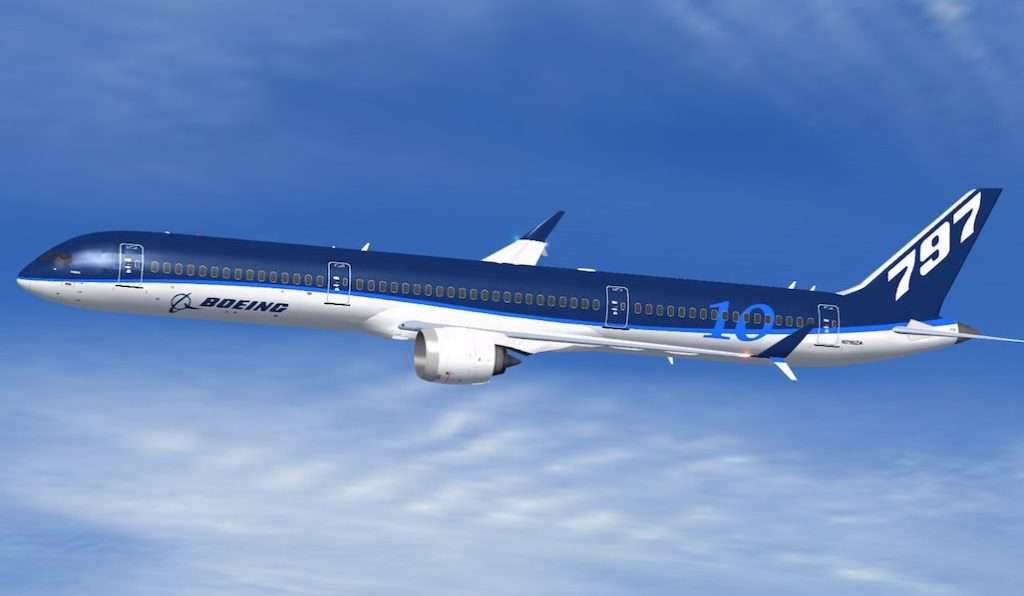
Moreover, Qatar Airways was formally shown these studies by Boeing itself, highlighting that progress at this point was well and truly taking shape for the 797.
Even before this interest had taken shape, the airline was a strong supporter of Boeing jets. Still, typically on a larger scale with strong usage of their widebodies, so if the NMA had launched, there could’ve been a world where it transitioned mostly towards Boeing.
What Is The Boeing 797?
The 797 across the 2010s was one of the most talked about prospective aircraft, interest also stretching into the early 2020s.
Boeing found itself at a T-intersection, left would’ve seen the launch of the aircraft, right would’ve seen the passing on the opportunity. Many felt that a new plane was neccesary, whereas Boeing faced obstacles.
If released, the prospective 797 would have ideally slotted in between the gap present through the 737 MAX and the 787, where the 757 and 767 once stood. Of course, these two aircraft are only aging as the years progress.
Given the type never released, firm details on the program have always remained scarce. However, based on available commentary, analysts essentially predicted the release of two variants that would aim to fly 4,500 to 5,000 nautical miles.

The hope from many was that the NMA would address, as its name suggests, the middle of the market segment and provide an adequate replacement to older jets, but also act as a key bridge between existing models.
What has now been seen with further derivatives in the A321neo program, all being highly successful, is the hope Boeing had for such an endeavour; however, firmly believing it could’ve had an even bigger share of the market.
Additionally, unlike the A321XLR, the NMA would have been a clean-sheet design, looking to incorporate new technologies from engines to avionics.
As a result, it would’ve acted as the perfect plane to meet growing demand while incorporating new technologies, which would’ve been a positive step for airlines seeking to meet new efficiency regulations.
Other Interested Airlines
For an aircraft that did not make it past the drawing board, the 797 was one that certainly made an impression with many airlines expressing interest, including that of aircraft lessors.
On several occasions throughout the latter stages of the 2010s, Qantas stated that it was interested in the New Midsize aeroplane, known as the 797, at a time when Boeing was gauging interest from around the world for such a jet.
Boeing also believed that the NMA would be well-suited for the Australian market, with a requirement to serve cities within the country, as well as beyond, where strong capacity restrictions are in place.

With the range also meaning that domestic markets, as well as cities in South East Asia and Japan, were within reach, according to the planemaker’s sales officer at the time, it presented an opportunity unlike any other for an airline like Qantas.
In 2017, Alan Joyce, the former CEO, further stated that the economics on paper looked very good ahead of time, specifically at the first delivery of the 787-9.
These discussions further emerged in 2019 when the Sydney Morning Herald reported that the airline was considering replacing its short-haul fleet and specifically looking to increase its capacity.
With the renewal at this point expected to be confirmed in 2020, before the emergence of the COVID-19 pandemic, there was considerable interest in the NMA, dubbed the 797 from Qantas, but scepticism remained.
In the U.S, Delta also expressed interest in the purchase of a prospective Boeing 797, where in February 2018, the carrier’s CEO Ed Bastian expressed his desire for the planemaker to commit to launching the new endeavour.

The enthusiasm was evident from Qantas, Delta, Qatar Airways, and many other operators, with the NMA just making sense for their future day-to-day flying needs.
Concerning Delta, the business had been a long operator of the 757 and 767. Still, as firmly part of a camp that did not believe a dedicated replacement had ever truly been launched, the 797 may very well have acted as that.
By the time 2019 came around, despite the obstacles facing Boeing, Delta said it would purchase potentially up to 200 if Boeing moved ahead with it, and with many other airlines interested, the 797 could have very well launched with hundreds of deals.
What Happened?
Despite receiving from Delta, Qantas and of course Qatar Airways, the highly speculated Boeing 797 was never released with a decision to cede the market to Airbus.
The competitor is taking the opportunity to further develop the A321neo, with the release of the A321XLR in a bid to cover requirements laid out by airlines around the world in the middle of the market sector.

Several factors contributed to Boeing’s decision not to proceed with the 797 project; these had to be compelling enough for the business not to move ahead, considering the significant interest from airlines and analysts’ bold predictions for possible total orders.
One of the first challenges was the emergence of the crisis involving the 737 MAX, commencing in 2018 but taking over in 2019 with two fatal accidents involving new aircraft.
The popular single-aisle 737 MAX would be grounded, Boeing would face scrutiny, and the business would be decimated because of the knock-on effects of this, hurting any possible innovation.
At the beginning of 2020, with quality challenges to the 737 MAX and even stretching to other aircraft, the emergence of the COVID-19 pandemic forced the business to consolidate even further.

Many airlines around the world, instead of focusing on growth, found ways to postpone existing contracts and were certainly not wanting to purchase new jets.
When factoring in Boeing’s situation and the challenges in the economy, the push to launch a new jet seemed unlikely, with far greater priorities for the business moving forward.

ABOUT THE AUTHOR
Daniel Fowkes is a Melbourne-based aviation analyst and journalist with over a decade of industry experience. As founder of Dj’s Aviation, he delivers trusted analysis on aircraft, airline strategy and global aviation trends for djsaviation.net
Leave a Reply
Related Articles




Stay Informed
Get the latest aviation news, analysis and route updates delivered to your inbox.
We respect your privacy. Unsubscribe at any time.
Enjoyed this story?
Make us your go-to for aviation news
Add us as a preferred source on Google and see our latest stories first in Top Stories.
Add Us On Your News Feed
797 is still a plane in the planning stage ! Maybe by 2040 it may be flying!