
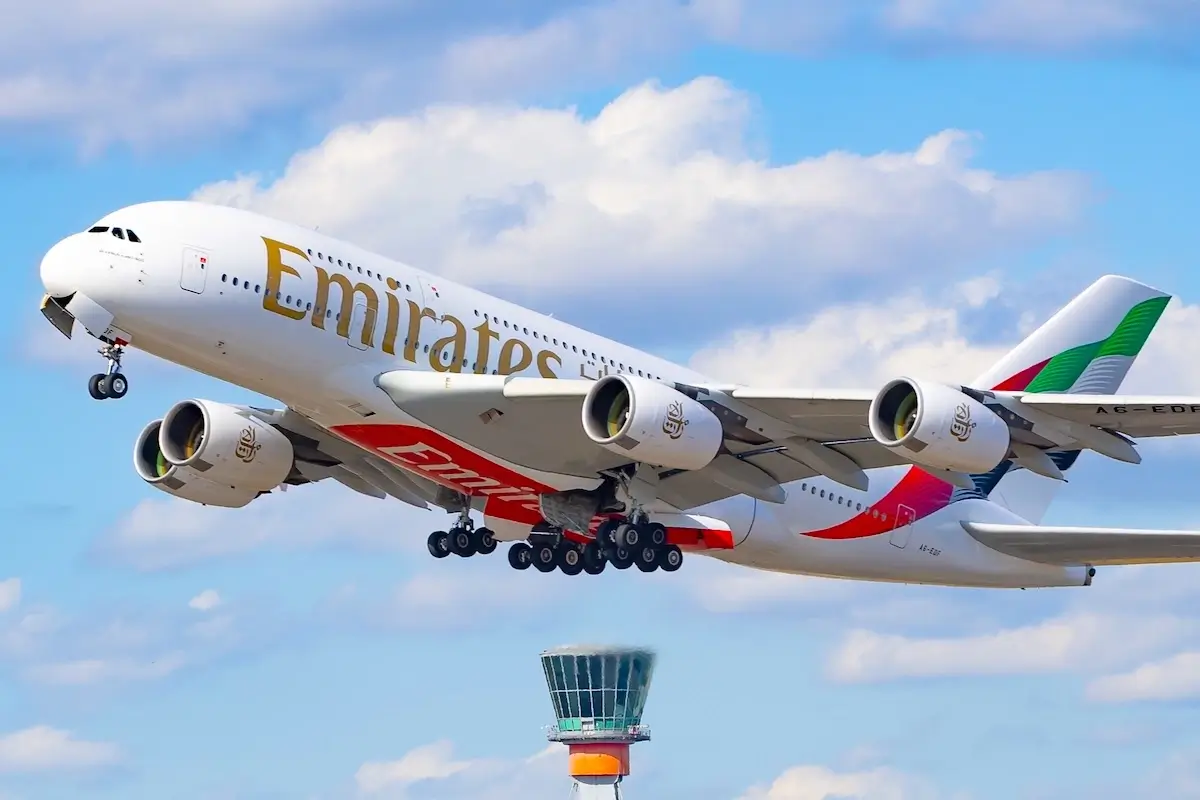
Emirates is the largest customer of the world’s largest passenger plane, the Airbus A380, but not all of its orders came at the same time.
Throughout the recent decades, Emirates placed strategic top-up deals for the aircraft, but why is that, and what did the deals consist of?
A First Order Comes
Emirates’ first commitment to the Airbus A380 program was when the jet was known as the A3XX, and it was a groundbreaking contract that helped get the aircraft to where it eventually aimed to be, in service.
Placed in July 2000, the deal saw Emirates commit to five of the aircraft type, viewed as necessary for the future of its operations and for meeting growing demand, while aligning with what the UAE hoped Dubai would become on the global stage.
The LOI at the time was for up to 10 aircraft, becoming the first to publicly confirm its interest earlier that year, with five firm and five options for delivery from 2007 onwards.

In addition to the conversations surrounding the A3XX, it was confirmed that the Emirates Chairman was also interested in taking on a possible two of the freighter model, which at the time had yet to receive the can.
The deal was at such an early stage of development that it was only a month after Airbus officially launched the program, after receiving LOIs from other airlines as well, hoping to turn them into firm orders to get the wheels in motion for this plane to market.
Repeated Orders Start To Come
The first order for the A3XX would not be the last placed by the Dubai-based carrier, as over the next decade, plus repeated top-up deals, would position the airline as the largest customer of this superjumbo.
Just a year after its initial launch order, the airline reaffirmed its commitment to the Airbus A380 with the decision reached to order 15 more of the type, part, however, of a broader US 15 billion dollar deal for more widebody aircraft, one of the biggest in aviation history at the time.

The deal was signed with the airline, which also made its intentions regarding the future of its operations very clear. The airline’s managing director at the time confirmed that Dubai would become a booming city over the next 10 to 12 years, generating significant air traffic, tourism, and commerce.
As a result of this expected boom, the airline knew it would need the capacity to cover it, and that’s precisely what it decided to do, but it wouldn’t be the only top-up: in 2003, another deal was struck.
Announced at the 2003 Paris Airshow in a deal worth billions, the airline committed to 21 new superjumbo A380 aircraft, to be delivered alongside Airbus A340s, which were also ordered, a deal that would triple the airline’s fleet and aim to give it 125 planes by 2012.
By the time 2007 came around, at the Dubai Airshow, the airline committed to an additional 11 A380 aircraft; however, this was outshone by the airline’s first contract for the A350, 70 units included in a deal that would eventually be cancelled before being then re-ordered and entering operations just recently.

Three years later, and yet again, the airline would go on to commit to more Airbus A380 jets with 32 aircraft ordered at the Berlin Airshow, representing another decisive vote of confidence in the superjumbo and the role it would play in the airline’s fleet; this is also its largest single order for the jet placed.
That title would then be smashed three years later in 2013, when the airline placed the largest single order for the A380 to date, committing to 50 aircraft to completely overhaul its operation, accompanied by 150 777X jets, which were worth nearly $100 billion at list price.
Throughout this period, the cancellation of the A380F led to the ordering of A380-800s alongside a smaller top-up in the mid-2010s.
But Why Is That?
It’s not uncommon for airlines to reccomit to aircraft that they already are either flying or have in their backlog; however, at the rate Emirates did for the Airbus A380 certainly raised eyebrows, but it wasn’t without reason.
For decades, Emirates has been heavily focused on growth, putting Dubai on the map as a top-of-the-line destination and growing its hub-and-spoke model. It was believed that no better aircraft could achieve this reality than the A380.

As demand grew, so did the requirement for new passenger airlines. Still, given Dubai’s geographic location, the airline was seeing rapid growth and also facing infrastructure hurdles at other global airports that couldn’t keep up with demand.
Emirates aims to funnel traffic through Dubai, acting as its mega hub to markets around the world, and rather than increasing the number of flights it serves into some leading airports worldwide, which it would eventually do anyway, initially, it believed upgrading the aircraft utilised would be the best alternative.
While there was rumoured interest in the Boeing 747-8, it never materialised. With no other alternative on the market capable of meeting Emirates’ capacity needs, it was all-or-nothing on the A380.

The theme of top-up orders, or changes to the fleet backlog, would become a common theme right across the 21st century thus far, with many aircraft programs experiencing something very similar as the airline looked to meet demand, whether that through new commitments, order cancellations or even variant switches as it continued to strive for the best possible mix.
The A380 is Emirates’ flagship; it’s the largest operator of the jet, and the aircraft has been integral to the business’s development, allowing it to be positioned where it is today. For without the aircraft, things would’ve looked very different for the company.
Now that the A380 is aging, a retirement plan must be developed. Unfortunately, with no dedicated replacement, this game-changing aircraft for the airline will one day be no more as a new era of capacity and efficiency arrives.

ABOUT THE AUTHOR
Daniel Fowkes is a Melbourne-based aviation analyst and journalist with over a decade of industry experience. As founder of Dj’s Aviation, he delivers trusted analysis on aircraft, airline strategy and global aviation trends for djsaviation.net
Related Articles




Stay Informed
Get the latest aviation news, analysis and route updates delivered to your inbox.
We respect your privacy. Unsubscribe at any time.
Enjoyed this story?
Make us your go-to for aviation news
Add us as a preferred source on Google and see our latest stories first in Top Stories.
Add Us On Your News Feed