
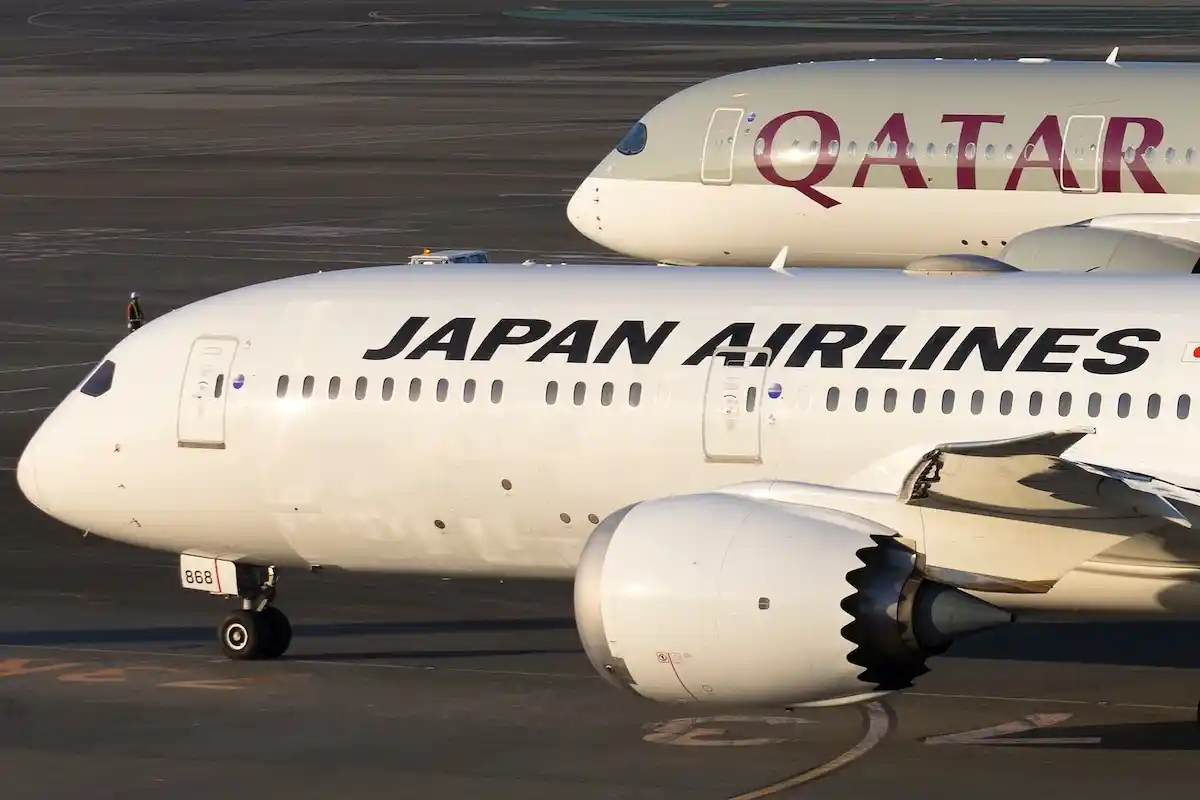
Airbus A350 vs Boeing 787 is one of the most-asked questions in modern widebody aviation, and there’s no single winner. The right aircraft depends entirely on the route, the airline’s network, and what an operator values most. Both jets are the two newest, most fuel-efficient long-haul twins on the market, and both have reshaped how airlines fly medium and long-haul routes since entering service in the 2010s.
This guide breaks down the Airbus A350 vs 787 debate across size, range, fuel burn, passenger comfort and cost, using data straight from Airbus, Boeing and independent industry sources.
Key Insights
- The Airbus A350 is the larger aircraft family, seating up to 410 passengers in a typical three-class layout (A350-1000) with a maximum range of 8,900 nautical miles (16,480 km).
- The Boeing 787 Dreamliner is the more size-flexible family, spanning three variants (787-8, -9 and -10) that seat between roughly 250 and 375 passengers.
- Both aircraft use carbon-fibre composite airframes, deliver around a 25% fuel-burn improvement over the previous generation of widebodies, and offer lower cabin altitudes for passenger comfort.
- The A350 tends to win on range and cabin size for ultra-long-haul flying; the 787 tends to win on flexibility, with a variant sized for almost any route length.
- Neither aircraft is objectively “better”. Airlines choose based on route network, fleet commonality and financing, not a single spec sheet line.
What Are the Airbus A350 and the Boeing 787 Dreamliner?
What Is the Airbus A350?
The Airbus A350 is a twin-engine, wide-body long-haul airliner built largely from carbon-fibre reinforced composites. It was designed from a clean sheet to replace older four-engine jets and ageing widebodies like the A340 and A330, and it now comes in two passenger variants (the A350-900 and the larger A350-1000), plus the A350F freighter. Airbus markets the family as “the long-range leader,” and had delivered over 700 aircraft to more than three dozen operators by 2026, with a backlog of well over 800 more on order.
Every A350 is powered by a variant of the Rolls-Royce Trent XWB engine, and the aircraft’s Airspace cabin is built around wider seats, larger windows and mood lighting designed to ease jet lag.
You can follow the model’s ongoing order activity and fleet expansion on our Airbus latest news page.
What Is the Boeing 787 Dreamliner?
The Boeing 787 Dreamliner is Boeing’s answer to the same problem: a mid-size, twin-engine widebody designed to replace the Boeing 767, offering roughly 20% better fuel efficiency. Where the A350 comes in two passenger sizes, Boeing split the Dreamliner into three (the 787-8, 787-9 and 787-10), so airlines can match capacity to a route without stepping up to a much bigger jet. The 787 was the first mainstream airliner built primarily from composite materials, and Boeing says the family has now carried more than a billion passengers on over 500 new nonstop routes since entering service in 2011.
Airlines can choose between GE Aerospace’s GEnx-1B engine or the Rolls-Royce Trent 1000 on any 787 variant, a flexibility the A350 doesn’t offer, since Airbus locked the aircraft to Rolls-Royce power exclusively.
For the latest Dreamliner order and delivery news, see our Boeing latest news section.
How Do the Airbus A350 and Boeing 787 Compare in Size and Dimensions?
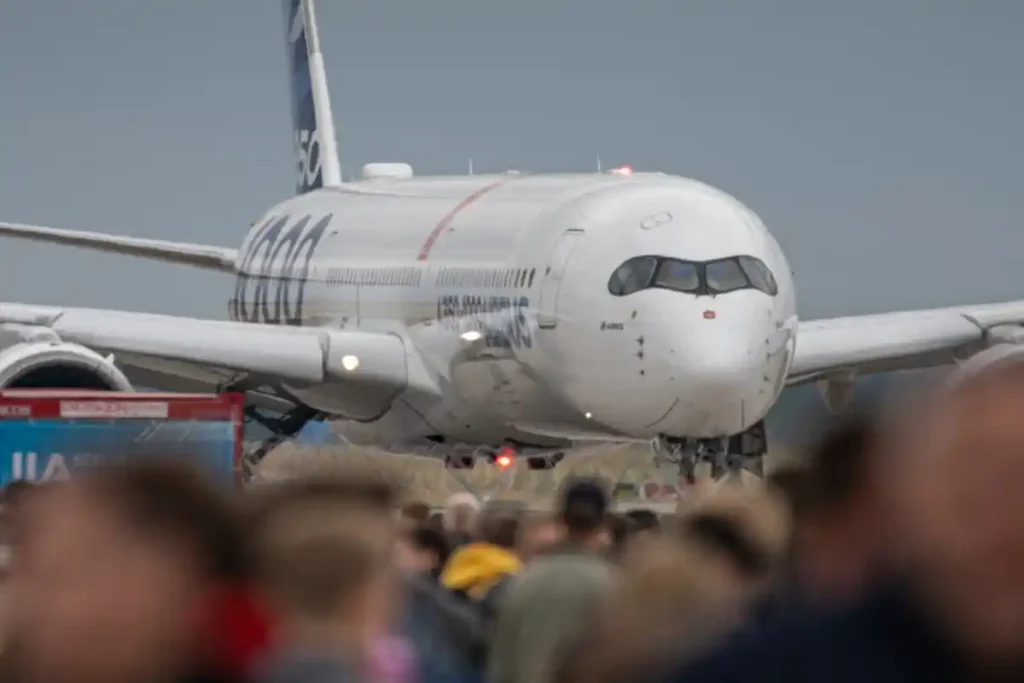
Size is where the Airbus A350 vs Boeing 787 comparison starts to split into “families” rather than single aircraft, because both manufacturers offer multiple fuselage lengths.
The A350-900 is 66.8 m long with a 64.75 m wingspan, while the larger A350-1000 stretches to roughly 73.8 m, with a higher maximum take-off weight of 322 tonnes versus 283 tonnes for the -900.
Boeing lists the 787-8 as the shortest at 56.7 m, the 787-9 at 62.8 m, and the 787-10 as the longest Dreamliner at 68.3 m. All three 787 variants share the same 60.1 m wingspan and roughly the same cabin cross-section, so the differences come almost entirely from fuselage length rather than width. In practice, this means the largest 787 (the 787-10) is close in overall length to the smaller A350-900, while the A350-1000 remains the biggest aircraft in either family by a clear margin.
Which Aircraft Carries More Passengers, the A350 or the 787?
In a typical three-class configuration, the Airbus A350-900 seats 300 to 350 passengers, and the larger A350-1000 seats 350 to 410, with a maximum certified capacity of 480 seats in a high-density layout.
Boeing’s published two-class seating figures run from around 200-275 on the 787-8, up to 250-325 on the 787-9, and 300-375 on the 787-10. So while the top-end A350-1000 out-seats every 787 variant, the Dreamliner family gives airlines a size to match almost any route, from thinner long-haul sectors right up to high-density medium-haul flying.
How Far Can the Airbus A350 and Boeing 787 Fly?
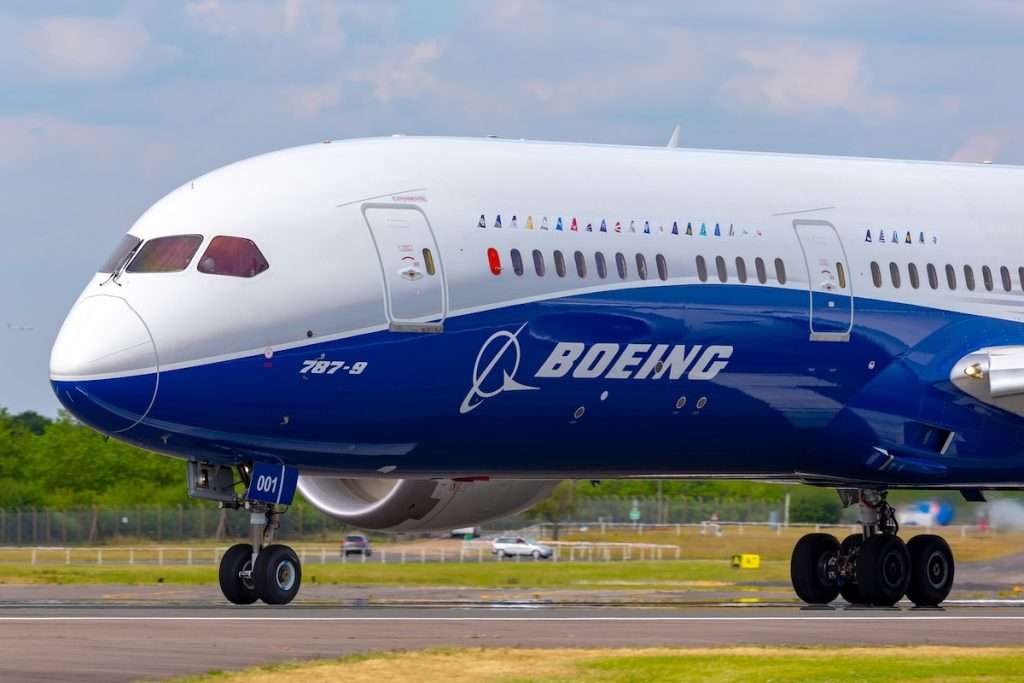
Range is one of the clearest differentiators between the Airbus A350 and the 787, and Airbus currently holds the edge at the top end.
Airbus lists the A350-900’s maximum range at 8,500 nautical miles (15,740 km) and the larger A350-1000 at 8,900 nautical miles (16,480 km), both sufficient for ultra-long-haul flying. Singapore Airlines uses an extended-range A350-900ULR variant to operate the world’s longest scheduled passenger flight, Singapore to New York.
Boeing’s current published figures put the 787-8 at up to 8,000 nautical miles (14,820 km), the 787-9 at up to 8,300 nautical miles (15,370 km), and the 787-10 at up to 7,500 nautical miles (13,890 km). The trade-off for its extra length and seating capacity. The 787-9 is the closest match to the A350-900 on range, while nothing in the Dreamliner range quite matches the A350-1000 or the ultra-long-range A350-900ULR.
Which Aircraft Is More Fuel-Efficient, the A350 or the 787?
Both manufacturers claim roughly the same headline number: about a 25% improvement in fuel burn and emissions compared with the widebodies each aircraft replaced. Airbus states the A350 family delivers a “25% advantage in fuel burn, operating costs and CO₂ emissions” against previous-generation competitors, while Boeing’s own engineering team credits the 787’s composite structure and aerodynamics with making it “up to 25% more fuel-efficient than previous-generation airplanes.”
Since both figures are benchmarked against older aircraft types rather than directly against each other, treat any single-number “A350 beats 787” or “787 beats A350” fuel claim with some scepticism. Actual burn depends heavily on stage length, payload and engine variant.
How Do the Engines of the A350 and 787 Compare?
The A350 runs exclusively on the Rolls-Royce Trent XWB; the Trent XWB-84 on the A350-900 and the more powerful Trent XWB-97 on the A350-1000. That single-engine-type approach simplifies maintenance planning for airlines that fly only the A350, but it also removes any negotiating leverage over engine pricing.
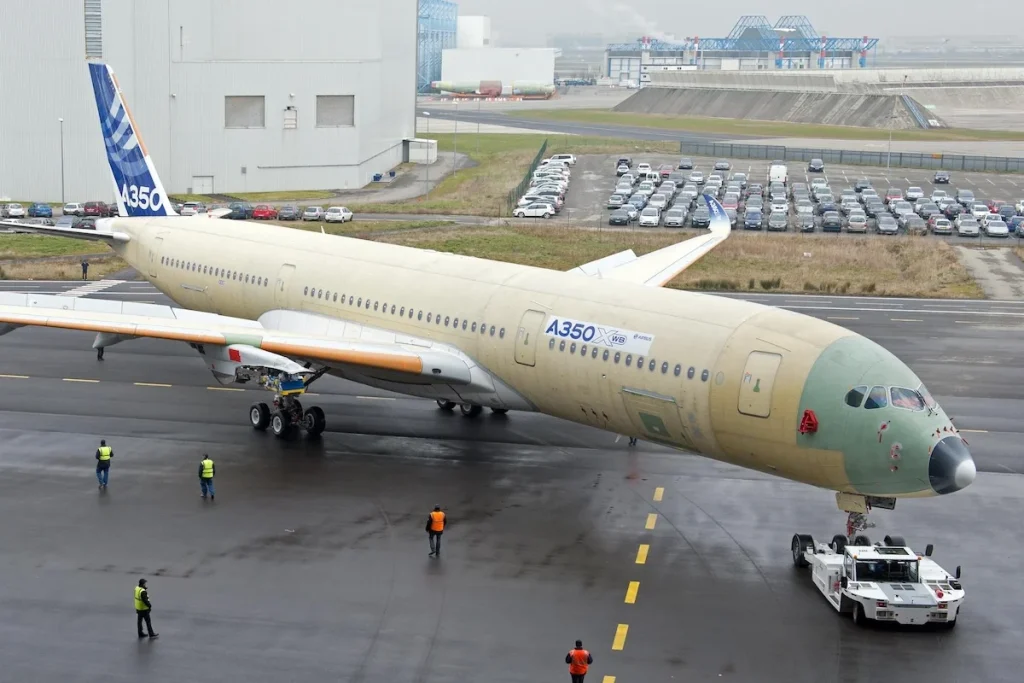
The 787, by contrast, ships with an engine choice: GE Aerospace’s GEnx-1B or the Rolls-Royce Trent 1000, selected by the airline at the time of order. This dual-source setup is one of the more practical differences in the Boeing 787 vs Airbus A350 conversation, since it gives Dreamliner operators more flexibility on spares, maintenance contracts and engine-related fleet decisions.
How Do Composite Materials Affect Efficiency?
Both aircraft owe much of their efficiency gains to the same underlying shift: replacing aluminium with carbon-fibre-reinforced polymer for the majority of the airframe. Composite structures are lighter than equivalent aluminium structures and don’t suffer the same fatigue and corrosion issues, allowing manufacturers to build lighter airframes without sacrificing structural strength.
That weight saving flows straight through to fuel burn per seat, and it’s also what allows both jets to pressurise their cabins to a lower altitude than older aluminium aircraft, which is a comfort benefit as much as an efficiency one.
Which Aircraft Offers a Better Passenger Experience?
On paper, the two cabins are closer than most passengers expect. Boeing pioneered a 6,000-foot cabin altitude on the 787 (roughly 2,000 feet lower than older jets), along with higher cabin humidity, both made possible by a composite fuselage that doesn’t corrode the way aluminium does in moist air. Airbus’s Airspace cabin on the A350 targets a similarly low cabin altitude of around 6,000 feet, with HEPA filtration and near-complete air renewal every two to three minutes.
Where the two diverge more is cabin width and seat layout. The A350’s wider fuselage generally supports more spacious 9-abreast economy seating on the -900 and -1000, while most 787 economy cabins are configured 9-abreast in a narrower cross-section, which can mean tighter seat width depending on the airline’s chosen configuration. Both aircraft use large, electronically dimmable windows rather than pull-down shades, LED mood lighting tied to time zones to help reduce jet lag, and quieter engine nacelles than the previous generation of widebodies.
In short, an A350 vs 787 comfort comparison usually comes down more to the airline’s specific seat map than to the airframe itself.
How Much Do the Airbus A350 and Boeing 787 Cost to Own and Operate?
Neither Airbus nor Boeing routinely discloses transaction prices, since most large orders are heavily discounted from list price. But list prices do occasionally surface through real orders: A February order from Japan’s ANA priced the Boeing 787 at around US$386 million per aircraft, based on the airline’s confirmed deal with Boeing, Airbus and Embraer, up sharply from roughly US$292 million in 2023. Airbus doesn’t publish an equivalent single figure for the A350, but industry pricing generally places the A350-1000 in a comparable multi-hundred-million-dollar bracket to the largest 787 variant, with airlines typically negotiating well below list price on large fleet orders.
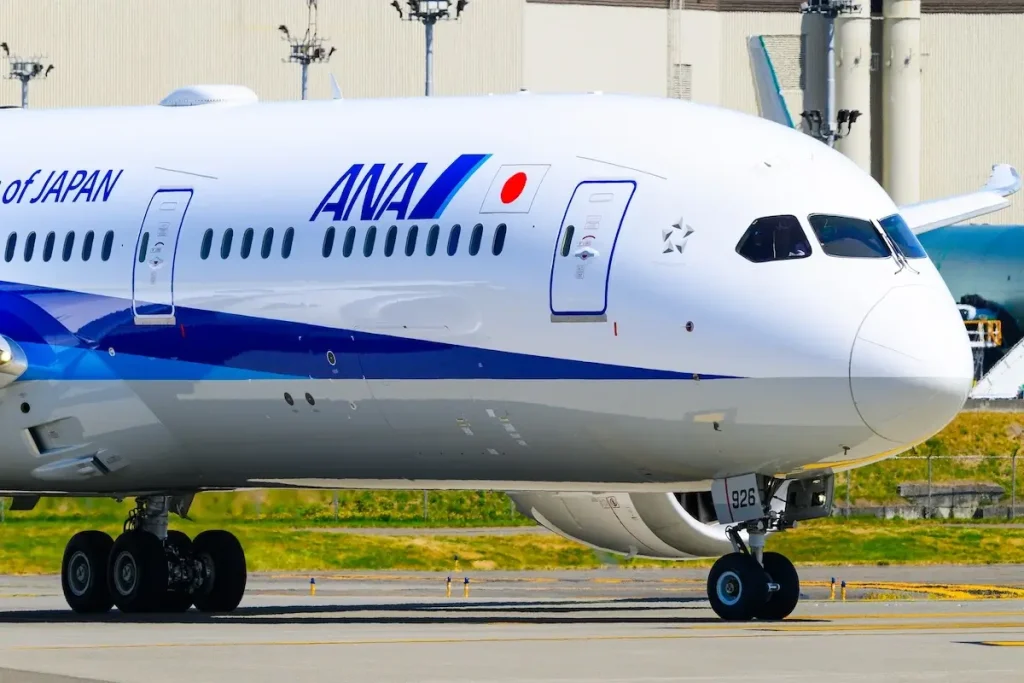
Beyond the purchase price, operating cost differences tend to come down to fleet strategy rather than the airframe alone. An airline that already flies the 787 gains simplicity by choosing either GE or Rolls-Royce engines to match an existing fleet, while an A350 operator locks into Rolls-Royce parts, tooling and training across the board. Maintenance intervals, spares pooling and crew training commonality with other Airbus or Boeing types in the fleet usually weigh more heavily on total cost of ownership than the sticker price of either jet.
Which Airlines Fly the Airbus A350 and the Boeing 787?
The Airbus A350 has become the flagship long-haul aircraft for several major carriers. Singapore Airlines operates the largest A350 fleet in the world, including its ultra-long-range A350-900ULR variant, followed closely by Qatar Airways, Cathay Pacific, Air France, Delta Air Lines, Lufthansa, and British Airways.
The Boeing 787 has an even broader global operator base, reflecting its position as one of the best-selling widebodies of all time. All Nippon Airways was the launch customer for the 787-8 in 2011, and major 787 operators today include United Airlines, American Airlines, British Airways, Qantas, Air New Zealand, Etihad Airways and Japan Airlines, among dozens of others. It’s common for large international carriers to fly both types side by side, using the A350 and 787 on different route lengths within the same long-haul network.
Airbus A350 vs Boeing 787: Full Specification Comparison
| Specification | A350-900 | A350-1000 | 787-8 | 787-9 | 787-10 |
| Length | 66.8 m | 73.8 m | 56.7 m | 62.8 m | 68.3 m |
| Wingspan | 64.75 m | 64.75 m | 60.1 m | 60.1 m | 60.1 m |
| Typical 3-class seating | 300–350 | 350–410 | ~250 | ~296 | ~330 |
| Max certified seating | 440 | 480 | – | – | – |
| Maximum range | 8,500 nmi (15,740 km) | 8,900 nmi (16,480 km) | 8,000 nmi (14,820 km) | 8,300 nmi (15,370 km) | 7,500 nmi (13,890 km) |
| Engine | Rolls-Royce Trent XWB-84 | Rolls-Royce Trent XWB-97 | GEnx-1B / Trent 1000 | GEnx-1B / Trent 1000 | GEnx-1B / Trent 1000 |
| Entry into service | 2015 | 2018 | 2011 | 2014 | 2018 |
Figures sourced from Airbus and Boeing technical data; seating and range vary by airline configuration and mission.
There’s no clean-cut winner in the Airbus A350 vs Boeing 787 comparison. The A350 pulls ahead on maximum range and top-end cabin size, while the 787’s three-variant spread gives airlines more flexibility to match capacity to a route.
For ongoing coverage of new orders, deliveries and route announcements involving both families, head to our latest aviation news hub.

ABOUT THE AUTHOR
Daniel Fowkes is a Melbourne-based aviation analyst and journalist with over a decade of industry experience. As founder of Dj’s Aviation, he delivers trusted analysis on aircraft, airline strategy and global aviation trends for djsaviation.net
Related Articles




Stay Informed
Get the latest aviation news, analysis and route updates delivered to your inbox.
We respect your privacy. Unsubscribe at any time.
Enjoyed this story?
Make us your go-to for aviation news
Add us as a preferred source on Google and see our latest stories first in Top Stories.
Add Us On Your News Feed