
Aircraft Guide · Seat Map
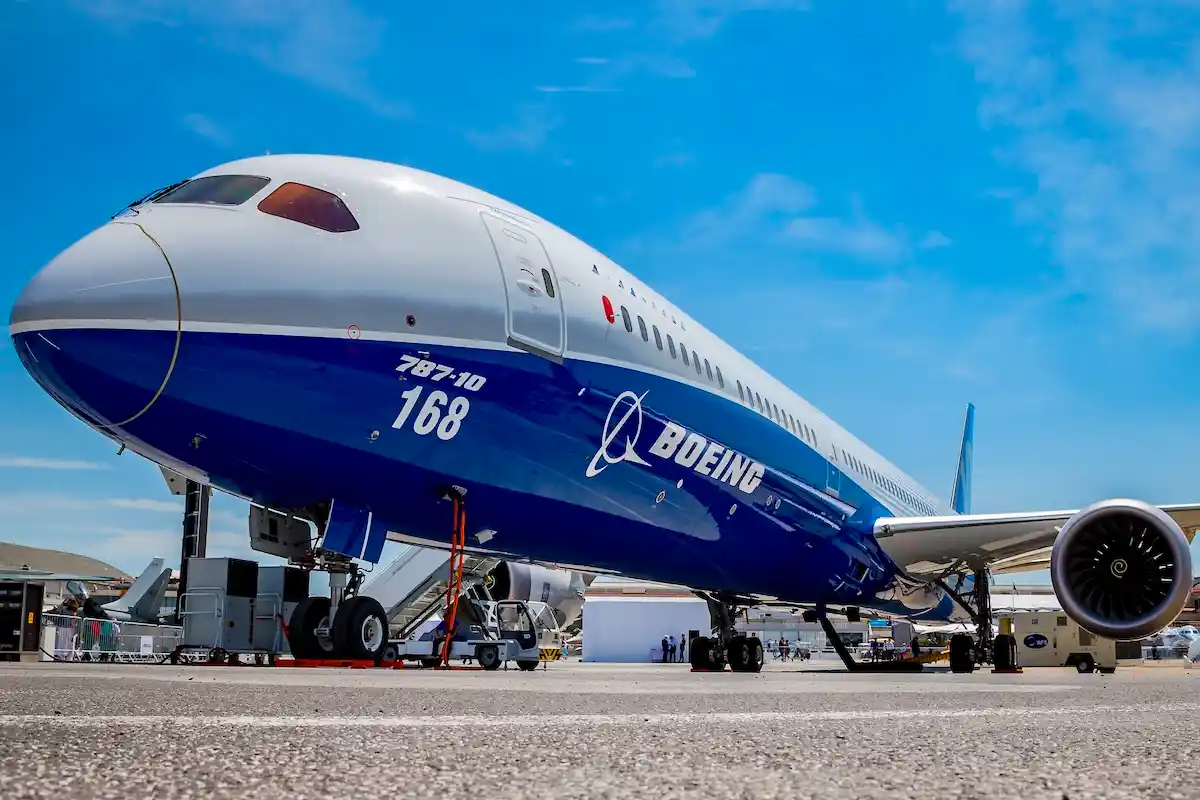
Boeing 787-10 Dreamliner
The Boeing 787-10 is the largest and shortest-range member of Boeing's composite-airframe 787 Dreamliner family, developed to replace the ageing 767-300ER on dense, high-demand routes. Positioned above the mid-size 787-9 and smaller 787-8, the Boeing 787-10 Dreamliner combines a further-stretched fuselage with the same fuel-efficient engine options as its siblings to give operators maximum seat count on long-haul missions without stepping up to a larger widebody. Dj's Aviation covers its specifications, fleet status, safety history and operators below.
Ordered 30+ (Singapore Airlines launch order)
In Service Since 2018 (Singapore Airlines launch)
Cruise M 0.85
Range ~6,330–6,430 nmi (varies by source)
Latest NewsBoeing 787-10 Dreamliner
Boeing 787-10 Dreamliner Quick Facts
ManufacturerBoeing
TypeWide-body (twin-aisle) twinjet
First flight31 March 2017
StatusIn active since 2018
DimensionsL 68.3 m (224.08 ft)
W 60.12 m (197.24 ft)
H ~17.02 m (55.84 ft)
W 60.12 m (197.24 ft)
H ~17.02 m (55.84 ft)
MTOW254,011 kg (~560,000 lb)
Cruise / RangeM 0.85
~6,330–6,430 nmi
~6,330–6,430 nmi
Ceiling~43,000 ft
EnginesGE GEnx-1B
Rolls-Royce Trent 1000
Rolls-Royce Trent 1000
Total ordered30+
CustomersSingapore Airlines
United Airline
British Airways
United Airline
British Airways
First delivery25 March 2018 (Singapore Airlines)
Variants
Seat Map
Hover or tap a seat for details
Business
Economy
Exit Row
Galley / Lav / Doors
32Business1-2-1 · 85-in pitch
298Economy3-3-3 · 32-in pitch
330Total10 J seats at 75-in
Illustrative layout. Exact seating varies by operator and cabin fit.
History & Development
Boeing formally launched the 787-10 variant at the 2013 Paris Air Show in June 2013, following Singapore Airlines’ conditional order for 30 aircraft placed on 30 May 2013. The Air Show generated a wave of further orders (102 aircraft sold in total that event, including Air Lease Corporation, United Airlines, British Airways and GE Capital).
The first 787-10 flight test aircraft rolled out from Boeing’s North Charleston, South Carolina plant in January 2017, and made its first flight on 31 March 2017. Three flight test aircraft accumulated roughly 900 test hours through 2017. The FAA certified the 787-10 on 19 January 2018, with EASA approval following on 28 February 2018.
Singapore Airlines, the launch customer, took delivery of its first 787-10 on 25 March 2018 at a ceremony in North Charleston attended by roughly 3,000 people, entering revenue service shortly after (sources differ slightly on the exact date, with 3 April 2018 most commonly cited). Unlike the 787-8 and 787-9, the 787-10 has not experienced a type-wide grounding of its own; as of early 2026 it retains a clean individual accident and hull-loss record.
Cabin: Seating & Configuration
The Boeing 787-10 retains the standard 787 fuselage cross-section, with a cabin width of 5.74 m (18 ft 10 in), allowing airlines to configure economy in either 3-3-3 (nine-abreast) or 2-4-2 (eight-abreast) layouts; 3-3-3 is far more common. Business class is typically 2-2-2 or 1-2-1, depending on the seat product. Because each airline designs its own cabin, seating totals vary — Singapore Airlines’ two-class layout seats 337 (36 business, 301 economy), while other operators publish typical two-class figures in the 300–336 range.
Specifications
The dimensions and weights below reflect standard 787-10 production data.
Metric
Value
The 787-10 shares its wing, raked wingtips and composite construction with the 787-9, but its longer fuselage required a semi-levered main landing gear (pivoting around the aft truck wheel rather than the midpoint) and a flaps-up vertical mode suppression system (FoVMS) to manage the aerodynamic effects of the stretch without adding wingtip counterweights.
Performance & Range
Metric
Value
M 0.85
~43,000 ft (typical for the family; not separately confirmed for the 787-10)
~6,330–6,430 nmi (figures vary by source; some cite up to ~7,500 nmi, which appears inconsistent with Boeing's more commonly cited figures and should be treated with caution)
Engines & Fuel
The Boeing 787-10 is offered with two engine options, unlike some single-source competitors.
Metric
Value
2× GE GEnx-1B or 2× Rolls-Royce Trent 1000 (customer choice)
~74,000–76,100 lbf (figures vary by source/rating)
~78,000 lbf
Both engine families are shared across the wider 787 range, with GEnx also powering the 747-8 and Trent 1000 unique to the 787 among current Rolls-Royce products.
Family Variants
787-8
Shortest variant, first to enter service (2011); based on the original 787 design
787-9
Mid-size, best-selling Dreamliner variant; longest range in the family
787-10
Stretched, highest-capacity variant covered on this page; shortest range of the three
In-Seat Amenities & Tech
In-seat amenities vary by operator. Most carriers’ Boeing 787-10 fleets feature electrochromic dimmable windows, ambient LED lighting tuned to flight phase, laptop/phone power outlets and in-flight entertainment, while Wi-Fi provision is not universal. As with any in-production type, cabin standards can differ between an airline’s earliest and most recently delivered 787-10 airframes.
Production & Timeline
Boeing assembles the 787-10 exclusively at its South Carolina (North Charleston) facility, the only 787 variant built there from its very first delivery, and now also the sole assembly site for all 787 variants following the March 2021 consolidation of 787 production out of Everett, Washington.
Milestone
Date
June 2013
January 2017
31 March 2017
19 January 2018
28 February 2018
25 March 2018
3 April 2018
Fleet & Operators
The Boeing 787-10 is flown by a smaller, more concentrated group of operators than the mid-size 787-9, reflecting its role as a high-capacity, long-haul option.
Operator
Role
Notes
Fleet figures vary by year as airlines take delivery of new aircraft; figures above reflect recent published data rather than exact current counts. A small number of additional operators exist beyond those listed here.
Incidents & Safety
Unlike some earlier Dreamliner variants, the Boeing 787-10 has maintained a clean individual safety record with no fatal accidents or hull losses recorded as of early 2026.
Notable safety events relevant to the 787-10 by association (through shared systems, structure or certification) include:
Related News
Aircraft News
Latest Airlines News
Carrier strategy, fleet moves & financial updates
Aircraft News
Latest Aircraft News
Programmes, retrofits & next-gen narrowbodies
Route News
Latest Route Updates
New launches, cuts & network shifts
Freight Orders & Delivery
Latest Freight Orders & Delivery News
Cargo conversions, orders & deliveries