
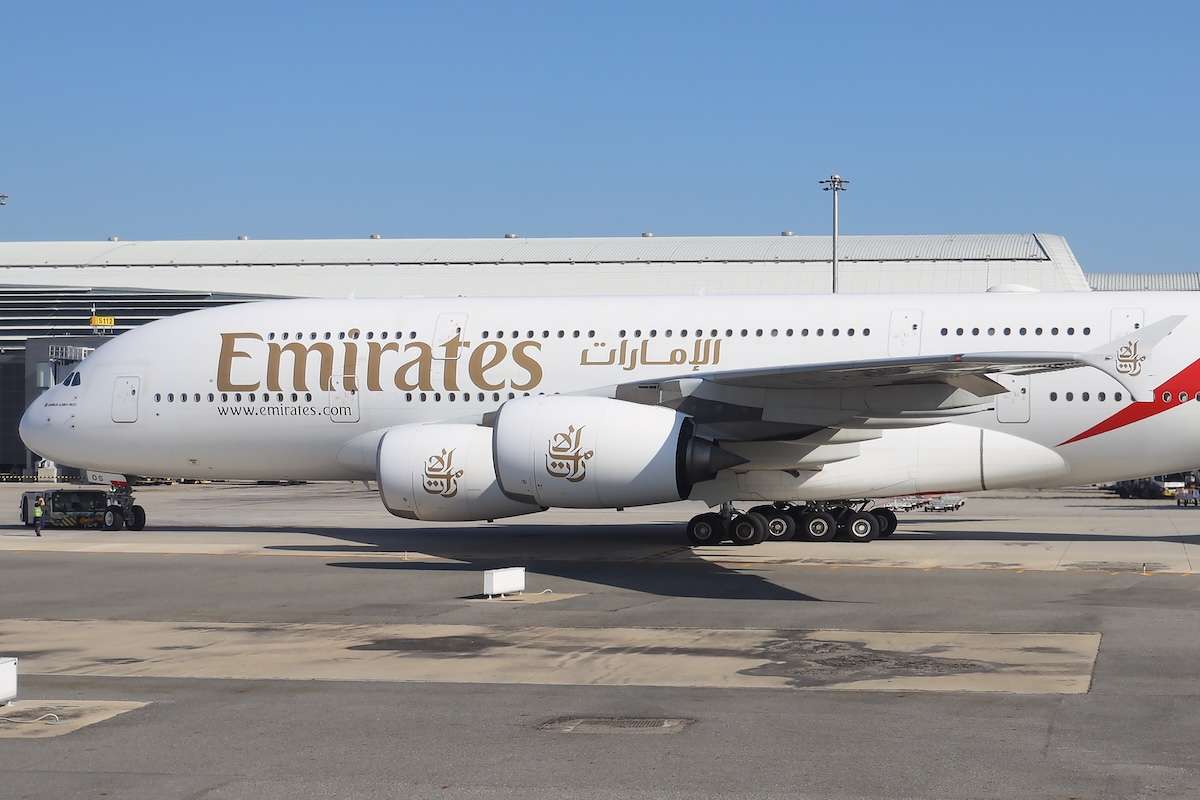
Emirates is once more reshuffling its A380 operations and capacity deployment for the world’s largest passenger plane in the coming months.
With the temporary removal of the A380 from specific high-profile routes, the airline is mostly switching the jet out of the Boeing 777s, and in some cases, the newer A350-900.
Both of these changes by the airline represent a reduction in seat capacity across routes, continuing through to late September 2026, as flagged by aeroroutes.com.
Where The A380 Is Being Pulled Back
On a string of key long-haul routes, Emirates is making shifts with the utilization of the A380 for the last part of the Northern Summer 2026 schedule as the Northern Winter 2026/27 season approaches.
From 1 July through 30 September, the airlines’ Amsterdam flight on EK149/150, followed by Copenhagen, Glasgow, Hong Kong, Munich, Prague, Osaka Kansai, Zurich, and one of the Singapore and Sydney frequencies, will see the superjumbo replaced by the 777-300ERs.
For each of the changes Emirates is making, flight frequency remains unchanged; thus, the airline remains committed to offering the same number of flights. However, in each case, seat capacity drops, with the 777-300ER offering fewer seats than the A380.
Moscow Domodedovo service will see a partial shift: the one daily A380 flight remains, and the other rotation is moved to the 777-300ER. This means there’s a mixed pattern of one A380 and two 777-300ER flights that’ll run throughout the remainder of the summer.

The key cities of Hong Kong, Sydney and Singapore, among the most notable changes, move from their double-daily A380 coverage to a mixed or all-777 pattern on rotations. This is noticeable given that these cities are often considered flagship locations by the Dubai-based carrier and thus can be uniquely served by only the superjumbo,
On routes like Orlando and Shenzhen, the change for the airline is subtle and doesn’t involve the A380; rather, it’s a shift from the 777-300ER to the smaller but long-range 777-200LR. In these cases, the theme is the same: Emirates is trimming peak capacity in selected markets but not trimming flight requirements, risking the loss of slots.
Why Are The A380 Swaps Are Happening?
Emirates is continuously making changes to its network, including redeploying its widebody fleet from the A380 to the 777 and the newly delivered A350. Its capacity reshuffle comes at an important point in managing its fleet.
The Dubai-based carrier recently reached the milestone of 100 retrofitted planes. These upgrades are part of its most ambitious, largest, and most expensive aircraft renewal in history. As a consequence, its Boeing 777s and Airbus A380s are continuously pulled from service to allow this work to take place.
While Emirates has sought to limit the retrofit impact on its network, as Premium Economy continues to be rolled out across more cities, there are periodic removals of superjumbos and even 777s from service to facilitate these changes.
Not all routes will, however, see aircraft changes even if temporary, due to the retrofit; some may be due to seasonal demand and the need to feature a higher-capacity jet elsewhere for a limited period.
However, with over 200 planes in the fleet undergoing this major revamp, no matter how efficient Emirates intends to be, it’ll still be forced to make changes to its network. While temporary, it is also aware that the investment it’s making will make the temporary shifts worthwhile in the long term.
Even with the capacity pullback in certain markets, optimization is still occurring, with Emirates having made several announcements involving its A380 to other cities globally, where it has increased seats to match demand.
Johannesburg sees two daily Airbus A380 flights, and Rome will move to an all A380 pattern by late August. Daily resumption of service to Perth is planned, with the A380 playing a role. The introduction of the A350-900 also improved capacity fine-tuning and made shifts like these more common, even amidst seasonal demand changes and a retrofit.

ABOUT THE AUTHOR
Daniel Fowkes is a Melbourne-based aviation analyst and journalist with over a decade of industry experience. As founder of Dj’s Aviation, he delivers trusted analysis on aircraft, airline strategy and global aviation trends for djsaviation.net
Related Articles




Stay Informed
Get the latest aviation news, analysis and route updates delivered to your inbox.
We respect your privacy. Unsubscribe at any time.
Enjoyed this story?
Make us your go-to for aviation news
Add us as a preferred source on Google and see our latest stories first in Top Stories.
Add Us On Your News Feed