

Emirates’ A350-900 will debut on the Dubai-Entebbe route on 29 March 2026, operating daily.
The A350 will replace the airline’s Boeing 777-300ER with the 298-seat aircraft, which is best suited to the Entebbe market.
EK729 will depart Dubai at 0955 and arrive in Entebbe at 1425. The return flight EK730 is scheduled to depart at 1635 and arrive in Dubai at 2300 local time.
With Emirates deploying its newest aircraft type to Entebbe, customers will not only receive the latest equipment but also a glimpse into the carrier’s future, as the cabin is emphasised as a key area of innovation.
Additionally, with the Boeing 777-300ER being withdrawn from this market, Emirates can redeploy the aircraft to another city where a high-capacity, well-equipped aircraft is required.
Emirates’ A350-900 Fleet
Emirates’ A350-900 fleet now consists of 16 aircraft, based on data available in mid-February 2026; however, the airline’s commitment is increasing steadily, driven by a healthy backlog.

The airline’s fleet averages 0.7 years old; it’s the newest in the fleet and represents the first new aircraft family to enter the airline’s operations in some time, after an exclusive reliance on the Airbus A380 and Boeing 777.
As the most modern jet in the airline’s fleet, the aircraft is configured with three classes and features new cabins optimised for comfort.
At the front of the plane, 32 business-class lie-flat seats are available in a 1-2-1 configuration, with a 44-inch pitch and a 21-inch width. Minibars, wireless charging, and a self-service snack are available, as are 4K screens.
Premium Economy, with its cream leather finish, features 21 seats in a 2-3-2 layout, leg rests, a strong recline, a 13.3-inch 4K display, and Bluetooth pairing.
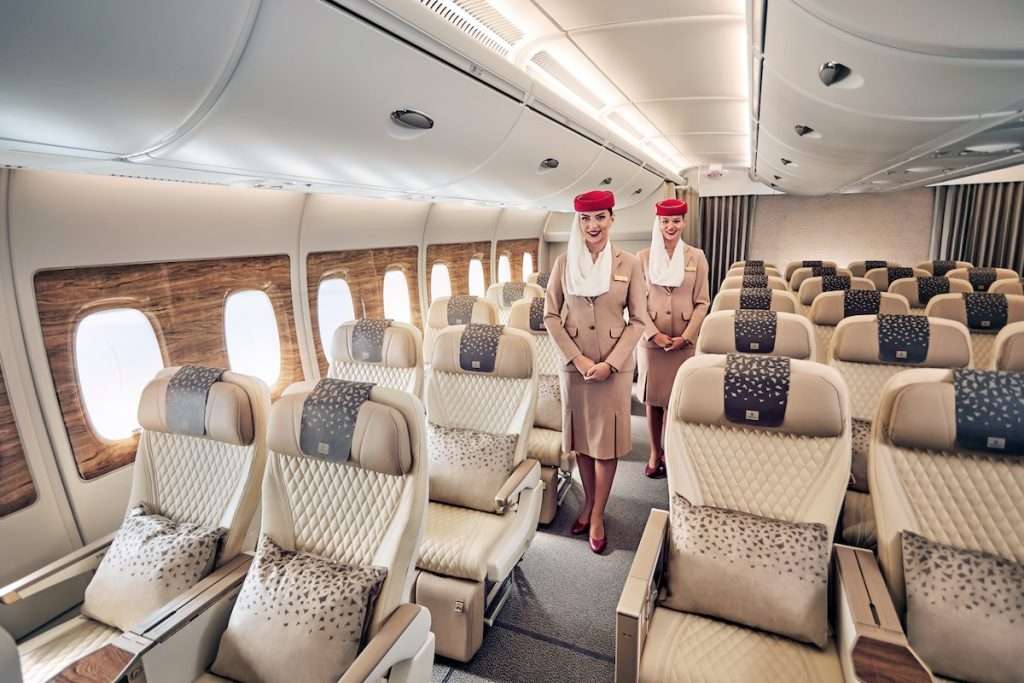
Lastly, at the back of the aircraft, 259 Economy seats are available, with a generous seat pitch of 232 inches and 18-inch-wide seats with 4K screens and USB-A/C ports, complemented by Wi-Fi across the cabin.
Why Does Emirates Love The Airbus A350?
Emirates adores the Airbus A350 for many reasons, and since taking delivery of the jet in late 2024, it has filled a critical gap between its high-density A380 and 777 workhorses.
As more units are deployed across medium- to long-haul routes in Europe and West Asia (and beyond), the aircraft will reduce fuel costs by 20-25%.
The complex airframe and Rolls-Royce Trent XWB engines position the aircraft as a leader in its class, and, while only one part of the future fleet, it offers a more reliable solution than the long-delayed Boeing 777X.

The jet’s range is unlocking secondary markets that were previously unfeasible for larger jets, such as the A380, enabling deployment there, providing stable year-round connectivity, and freeing up larger jets for cities in need of more capacity.
Passengers also love the A350 experience, which reflects well on Emirates and its customer satisfaction levels, with new cabins, entertainment screens, a quiet cabin, and more.

ABOUT THE AUTHOR
Daniel Fowkes is a Melbourne-based aviation analyst and journalist with over a decade of industry experience. As founder of Dj’s Aviation, he delivers trusted analysis on aircraft, airline strategy and global aviation trends for djsaviation.net
Related Articles




Stay Informed
Get the latest aviation news, analysis and route updates delivered to your inbox.
We respect your privacy. Unsubscribe at any time.
Enjoyed this story?
Make us your go-to for aviation news
Add us as a preferred source on Google and see our latest stories first in Top Stories.
Add Us On Your News Feed