
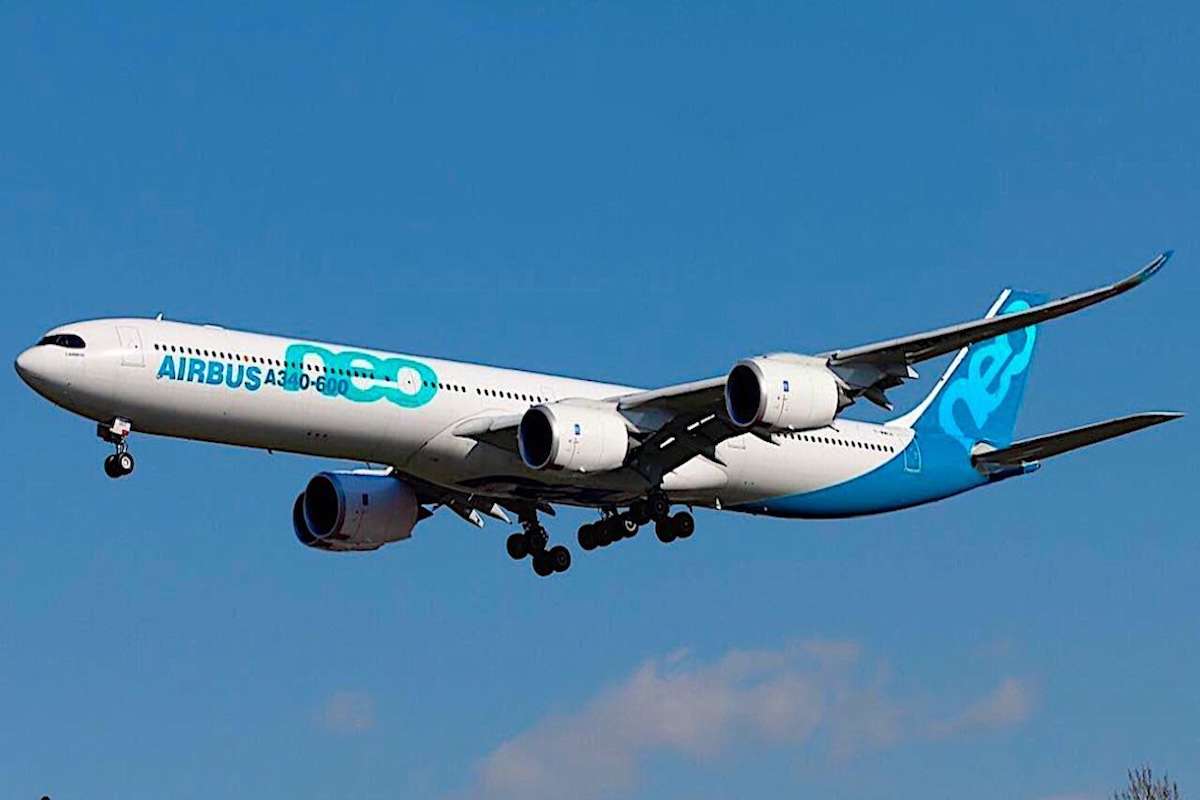
Airbus has on several occasions redeveloped an existing aircraft with new engines, giving the program a new lease of life. But what about with an A340neo?
The A340 never quite lived up to Airbus’ expectations, with the program ultimately coming to a close. But would a re-engine through the A340neo have been the answer?
Therefore, what is the A340neo, what can we learn from next-generation technologies, why did the A340 fail and ultimately, has a prospective re-engine ever made sense?
Introducing A Prospective A340neo
Similar to many other current engine option aircraft, such as the A330ceo, A321ceo, and A320ceo, there has been room to evolve these popular jets into a next-generation plane.
Leveraging the development of engine technologies has enabled Airbus to offer substantial upgrades across its commercial airplanes division. If it had proceeded with this, it would have resulted in the A340neo.
In essence, the A340neo would have sought to build upon the A340 and address some of the complaints with the first version, making it a more attractive option for airlines.

Visible through the A350, if Airbus had wanted to take the development of the A340neo a step further, it could have leveraged further advancements, such as composite fuselage materials and other improvements to the cabin interior, to enhance passenger comfort levels.
While the A340neo would have retained its four-engine model, these engines would have been significantly more efficient and quieter, similar to those in the A330neo and A320neo families, which have leveraged new technologies to bring improvements.
What Happened To The A340?
Unfortunately for the A340, its fate within the industry was not one that Airbus may have wanted to experience when it decided to proceed with the program’s launch.
The quad-engined widebody fell victim to the decline of reliance on this type of plane as the broader industry began shifting towards more fuel-efficient and versatile aircraft that also had half the number of engines.
While this remains one of the blander reasons why the A340 struggled, it’s one of the most critical to explore; it’s one of the most vital aspects for the A340, which was designed as a single-deck plane.

The Airbus A340’s selling point, however, lay in ETOPS, which was still in its infancy at the time of the A340’s introduction. As a result, for customers who required long-haul flying, the A340 presented an opportunity to capture demand on their networks.
Only shortly after the manufacturer offered the A340 did other aircraft begin to emerge. Not only was it deemed that these aircraft had significant cost benefits, but they were typically a less risky option.
Many consider the 777’s development as the beginning of a new era for long-haul travel, which was further enhanced and highlighted by Boeing’s own 787 and the eventual development of the A350.
As airlines also put greater emphasis on being environmentally friendly, planes like the A340 became increasingly unfavourable as the mid-2010s approached, and analysts had argued this even before then.

Slowly but surely, where the A340 had excelled, more favourable alternatives became available, meaning that the A340 wasn’t required, and Airbus would pull the plug on the programme.
The A340’s presence across many airlines’ fleets would also decrease as these same carriers saw opportunities elsewhere to enhance their operations and increase profitability.
Why The A340neo Makes No Sense
Despite Airbus greenlighting several new-engine initiatives to existing programs, these were for planes that, when their successors were approved, still had a firm place in the industry.
In the case of the A320ceo family, this was the planemaker’s only and most successful single-aisle program. It was competing firmly with the 737 and sought to get ahead of Boeing; for that, it succeeded, as the American rival planemaker rushed to introduce the 737 MAX in response.

Meanwhile, the A330neo was approved at a point where Boeing was emerging with its 787 and enjoying success. Airbus believed that launching a replacement for the A330ceo would mitigate some sales and provide a straightforward solution to airlines’ requirements.
Both of these decisions have been successes for the planemaker. However, a prospective A340neo would not have had the same fate, simply because the type it was replacing was not favoured and struggled.
The market for the A340 was not present, and this played a role in the demise of the quad-engined jet. Regardless of the upgrades that could have been offered on the A340neo, they wouldn’t have been enough to change the program’s fate.

ABOUT THE AUTHOR
Daniel Fowkes is a Melbourne-based aviation analyst and journalist with over a decade of industry experience. As founder of Dj’s Aviation, he delivers trusted analysis on aircraft, airline strategy and global aviation trends for djsaviation.net
Related Articles




Stay Informed
Get the latest aviation news, analysis and route updates delivered to your inbox.
We respect your privacy. Unsubscribe at any time.
Enjoyed this story?
Make us your go-to for aviation news
Add us as a preferred source on Google and see our latest stories first in Top Stories.
Add Us On Your News Feed