
Aircraft Guide · Seat Map
Airbus A321neo
The Airbus A321neo is the stretched, longest-fuselage member of Airbus's re-engined single-aisle family, developed as the manufacturer's answer to the Boeing 737 MAX in the medium- to long-haul narrowbody market. The A321neo variant offers new, more efficient engines, combined with airframe improvements and the addition of winglets (called Sharklets by Airbus), delivering fuel savings of up to 15%. Dj's Aviation covers the Airbus A321neo's specifications, fleet status, safety history and current operators below.
Orders Nearly 7,700 for the A321neo variant alone
In Service Since May 2017 (Virgin America launch)
Cruise M 0.78
Range up to ~4,700 nmi (8,700 km) on the A321XLR
Latest NewsAirbus A321neo

Airbus A321neo Quick Facts
ManufacturerAirbus
TypeNarrow-body, single-aisle, twin-engine
First flight9 February 2016
DimensionsL 4.51 m (146 ft)
W 35.80 m (117 ft)
H ~11.76 m (38.58 ft)
W 35.80 m (117 ft)
H ~11.76 m (38.58 ft)
MTOW97,000 kg (214,000 lb)
101,000 kg (222,700 lb)
101,000 kg (222,700 lb)
Cruise / RangeM 0.78
4,000 nmi
4,000 nmi
Ceiling~39,800 ft
Engines~33,000–33,110 lbf thrust
Total ordered (A321neo variant)7,739
A320neo family total20,000
CustomersIndiGo
Wizz Air
Wizz Air
First delivery31 May 2017
Variants
Seat Map
Hover or tap a seat for details
Business / EconomyXtra (rows 1–15)
Economy
Exit Row
Galley / Lav / Doors
216Total3-3 layout
≤57BusinessDynamic curtain
84Xtra ZoneRows 1–15
Illustrative layout · row 13 omitted. Business is sized dynamically (middle seats not sold); rows 1–15 sell as EconomyXtra otherwise. Exact seating varies by operator and cabin fit.
History & Development
In December 2010, Airbus announced the new-generation A320neo family (New Engine Option). The lengthened-fuselage A321neo variant offers new, more efficient engines, combined with airframe improvements and Sharklet winglets, delivering fuel savings of up to 15%. AerCap was the first customer to order the aircraft on 27 April 2011, with IndiGo the first airline to order it on 22 June 2011, for 304 aircraft.
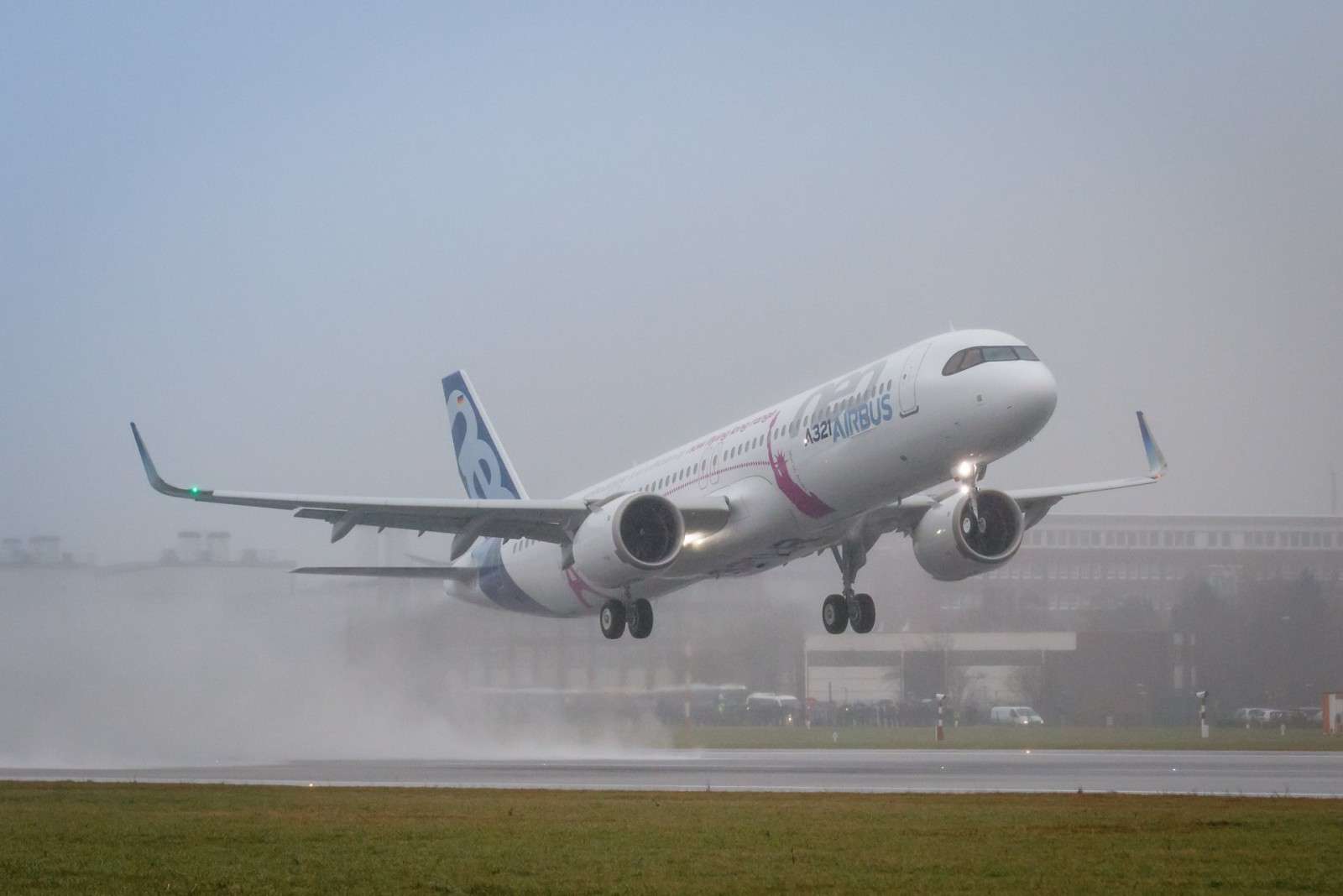
The lengthened A321neo prototype made its first flight on 9 February 2016 and received its type certification on 15 December 2016. It suffered a tailstrike during a landing at Perpignan three days after its first flight, delaying the certification programme by several weeks. The first A321neo entered commercial service with Virgin America in May 2017, which later merged with Alaska Airlines in 2018; Alaska acquired all of Virgin America’s aircraft, and the Virgin America brand was retired.
From October 2014, Airbus marketed a longer-range, 97-tonne (214,000 lb) MTOW variant with three auxiliary fuel tanks, launched as the A321LR on 13 January 2015, offering a range of 4,000 nmi (7,400 km) in a two-class, 206-seat configuration. This variant completed its first flight on 31 January 2018, with certification announced on 2 October 2018.
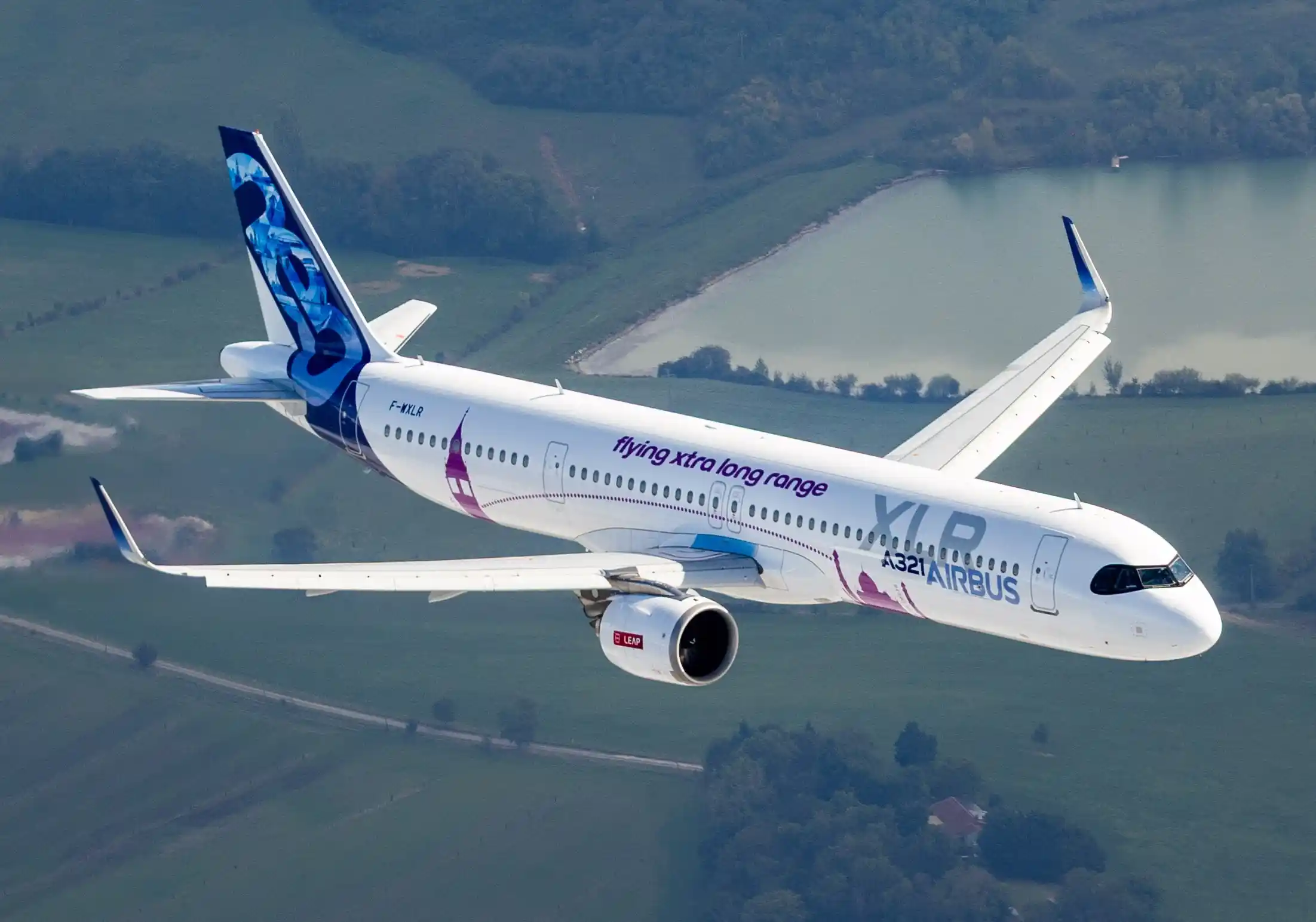
Airbus launched the longest-range single-aisle airliner, the A321XLR, at the 2019 Paris Air Show, and final assembly of the aircraft takes place in Hamburg, Germany; Mobile, Alabama, United States; and Tianjin, China. “Airbus delivers first aircraft from new Toulouse Final Assembly Line – an A321neo to Pegasus Airlines,” 27 December 2023, marking a new production line for the type.
By order volume, the A321neo has overtaken every other narrowbody programme: by December 2021, as more orders migrated to the larger A321neo, it became the family’s most popular variant with 3,958 orders compared to 3,748 for the A320neo; in June 2023, total orders for the A321neo reached 5,163, surpassing the previous A320ceo total of 4,763; and in July 2023, orders reached 5,259, surpassing the record 5,205 orders for the Boeing 737-800 and becoming the most-ordered variant of any airliner in the world. In December 2023, the A320neo family became the first airliner generation to reach a record order of 10,000 units, with a backlog of 7,000 units.
Cabin: Seating & Configuration
The Airbus A321neo carries up to 244 passengers, making it the highest-capacity member of the current A320 family. Typical two-class layouts seat 180 to 220 passengers, while long-range variants such as the A321LR are usually configured with fewer seats (up to 206) to make room for extended-range fuel tanks and, on many carriers, lie-flat business seating for transatlantic use.
Specifications
Dimensions
Performance & Range
Metric
Value
M 0.78 (typical A320-family cruise speed)
~39,800 ft
Up to ~4,000 nmi depending on seating configuration
Up to 4,000 nmi (7,400 km) in a 206-seat configuration
Up to 4,700 nmi (8,705 km)
Engines & Fuel
Metric
Value
CFM International LEAP-1A (up to 33,000 lbf) or Pratt & Whitney PW1100G-JM (up to 33,110 lbf)
Compliant with ICAO Annex 16 Chapter 4 and Chapter 14
Airbus A320-family digital fly-by-wire cockpit with EFIS/ECAM displays and Integrated Modular Avionics
Up to 10 LD3-45W containers, approximately 51.7 m³ underfloor
Family Variants
A321neo
The baseline variant; longest fuselage in the A320neo family; up to 244 seats in high-density layouts
A321LR
Long Range version with three Additional Centre Tanks, offering up to 4,000 nmi (7,400 km) range in a 206-seat configuration
A321XLR
Extra Long Range variant with a permanent Rear Centre Tank and optional forward Additional Centre Tank, extending range to up to 4,700 nm (8,705 km) at 101 tonnes MTOW; first delivered to Iberia in late 2024
A321 military derivatives
The German Air Force operates two A321LR-based aircraft for medical evacuation and passenger transport; in November 2024 Airbus revealed the A321 MPA (Maritime Patrol Aircraft), a proposed successor to the French Navy's Atlantique 2, competing against Dassault's Falcon 10X
In-Seat Amenities & Tech
In-seat amenities vary considerably by operator and cabin refurbishment status. The Cabin-Flex configuration for the A321neo allows for a reconfigured door layout, permitting higher seating density without compromising evacuation certification, while the “Space-Flex” cabin option, alongside a “Smart-Lav” modular lavatory design, allows an in-flight conversion of two lavatories into one accessible toilet. Long-range operators have increasingly used the A321LR and A321XLR to offer full lie-flat business seating on single-aisle aircraft for transatlantic and other long, thin routes, a configuration once reserved for widebodies. In-flight entertainment and connectivity systems (for example, Panasonic’s Astrova platform selected by some operators for A321XLR deliveries) differ by airline and by delivery batch.
Production & Timeline
Milestone
Date
1 December 2010
9 February 2016
15 December 2016
1 March 2017
31 May 2017
31 January 2018
2 October 2018
Airbus continues to target a production rate of 75 A320-family aircraft per month by 2027, though as of late April 2026, output was running in the mid-50s per month, with the next step into the low 60s expected by year-end. Bottlenecks persist at aerostructures suppliers, cabin equipment providers, and at engine makers CFM International and Pratt & Whitney, whose Geared Turbofan continues to face accelerated inspections and early removals.
Fleet & Operators
Operator
Notes
World's largest A321neo operator, with almost 160 aircraft in service and 558 on order
Around 170 A321neos in service, with hundreds more on order as the backbone of its fleet strategy
Around 90 A321neos in service with a similar number on order, deployed across domestic and transcontinental US routes
90 A321neos in active service, used extensively on domestic and regional international routes
80 A321neos in service with purchase commitments for 148 through 2027, positioning it as a centrepiece of Delta's premium narrowbody strategy
58 A321neos in service and 190 on order, supporting an expansive regional network from Istanbul
Operates the A321neo across an extensive transatlantic network from Dublin and Shannon
Large order book including A321neo and A321XLR variants as part of its post-privatisation fleet renewal
Growing A321neo fleet, including newly leased aircraft from BOC Aviation
Fleet figures vary by month as airlines take delivery of new aircraft or retire older fleet; figures above reflect general fleet composition as reported in late 2025/2026 sources rather than exact real-time counts.
Incidents & Safety
No confirmed hull-loss accidents specific to the Airbus A321neo appear in the sources reviewed for this page as of mid-2026. The main safety and reliability issue affecting the type has centred on its Pratt & Whitney engine option:
Related News
Aircraft News
Latest Airlines News
Carrier strategy, fleet moves & financial updates
Aircraft News
Latest Aircraft News
Programmes, retrofits & next-gen narrowbodies
Route News
Latest Route Updates
New launches, cuts & network shifts
Freight Orders & Delivery
Latest Freight Orders & Delivery News
Cargo conversions, orders & deliveries