
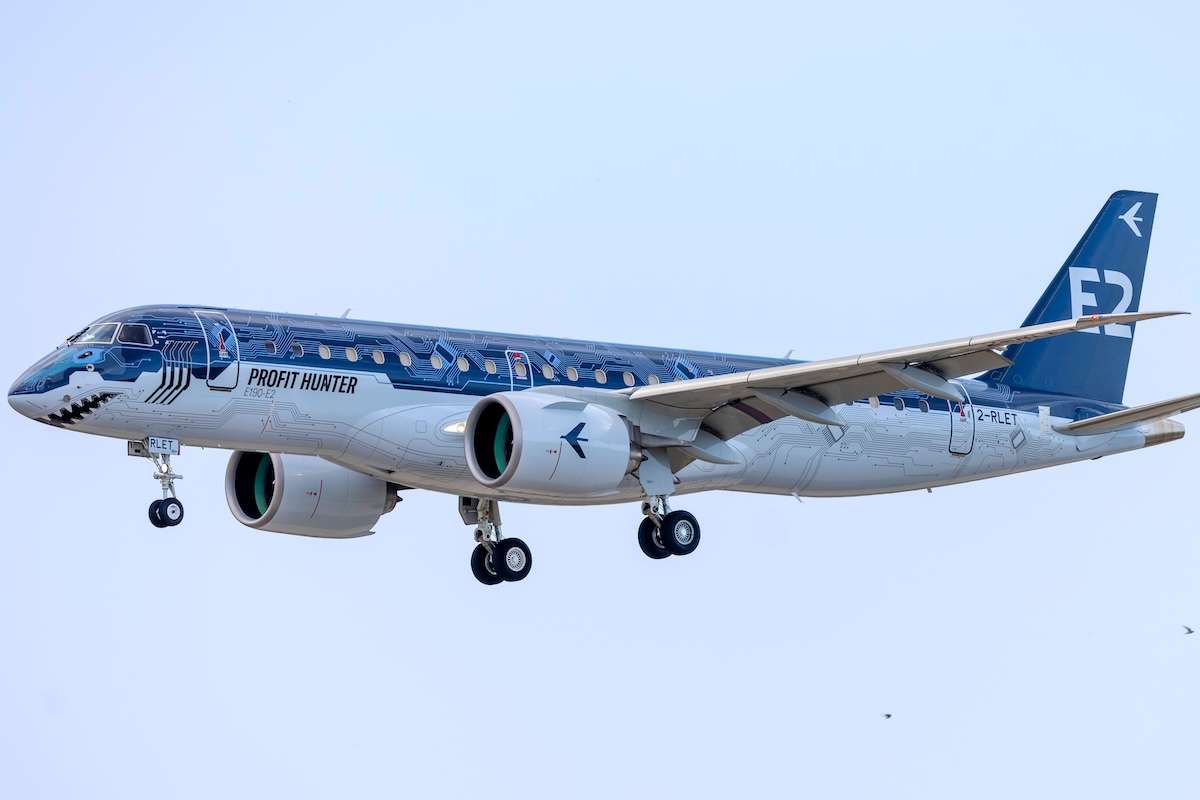
Airbus’ Chief Guillaume Faury has issued a public warning to Brazilian planemaker Embraer about thinking twice before moving ahead with the launch of a new single-aisle jet.
That single-aisle jet has been heavily rumoured in recent years as the answer to the Airbus A320neo and Boeing 737 MAX, despite COMAC’s C919 being the best third option on the market.
His comments suggest a high-risk gamble against not just Airbus but Boeing’s long-established offerings and the rising challenger from China, which, despite its certification struggles, is optimistic about the future.
In an interview with Aviation Week, he emphasized that Embraer must give careful consideration before moving beyond the E2 regional jet family.
Why These Comments From Airbus?
Faury being asked about speculation surrounding Embraer’s larger jet ultimately comes after a strong period of reporting on the prospect of such a model coming to fruition at the Brazilian planemaker. The business is looking to take its next steps to respond to the market.
Entering the market, however, was something Faury said was against Airbus and Boeing; even COMAC is not easy, and it’s worth thinking twice because of the risk that it may not pay off. The big market being referred to is the core narrowbody segment, where the A320neo and 737 MAX sit in the nice 170- to 200-seat bracket, rather than the A220 segment, which the E-Jets currently occupy.

In an unfavourable industry, the segment occupied by the well-established A320 and 737 families requires significant capital investment and competitive pricing to disrupt long-standing customer relationships. While Embraer has the support for its E-Jet, taking that a step upwards presents an enormous challenge.
Faury isn’t just coming from the view that there are pressures in finding a market for the 180-seater jet, but rather from Embraer’s requirement to finance and industrialize it, build out a much broader supplier base, and then ramp up volumes to compete with Airbus and Boeing themselves.
Is Embraer Even Launching A New Plane?
Embraer hasn’t committed to a new narrowbody project that would be a step above its E2, despite strong reports speculating about this in recent years. Executives have repeatedly said that decisions on the next clean sheet haven’t been made yet, and their priority list differs from what’s publicly discussed.
The Brazilian manufacturer doesn’t just focus on commercial products but also on business and military products, so there are many decisions to be made about what its next direction will look like. Fundamentally, the manufacturer needs to work out how to evolve in the coming decades, not just secure its current position, but innovate to sustain future success and market demand.
Embraer, however, has acknowledged that a larger single-aisle jet would be in demand and would require a mountain of work, including financial backing and partners to help manage the workload and investment.
This type of development comes with risks and is measured by a value in the tens of billions, and that’s a figure far above what a business like Embraer would be willing to splurge on its own without some support.
Thus far, the planemaker has been stepping up the conversation about the future of its aircraft. As part of that, propulsion studies have been a high priority to explore what’s beyond the E2 family and turboprops, with all options kept open.

However, there is no launched programme, with no defined size and no rival to the A320 or 737 publicly announced by the manufacturer yet, and if there were to be, it would be quite some time away.
That said, with reporting on this matter, it’s naturally something to be asked of Airbus and Boeing executives. Faury’s warnings are not just attempts to push competition away; they are very real and grounded in the sheer scope of a new narrowbody clean sheet.
In November 2025, the Embraer Chief Executive Officer, Arjan Meijer, put it bluntly, saying that any decision about what will come next will not be rushed. Instead, a comprehensive study will be conducted to determine the best steps to take moving forward, so that when an investment is required, it’s the right one.

ABOUT THE AUTHOR
Daniel Fowkes is a Melbourne-based aviation analyst and journalist with over a decade of industry experience. As founder of Dj’s Aviation, he delivers trusted analysis on aircraft, airline strategy and global aviation trends for djsaviation.net
Related Articles




Stay Informed
Get the latest aviation news, analysis and route updates delivered to your inbox.
We respect your privacy. Unsubscribe at any time.
Enjoyed this story?
Make us your go-to for aviation news
Add us as a preferred source on Google and see our latest stories first in Top Stories.
Add Us On Your News Feed