

Emirates SkyCargo has filed preliminary schedules for its new Boeing 777-300ERSF special freighter, with a planned entry into service in mid-2026.
The conversions are expected to significantly boost the Group’s dedicated freighter fleet and surging e-commerce and global trade demand, even amidst the ongoing conflict in the Middle East.
New Schedule and Entry Plan
Emirates SkyCargo, flagged by aeroroutes.com in a recent schedule filing, aims to roll out this new Boeing 777-300ERSF more ambitiously, with service commencing in May 2026 under the internal code 77VE.
As part of the preliminary schedule, debuting on 4 May 2026, the airline would deploy the aircraft on a Dubai-Al Muktamar service to Accra, Nairobi, and Amsterdam, before returning to the company’s hub once a week.
On 6 May 2026, a once-weekly service between Dubai, Lusaka, Harare, Nairiboi, Amsterdam and then back to the hub location of Dubai Al Maktoum.

From 8 May 2026, Dubai Al Maktoum would be served by this aircraft, with service continuing through to Hong Kong once a week. This is planned to jump to twice a week from 1 October 2026, then to 5 times a week three weeks later, on 23 October 2026.
From 9 May 2026, a once-weekly flight from Dubai will operate via Lagos, Accra, Nairobi, and Amsterdam, then return to Dubai, on the Boeing 777-300ERSF, also known as the Special Freighter.
Lastly, a twice-weekly service effective 26 October 2026 will be offered from Dubai to Riyadh as part of the final deployment, which remains highly subject to change, given its reliance on the pace of conversions occurring as intended.
What Is The Boeing 777-300ERSF?
The Boeing 777-300ERSF is a passenger-to-freight conversion (P2F) of the stretched and popular 777-300ER and offers a main deck payload of up to 105 metric tons, representing 25% more volume than the 777-200F currently in service.
When paired with a range of around 4,700 nautical miles and a larger nose door, reinforced floors, and 32 pallets on the main deck, plus containers below, it’s a programme aimed at helping keep the popular 777-300ER airborne for longer than just as a passenger jet.
Often known as the Big Twin, the 777-300ERSF aims to transform existing passenger jets into large cargo freighters, with the first two units expected to be delivered in the mid- to late stages of 2025.
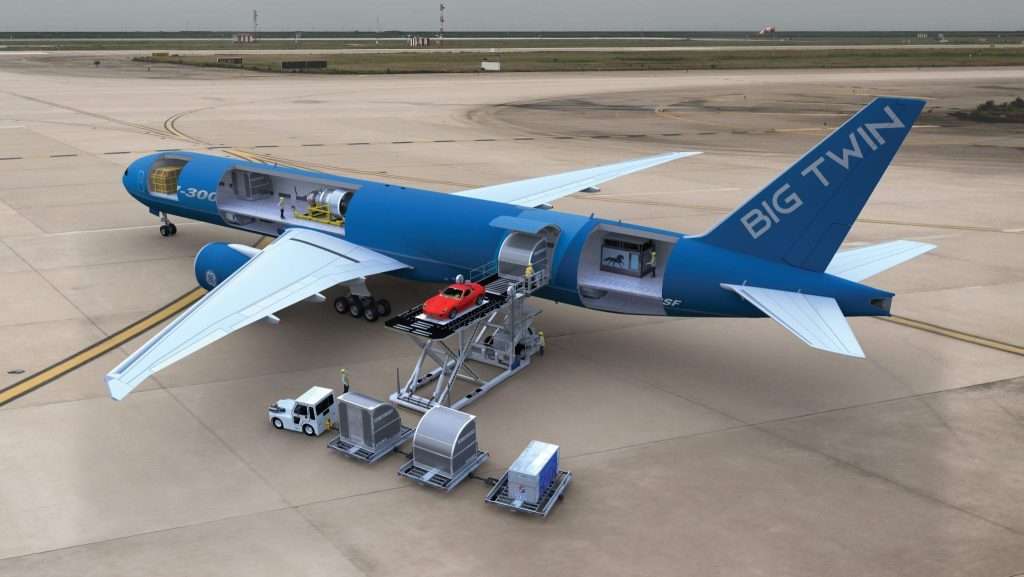
The conversion program was launched at the beginning of the 2020s as part of a collaboration between the major leasing company AerCap and Israel Aerospace Industries (IAI) and was pitched for the 777-300ER platform.
Thanks to its payload and availability through conversions, the aircraft is positioned as a more immediate solution for freight requirements in an age when newer freighters face not only delays but also significant uncertainty around their launch dates, notably with Boeing’s 777-8F.
What Does This Aircraft Mean For Emirates?
For Emirates, these aircraft address the ever-growing capacity requirements across the SkyCargo division and, better yet, utilise already available assets in passenger jets nearing the end of their operational life, which are carrying customers.
Conversions provide a faster and, at times, more cost-effective medium-term solution to ramp up capacity in favour of new builds, which typically have delays, and now relying on passenger 777-300ERS amid widebody shortages presents itself as a favourable option.

Once these aircraft formally launch, the company will be able to see a near doubling of its main deck capacity across key routes, enabling denser travel to Africa, Europe and beyond.

ABOUT THE AUTHOR
Daniel Fowkes is a Melbourne-based aviation analyst and journalist with over a decade of industry experience. As founder of Dj’s Aviation, he delivers trusted analysis on aircraft, airline strategy and global aviation trends for djsaviation.net
Related Articles




Stay Informed
Get the latest aviation news, analysis and route updates delivered to your inbox.
We respect your privacy. Unsubscribe at any time.
Enjoyed this story?
Make us your go-to for aviation news
Add us as a preferred source on Google and see our latest stories first in Top Stories.
Add Us On Your News FeedRelated articles
· Freight
Boeing’s 777F Production Suspended For 2 Months
Daniel Fowkes
25/10/2026
· Freight
Boeing 747-8F Grounded in Europe after Gear Collapses
Daniel Fowkes
25/10/2026
· Freight
Atlas Air Could Fly 60 Airbus A350Fs
Daniel Fowkes
23/10/2026
· Freight
Mystery Surrounds Airbus A350F Order
Daniel Fowkes
10/10/2026