
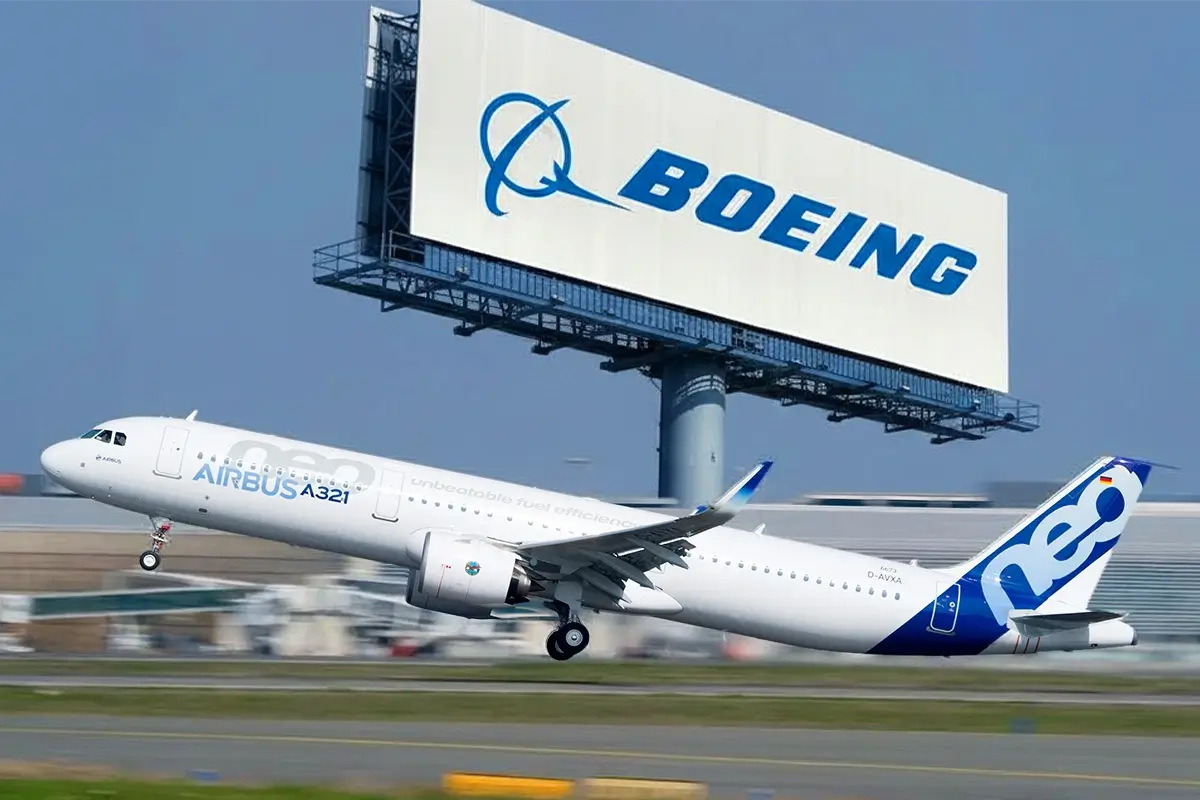
The Airbus A321neo’s recent success is positioning the planemaker to dominate the middle of the market sector for years to come, and all without a response from Boeing.
Now, leading global aviation finance companies are urging Boeing to respond to the A321neo’s dominance to ensure that, as the future decades approach, the American business does not fall further behind.
Avolon Urges Boeing To Respond
In Avolon’s UpNext report, the leading global aviation finance company highlighted Boeing’s position specifically in the middle of the market sector, and instead its lack thereof.
It said that while Boeing has put forward its 737-10, a currently uncertified but highly anticipated and in-demand single-aisle jet that is the largest of the MAX family, it still doesn’t come close to what the A321neo family has achieved.
Avolon says the market share gap between the two derivatives of their respective popular single-aisle families is substantial and will eventually demand a response from the American planemaker.

Towards the backend of the 2010s, studies suggested that there was demand for thousands of new midsize aircraft (NMA); however, Boeing’s presence in this space has ultimately lacked across recent years, and that is being highlighted through the report.
As Boeing continues to pace through recovery, it becomes increasingly important to assess gaps in the commercial airplanes division and the middle-of-the-market sector. Boeing is aware it has a hole in this sector, and at some point, a response will be needed.
Airbus Surges Ahead With A321neo
Airbus has been able to surge ahead in the middle of the market segment with its A321neo family for more than half a decade, a surge driven by several factors, none more than Boeing’s lack of a response.
Fundamentally, from a backlog standpoint as well, Boeing’s quality issues for several years placed a lack of confidence in airlines’ feelings around committing to programs, especially the MAX and as a result left companies piling into Airbus, so much so that for this planemaker, its single-aisle program is sold out years in advance.
With Boeing having recovered on the quality front, its MAX portfolio remains a compelling solution for airlines looking to elevate or renew their single-aisle operations, but Airbus’ 2019 decision to launch the A321XLR, a further derivative of the base A321neo, put the nail in Boeing’s coffin in this sector.

The launch of the A321XLR, with its up to 4,700 nautical miles of range on a single-aisle jet, was impressive enough that it put the model in its own class. Enabling companies that want a more efficient platform to launch services to secondary cities without the need for a widebody, certainly visible across transatlantic markets, but not exclusive to here.
Boeing was unable to keep pace with its MAX variants, which saw their range cap out considerably lower than this. For airlines that favoured flexibility, capacity, and range without breaking the bank, Airbus’ lead widened, making the A321neo series the best-selling model for consecutive years.
Has Boeing Ever Responded?
While Boeing’s high-capacity 737-10 is a solution from a capacity standpoint to the surge in the middle of the market sector, it still lacks the A321XLR; the American planemaker’s position in this niche could, however, have looked very different.
Towards the backend of the 2010s, Boeing was actively studying the launch of a new middle-of-the-market airliner, often dubbed the 797, and had international airlines and lessors interested in the prospects of an acquisition if a launch was greenlit.
However, for Boeing, the prospect of a 797 launch in response to, at the time, murmurs about the yet to be launched A321XLR came during one of the planemaker’s darkest periods in history, the 737 MAX crisis, spurred on by two fatal accidents involving the model.

With all attention shifted towards rebuilding trust in not just this series. Still, Boeing itself, in communications with impacted families and in internal evaluations that spanned more than half a decade, put innovation on the back burner.
By the time internally greater stability had been achieved, analysts argued the boat had long sailed, when factoring in the time for studies, production, certification, and more, the jet would not have launched for at least another half decade plus, and arguments arose over whether the technology available would’ve been worthwhile to implement.
Bottom Line: A Response Needed, But When?
As the 2030s approach, Boeing faces an urgent need to respond to the long-enduring success of the A321neo program, which has carved out a dominance in its sector.
Avolon, in its UpNext calls, is urging Boeing to respond at some point, as Airbus’ game-changing A321XLR provides airlines with new solutions across single-aisle flying and gives the business a comfortable lead over Boeing.
The near launch of the 797 from Boeing could’ve changed the sector, but with crashes, quality issues and more, the American planemaker finds itself behind, and according to those close to the industry, it needs to respond at some point.

ABOUT THE AUTHOR
Daniel Fowkes is a Melbourne-based aviation analyst and journalist with over a decade of industry experience. As founder of Dj’s Aviation, he delivers trusted analysis on aircraft, airline strategy and global aviation trends for djsaviation.net
Related Articles




Stay Informed
Get the latest aviation news, analysis and route updates delivered to your inbox.
We respect your privacy. Unsubscribe at any time.
Enjoyed this story?
Make us your go-to for aviation news
Add us as a preferred source on Google and see our latest stories first in Top Stories.
Add Us On Your News Feed