
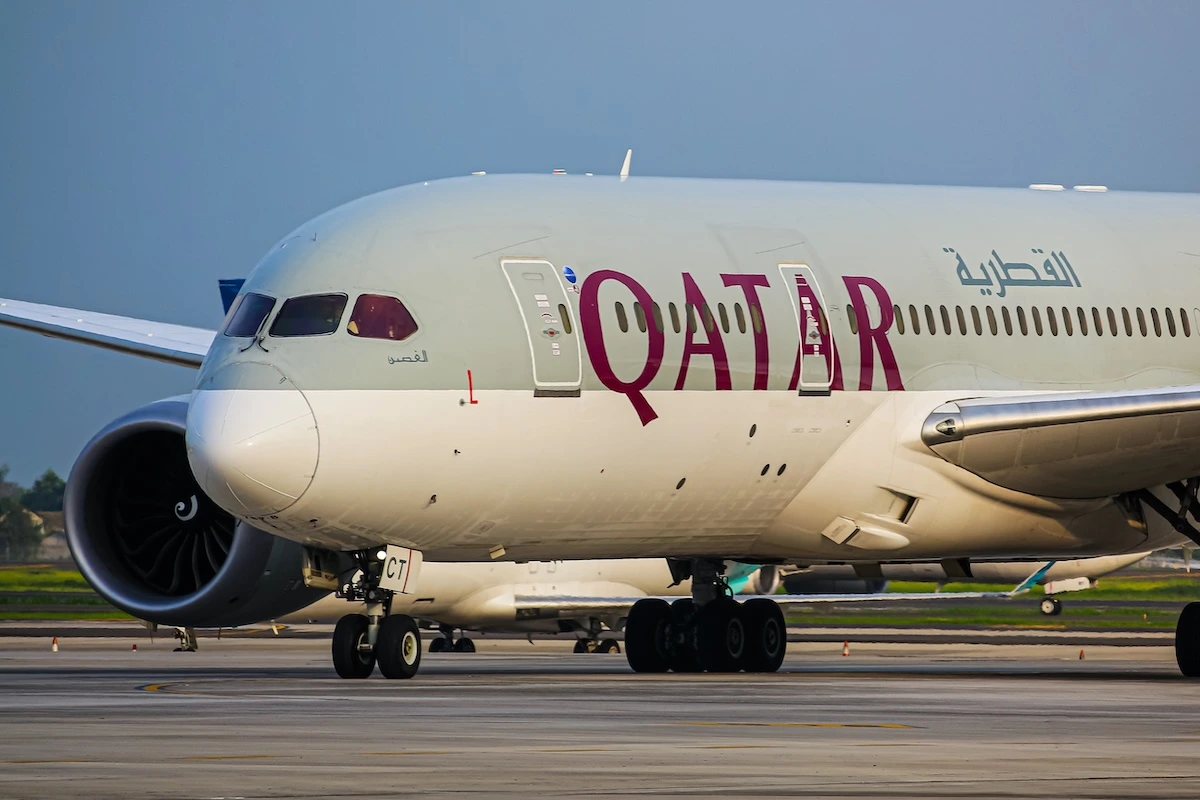
Qatar Airways has extended the suspension of all flights to and from Doha through 3 March 2026 due to ongoing tensions.
As Qatari Airspace remains closed for a third consecutive day, operations cannot resume, halting the airline’s entire operation. As a result, the business must wait for regulators such as the Qatar Civil Aviation Authority (QCAA) to confirm that it’s safe for the skies to reopen.
The airline says the next formal schedule update from the QCAA is expected to arrive at 0900 Doha time on 3 March, 2026. This update would represent yet another that carries the risk of a further suspension of planned service resumption or the grant of permission to resume.
What Is Happening To Qatar Airways?
In essence, all Qatar Airways passenger services to and from Hamad International Airport are paused. What this does is freeze the airline’s crucial global hub-and-spoke network, with the airline maintaining some operation on the ground but not in the air.
The described skeleton operation on the ground in Doha appears to focus on affected customers, with extra staff deployed to assist disrupted travellers. This includes providing services such as accommodation and food if required, alongside the critical rebooking process.

For passengers, the impact is also profound, while minimal compared to what has been taking place nearby, and safety remains the top priority. This has disrupted many travel plans and caused a ripple effect, not just on one day but on many days, and right around the world, despite the reality that airlines’ aircraft remain grounded in different regions.
In the case of Qatr Airways, a forced operational shutdown like this will significantly impact the airline’s performance once it is all said and done. Despite this, it’s something the airline will have to manage.
Not only is Qatar Airways compliant, but it is unwilling to put the safety of its crew or passengers at risk by keeping its planes in the air during these periods of uncertainty.
Why Is This Happening?
All of this is happening as a direct result of the QCAA’s decision to close Qatari airspace as a precaution amid a wider regional crisis, which has been spurred on by strikes led by the United States against Iran, subsequent retaliatory strikes from the latter and more.
With multiple states in the Middle East, including Iran, Israel, Jordan, Qatar, and the UAE, all imposing airspace restrictions, which have forced airlines that call these locations home to halt their operations.

Manchester Airport England
27 October 2019 – Photo: Plane Photography / shutterstock
Additionally, it has affected airlines that are based elsewhere that serve those markets, with suspensions in place or flight reroutes to ensure their journeys are not affected.

ABOUT THE AUTHOR
Daniel Fowkes is a Melbourne-based aviation analyst and journalist with over a decade of industry experience. As founder of Dj’s Aviation, he delivers trusted analysis on aircraft, airline strategy and global aviation trends for djsaviation.net
Related Articles




Stay Informed
Get the latest aviation news, analysis and route updates delivered to your inbox.
We respect your privacy. Unsubscribe at any time.
Enjoyed this story?
Make us your go-to for aviation news
Add us as a preferred source on Google and see our latest stories first in Top Stories.
Add Us On Your News FeedRelated articles
· Airlines
Allegiant Air Buys Six More 737-8s From Boeing
Daniel Fowkes
26/10/2026
· Airlines
Emirates vs Qatar Airways: The Gulf Superhub Rivalry Compared
Bryan Shelmon
26/10/2026
· Airlines
Riyadh Air Is Moving Away From Riyadh
Daniel Fowkes
26/10/2026
· Airlines
Emirates Isn’t Worried At All
Daniel Fowkes
25/10/2026