

Boeing launched the 777X in 2013, but it’s the 777-8 that has since lagged in conception and is considered, broadly, a failure.
Why has this variant failed to attract interest from airline customers? Why does it battle big brother syndrome, and how could the program’s evolution based on customer trends further impact its future within the industry?
Introducing The Boeing 777-8
The 777-8 was launched as part of Boeing’s commitment to renewing the 777 family, with the reveal of its 777X in the early to mid-2013 timeframe.
With two models launched initially, the larger 777-9 was complemented by the smaller 777-8. This aircraft is intended to have reduced capacity to enable it to thrive on longer route segments, as seen with the -200LR, which has been adopted by airlines recently.
The 777-8 measures 69.8 metres and can seat around 384 passengers, depending on how airlines configure it, whereas the 777-9 measures 77 metres and has a capacity just above 420.

As touched on, from an operational standpoint, any airline seeking a new widebody aircraft would target the 777-8 due to its ability to operate on long-distance routes such as New York to Singapore, Dubai to Los Angeles, and so on.
These routes, while appealing to airlines, would carry fewer passengers than on more high-profile international routes where the 777-9 is slated to operate.
On paper, the 777-8 offers efficiency, range and other capabilities that should make it a standout; however, it finds itself quite the opposite, a problem child in a program filled with struggles since its establishment.
A Story Of The Big Brother
Families are complicated, and more often than not, siblings will battle it out for recognition or attention. The 777-8’s story has frequently been cast aside, while its big brother, the 777-9, has been put in the limelight.
Unfortunately, almost all of the family’s backlog is for the -9 model, not the -8. Instead, the latter represents a small fraction of orders, and more often than not, when an airline is interested in acquiring the 777X, it’s always for the larger variant.
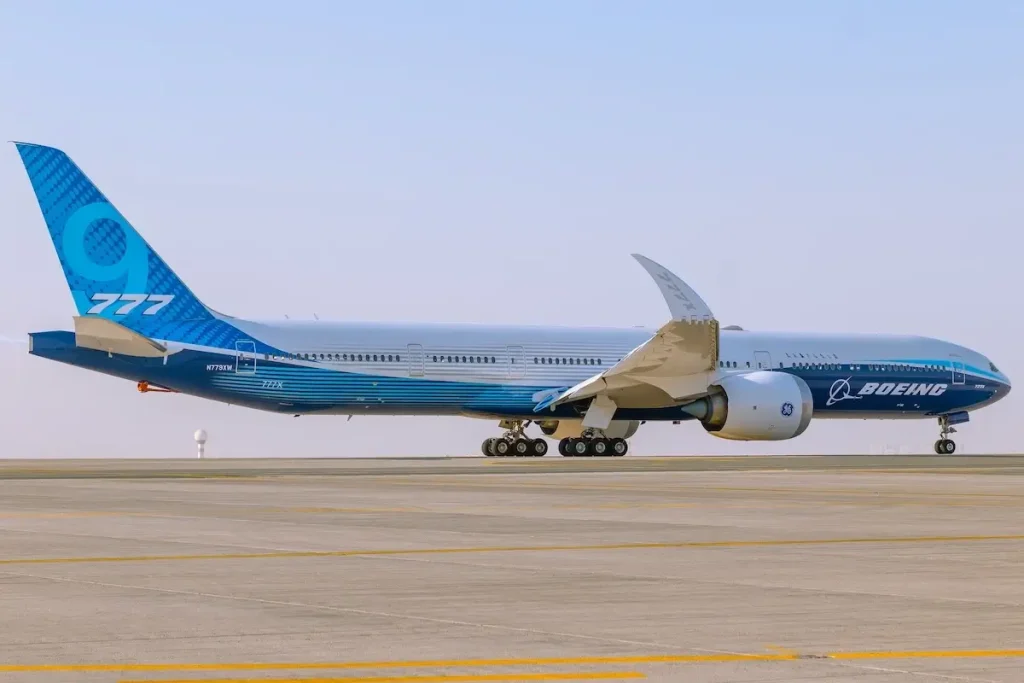
Much of this stems from the capabilities offered through the larger model, which, while sharing the same design elements, engines, and so forth as the smaller model, makes more sense in airline fleets.
The range offered with the -9 is upwards of 7,000 nautical miles, or 13,500 kilometres. For the vast majority of airlines looking to fly international services, excluding the likes of Qantas’ Project Sunrise initiative, this range is exactly what they’re looking for.
This range means global cities such as Melbourne to Dubai, Los Angeles to Sydney, and Dubai to New York, among others, can all be reached with a passenger capacity of over 400 if a two-class layout is selected.
The 777-8 struggles because, while it offers additional range more often than not, airlines prefer the capacity, and the range loss of the -9 isn’t significant enough to make it unfavourable. Analysts could even see the 777-8 as its leading feature, and as overkill.

Even if airlines opted for the 777-8, they wouldn’t necessarily see a better overall cost per seat, because the 777-9, once filled, would offset any fuel savings from the smaller model.
All that considered, it’s also essential to realise that ultimately many of the customers who have selected the family thus far are doing so from one of the world’s biggest hubs, whether it be Dubai, Singapore or Frankfurt.
As a result, there is a high-priority requirement for these airlines to strike the perfect balance across key areas, such as range, capacity, and the bottom line, so that results across their network are better and more well-received financially across markets.
To date, just a handful of customers have chosen to commit to the smallest member of the series. That theme has only continued over recent years, too: the jet often not even finding itself in the conversation right from the beginning, when airlines begin studying a new long-haul jet, and Airbus’ position in this has not helped either.
In Steps The A350-1000
The Airbus A350 family and the Boeing 777X are not intended to be direct competitors; the 777X’s specifications often outshine those of the A350. However, they conflict when airlines seek to purchase a new long-haul jet.

With that in mind, if the 777-9 is deemed to be something too sizeable for airlines, the alternative is committing to the A350 family, which has its more specifically high-capacity A350-1000 on offer, capable of seating just shy of 400 passengers, a downgrade but still a versatile aircraft.
What this family has been able to do, which Boeing has not been able to do with its upcoming flagship, is prove the aircraft to be reliable, as seen through scheduled passenger flights achieved through certification, which the American planemaker has not.
The uncertainty surrounding the 777X program has been a factor that airlines have had to consider for years now when evaluating their fleet requirements. The smallest member in Boeing’s new long-haul jet has been consistently delayed because its bigger brother cannot get certified.
That uncertainty isn’t as significant a concern for a company like Etihad Airways, which has outright said it is not affected by delays because its delivery window is sometime in the future, but for a business like Emirates, it has been catastrophic.

For airlines needing more immediate capacity, the A350-1000, for example, has proven itself to be vastly more reliable and readily available. There are also other factors as to why Airbus’ widebody has been so highly regarded and is forming the backbone of many fleets moving forward.
A Family That Is Evolving?
The 777-8 has, since its conception, been an aircraft often disregarded, as its bigger brother has significantly outperformed it. In its slice of the market, it’s considered a niche, and evolving demand has seen airlines look elsewhere.
But now, the Boeing 777 family could be getting a new entrant into the market, an even bigger brother with technical feasibility having already been achieved through a -10 model. Still, now Boeing is confirming that it’ll take the neccesary steps to study whether this would be a genuine logical decision to launch.
This interest stems from Emirates’ calls for a new, larger aircraft to cater not just to the required range across its operations, but more importantly, to replace its own superjumbo with the Airbus A380.

The drive for additional capacity is once again the exact opposite of what the slightest variant in the program offers customers. It is one of the many reasons it has been disregarded and, to this point, could be considered a disappointment, with some going further to highlight its failure.
The -8s misfortunes are even evident in the A330neo program, where the A330-900 is meant to take an even larger share of the order book. At the same time, the smaller A330-800 is completely disregarded, with airlines showing absolutely no interest in acquiring it.

ABOUT THE AUTHOR
Daniel Fowkes is a Melbourne-based aviation analyst and journalist with over a decade of industry experience. As founder of Dj’s Aviation, he delivers trusted analysis on aircraft, airline strategy and global aviation trends for djsaviation.net
Related Articles




Stay Informed
Get the latest aviation news, analysis and route updates delivered to your inbox.
We respect your privacy. Unsubscribe at any time.
Enjoyed this story?
Make us your go-to for aviation news
Add us as a preferred source on Google and see our latest stories first in Top Stories.
Add Us On Your News Feed