

Boeing has confirmed a historic new purchase for its popular 787 widebody program.
The deal from Uzbekistan Airways represents the largest ever purchase in the carrier’s history and a statement of its own intent to move forward with fleet modernisation.
Uzbekistan Airways will acquire up to 22 of the 787 Dreamliners with a firm purchase of 14 units, all for the 787-9 variant. At the same time, options for a further eight units also exist, should they wish to be activated at a later date.
These Boeing 787s will be a fine addition to the airline’s fleet once delivered, for the carrier was the first operator of the Dreamliner in Central Asia.
Since taking delivery of the aircraft, Uzbekistan Airways has looked to leverage the capabilities of the 787-8 on service to key markets in Europe, Asia, and the United States.
Now, purchasing the 787-9 will enable the company to benefit from additional capacity, which can be deployed across its existing international services. Additionally, there is now the ability to expand its long-haul destinations as demand continues to rise.
The president of the Republic of Uzbekistan and other key leaders from the airline and Boeing celebrated the new contract on the sidelines of the United Nations General Assembly.
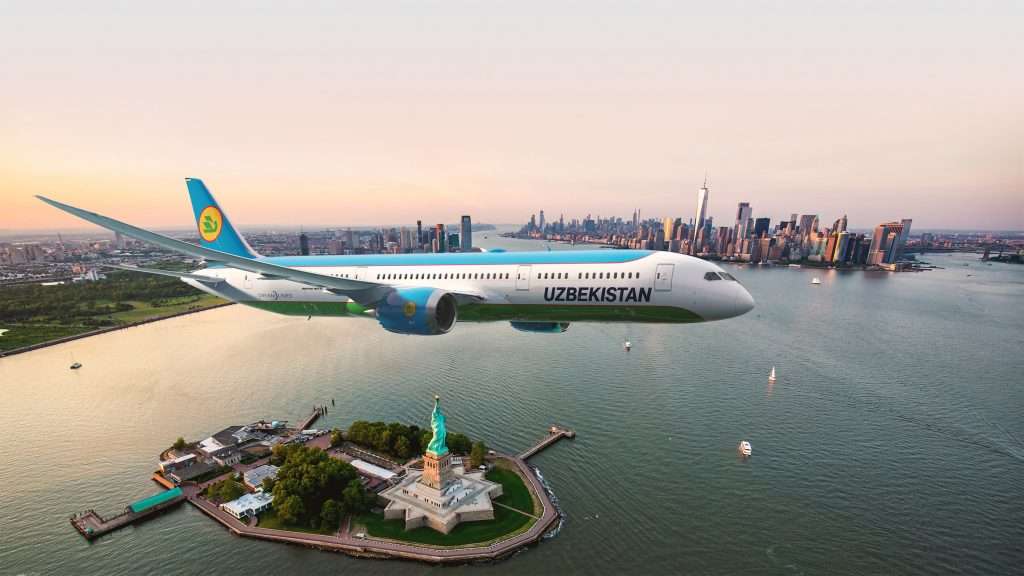
Away from the unveiling of new commercial aircraft, a Memorandum of Cooperation was also signed, which will see Boeing and the Ministry of Transport in Uzbekistan explore possible opportunities to further expand the aviation ecosystem.
Uzbekistan Airways has thus far taken delivery of seven 787-8s, which average around 7.3 years of age, and, as mentioned, are incredibly important for serving the long-haul network.
What’s Next For The Boeing 787?
For the Boeing 787, what’s next? Much of the future of the popular widebody program centres around upcoming production goals.
In late-2024 reporting, Boeing said that its ambition was clear, with the hopes of achieving a production increase for the program in 2026.
The increase would see the planemaker look to raise production rates to ten units a month, with the eventual plan for this to increase further. However, much would need to be achieved before this could be formally proceeded with.
That reporting followed the planemaker’s confirmation in the earlier stages of 2024, indicating the necessity to stabilise output rates and therefore reduce production levels for a shorter period to ensure stability for the future.

With a $1 billion upgrade to the Boeing facility in Charleston, there is hope that Boeing will increase production of the 787 to as many as 16 units a month.
For Boeing, this would represent an increase from the highest level reached, which was 14, the peak occurring just before the 737 MAX crashes, the pandemic, and other factors, resulting in a reduction of the planemaker’s output level.
Talk of a production increase also follows positive developments in late August, which showed that the output rate for the 787 was showing steady increases with one of the busiest months in years.

ABOUT THE AUTHOR
Daniel Fowkes is a Melbourne-based aviation analyst and journalist with over a decade of industry experience. As founder of Dj’s Aviation, he delivers trusted analysis on aircraft, airline strategy and global aviation trends for djsaviation.net
Related Articles




Stay Informed
Get the latest aviation news, analysis and route updates delivered to your inbox.
We respect your privacy. Unsubscribe at any time.
Enjoyed this story?
Make us your go-to for aviation news
Add us as a preferred source on Google and see our latest stories first in Top Stories.
Add Us On Your News Feed