

Today, the Airbus A350 family is recognised as an industry leader, ranging from the A350-900 to the high-capacity A350-1000. Each variant has a purpose in the airline’s fleet.
Concepts such as the A350-2000 also presented opportunities for Airbus to pounce on demand across the industry for efficient high-capacity aircraft.
In the family, however, there was one firm variant and one unreleased in the A350-2000 that looked to push the boundaries of twin-engine high-capacity travel.
What are the similarities thus between the -1000 and the never-launched -2000 model, why did one ultimately not proceed, and how did the plane shape Airbus into how it is today?
Introducing The Airbus A350-1000
Today, the A350-1000 remains a cornerstone of many airline fleets, designed to meet high-capacity routes across long-haul journeys, all with high levels of efficiency.
With seating for approximately 350 to 410 passengers in a typical three-class layout and a range of 8,700 nautical miles, the A350-1000 was built upon older generation types, such as the A340, and aimed to be its key successor while also providing a solution to the older 777 variants.
Upon launch, Airbus ensured that the A350-1000 could feature updated engines, composite materials, and other state-of-the-art materials, providing a worthy upgrade to airlines that would purchase it compared to old-generation aircraft.

Since entering service, Qatar Airways, British Airways, and Cathay Pacific have adopted the aircraft and used it for their flagship services.
Thus, the A350-1000 can be seen at many major international hubs and will fly daily, achieving substantial fuel savings. It has firmly established itself as a mainstay of the Airbus portfolio, but is there a way to further elevate this program?
The Unreleased Airbus A350-2000
In contrast, the A350-2000 was ultimately an unrealised concept that aimed to push the boundaries of the A350 family to a previously unseen level.
It was envisioned as a stretched version of the A350-1000, designed to seat over 400 passengers firmly and, if not, exceed the capabilities seen on the upcoming 777-9 from competitor Boeing.
The A350-2000 would have featured an extended fuselage to accommodate additional passengers while maintaining similar range capabilities to those of the A350-1000, where possible.
Modifications, such as strengthened landing gear, were made to ensure the aircraft was fit to fly. However, those modifications could only go so far without implementing new engines or overhauling wings, and costs would balloon over time.
The target market for a possible even higher capacity variant of the A350 was challenging. It was possibly seen as a solution for dense long-haul routes, particularly in markets in the Middle East.
Furthermore, the aircraft could have served as an ideal replacement for airlines operating high-capacity quad-engined aircraft, which have arguably struggled to find an optimal replacement thus far.
Comparing The Two Aircraft
From a specifications standpoint, the A350-2000 would have offered a significant increase in capacity over the A350-1000, making it better suited for airlines operating routes with high demand.
The fuselage length stretch would have allowed airlines to add more premium or economy seats. The potential positive knock-on ramifications of increased revenue per flight would have been considerable, depending on how the airline configured the aircraft.
However, the increased size of the A350-2000 came with trade-offs, including a higher maximum takeoff weight (MTOW), which resulted in greater fuel consumption per flight.
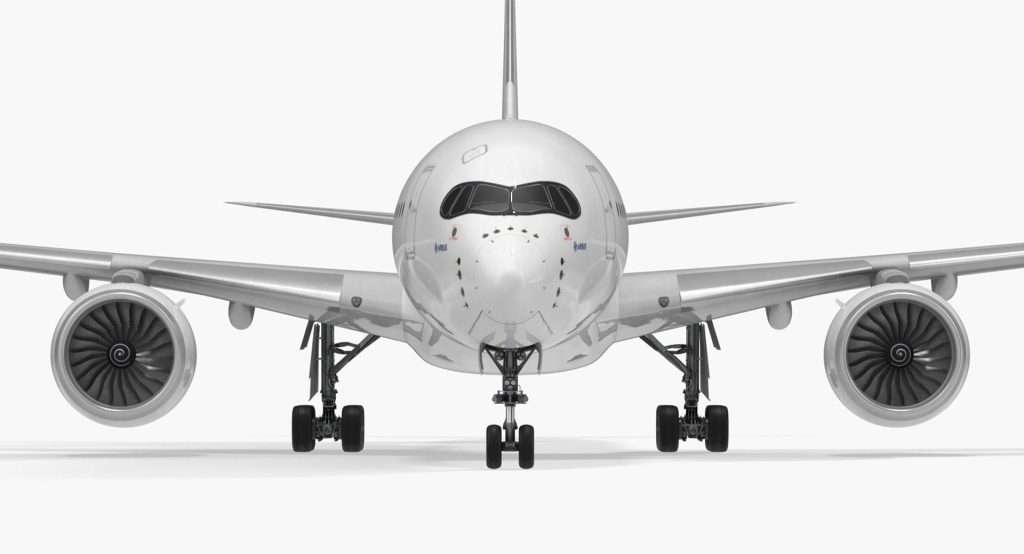
Purely focusing on simplicity, the A350-1000’s existing capabilities were already well-aligned with what airlines required in the market. It is more than capable of serving long-haul routes.
In contrast, the A350-2000 posed the risk of overlapping what had been seen with the -1000 model, complicating production matters.
Why The A350-2000 Never Released
The A350-2000 never progressed beyond initial studies. Several factors contributed to its lack of development, and while there seemed to be prospective internal interest, it never eventuated.
First and foremost, market demand for ultra-large aircraft has shrunk even in a more efficient nature. The rise of point-to-point travel, enabled by smaller and more efficient widebodies, has ultimately reduced the need for high-capacity airliners.
Moreover, the A350-1000 was the optimal endpoint for the wide-body family, as the planemaker confirmed on several occasions. This variant’s capacity and range struck the perfect balance that Airbus had been striving for during the program’s development.
Developing the A350-2000 would also have required substantial investment. Modifications such as structural integrity, gears, possible engines, and even a revised cockpit design wouldn’t have come cheap, and the financial returns would have needed to be substantial to make it worthwhile for the planemaker.
There was also no guarantee of a firm market for the aircraft, so investing all these funds in the company would be a risky proposition.
Given these risks, Airbus decided to prioritise the continued production of aircraft types such as the A350-1000 and, where possible, meet emerging demand in different ways.
This is evident in the ultra-long-haul capabilities introduced on the A350-1000, as seen through Qantas’ Project Sunrise ambitions.

Airbus’ After The A350-2000 Cancellation
The decision to forgo the A350-2000 continues to underscore the importance at Airbus of having a product that aligns with the existing market.
Airbus doesn’t want to overcomplicate matters, and while a larger A350-2000 did hold potential, it would undoubtedly have complicated matters moving forward.
By refining the A350-900 and A350-1000, Airbus has tailored its program to ever-so-specific solutions without breaking the bank. Ultimately, it is an approach that has minimised risk.
Why The A350-1000 Was The Perfect End
In many ways, the A350-1000 represents the culmination of Airbus’ vision for the A350 program. This variant’s combination of capacity and range was a big bonus, and the planemaker confirmed itself as the perfect platform for growth.
Airbus avoided the downsides of over-diversification by not proceeding with the A350-2000, allowing it to maintain a coherent and reliable family of wide-body planes.
Where further innovation has been required, this has been evident in the A350-1000ULR, A350F, and even the existing A350ULR, as seen in operation at Singapore Airlines.
Comparing the A350-2000 to the A350-1000 certainly showcases visible differences, but it also highlights why the even higher-capacity aircraft never took off.

ABOUT THE AUTHOR
Daniel Fowkes is a Melbourne-based aviation analyst and journalist with over a decade of industry experience. As founder of Dj’s Aviation, he delivers trusted analysis on aircraft, airline strategy and global aviation trends for djsaviation.net
Leave a Reply
Related Articles




Stay Informed
Get the latest aviation news, analysis and route updates delivered to your inbox.
We respect your privacy. Unsubscribe at any time.
Enjoyed this story?
Make us your go-to for aviation news
Add us as a preferred source on Google and see our latest stories first in Top Stories.
Add Us On Your News Feed
Thank you for this very comprehensive reasoning for Airbus not going ahead currently with a larger A 350.
Meantime they are doing very well in sales of all models.