
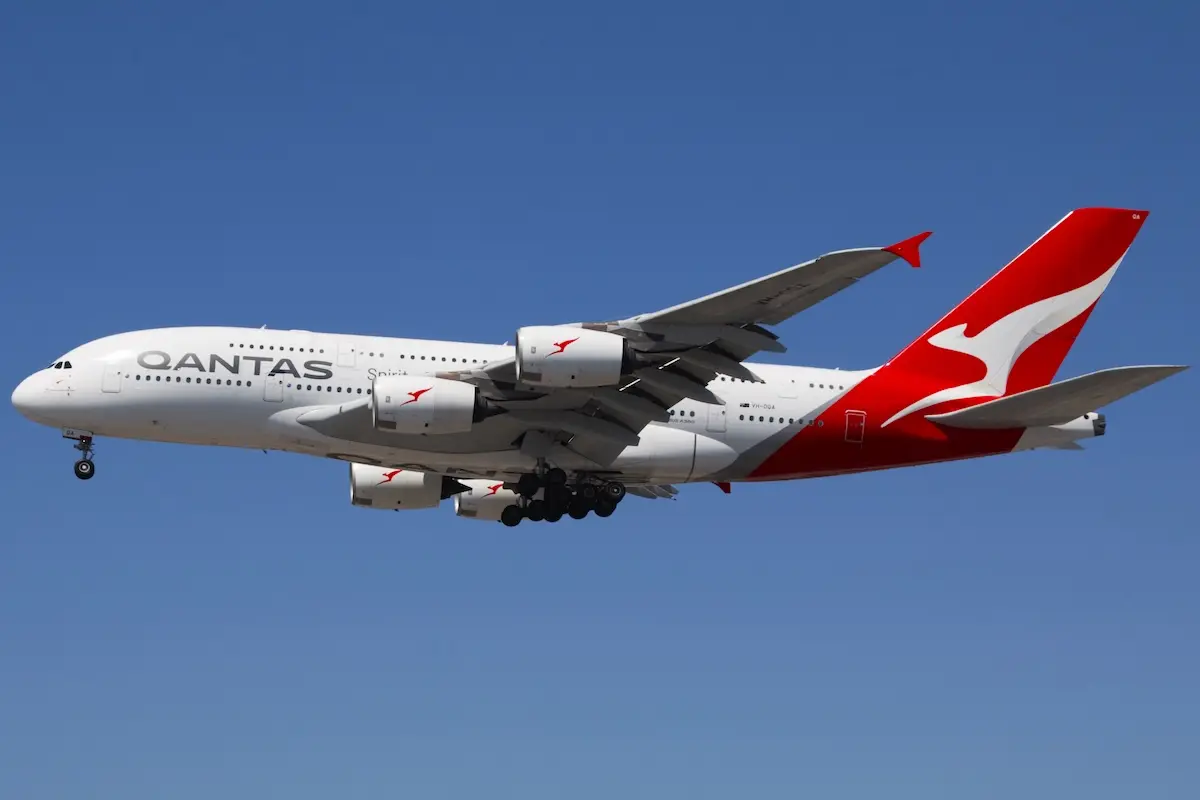
Qantas has been found to have operated an Airbus A380 on two international sectors with a maintenance work light left inside the aircraft’s wing.
The findings follow the Australian Transport Safety Bureau’s final report, which identified the issue following a more than six-month investigation into the events that led to the item being found after failed checks.
Work Light Found Inside the A380
The work light was found in a Qantas Airbus A380-842, registered as VH-OQK, after it arrived at Sydney Kingsford Smith from Los Angeles International Airport (LAX) on 7 January 2026.
After the long-haul flight, Qantas had scheduled the aircraft to spend time on the ground while engineers completed the defect rectification work before it departed as QF7 bound for Dallas Fort Worth (DFW).
During the downtime, the ATSB report stated that the task involved replacing an outlet temperature sensor on the secondary heat exchanger of the left air generation unit. This unit, more commonly known as an air conditioning pack, is located within the wing and therefore requires maintenance personnel to remove an underwing access panel before gaining entry.
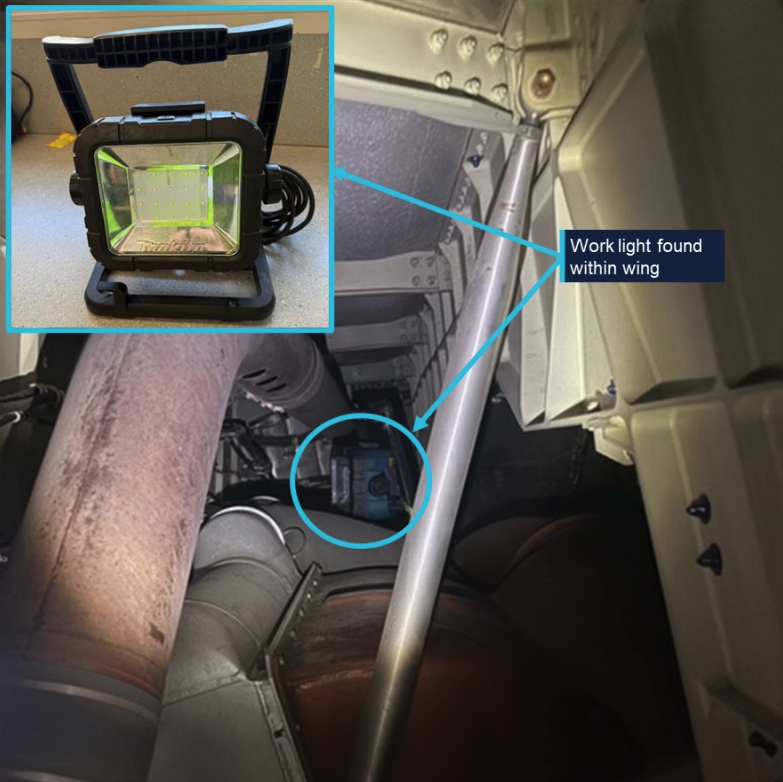
The ATSB found that the two aircraft maintenance engineers completed the sensor replacement successfully and used a portable Makita LED work light to illuminate the workspace. However, the final report stated that the light was switched off and left in the wing as the engineers finished their job.
The engineers then faced further complications when the auxiliary power unit failed during post-maintenance testing. Additional work was required as troubleshooting commenced to ensure the systems were operational.
However, the work light remained inside the wing and was not identified during the foreign object debris clearance inspection, and the access panel was subsequently reinstalled. VH-OQK, following its downtime, was then towed back to the gate, where departure preparations continued.
Qantas A380 Then Flies to Dallas and Back
At 1321 local time, a licensed aircraft maintenance engineer issued a certification of release to service for this A380-842, stating that while work had been conducted, it was safe to depart, albeit the work light had not been accounted for.
The A380 then departed Sydney as QF7 on the scheduled service to Dallas Fort Worth, United States. The aircraft then departed as QF8 back to Sydney, returning on 9 January at 0655 local time. Later that morning, a Qantas employee identified an unreturned tool report after reviewing the aircraft.
The work light was flagged as missing for two days after it was used on VH-OQK. The engineer who signed out the equipment could not confirm whether it had been returned and, as a result, suggested it may still be inside the wing of the world’s largest passenger plane.
Following the report, maintenance personnel conducted a lost-tool search and found the work light in the left wing. The ATSB determined that the event stemmed from a breakdown in foreign object control and accountability for tools used during maintenance.
The ATSB said its investigation found the light was not observed during inspections, as the workspace was poorly lit, with warm, stuffy conditions. Furthermore, an interruption required the engineers to switch tasks quickly, likely contributing to the work light being forgotten.
Concerningly, the Qantas Engineering maintenance information system did not automatically flag that a tool had remained signed out, nor did it prevent the certificate of release to service from being issued without reviewing an unreturned tool report. Qantas has since introduced additional tool-control measures to prevent a recurrence.

ABOUT THE AUTHOR
Daniel Fowkes is a Melbourne-based aviation analyst and journalist with over a decade of industry experience. As founder of Dj’s Aviation, he delivers trusted analysis on aircraft, airline strategy and global aviation trends for djsaviation.net
Related Articles




Stay Informed
Get the latest aviation news, analysis and route updates delivered to your inbox.
We respect your privacy. Unsubscribe at any time.
Enjoyed this story?
Make us your go-to for aviation news
Add us as a preferred source on Google and see our latest stories first in Top Stories.
Add Us On Your News FeedRelated articles
· Airlines
Allegiant Air Buys Six More 737-8s From Boeing
Daniel Fowkes
26/10/2026
· Airlines
Emirates vs Qatar Airways: The Gulf Superhub Rivalry Compared
Bryan Shelmon
26/10/2026
· Airlines
Riyadh Air Is Moving Away From Riyadh
Daniel Fowkes
26/10/2026
· Airlines
Emirates Isn’t Worried At All
Daniel Fowkes
25/10/2026