
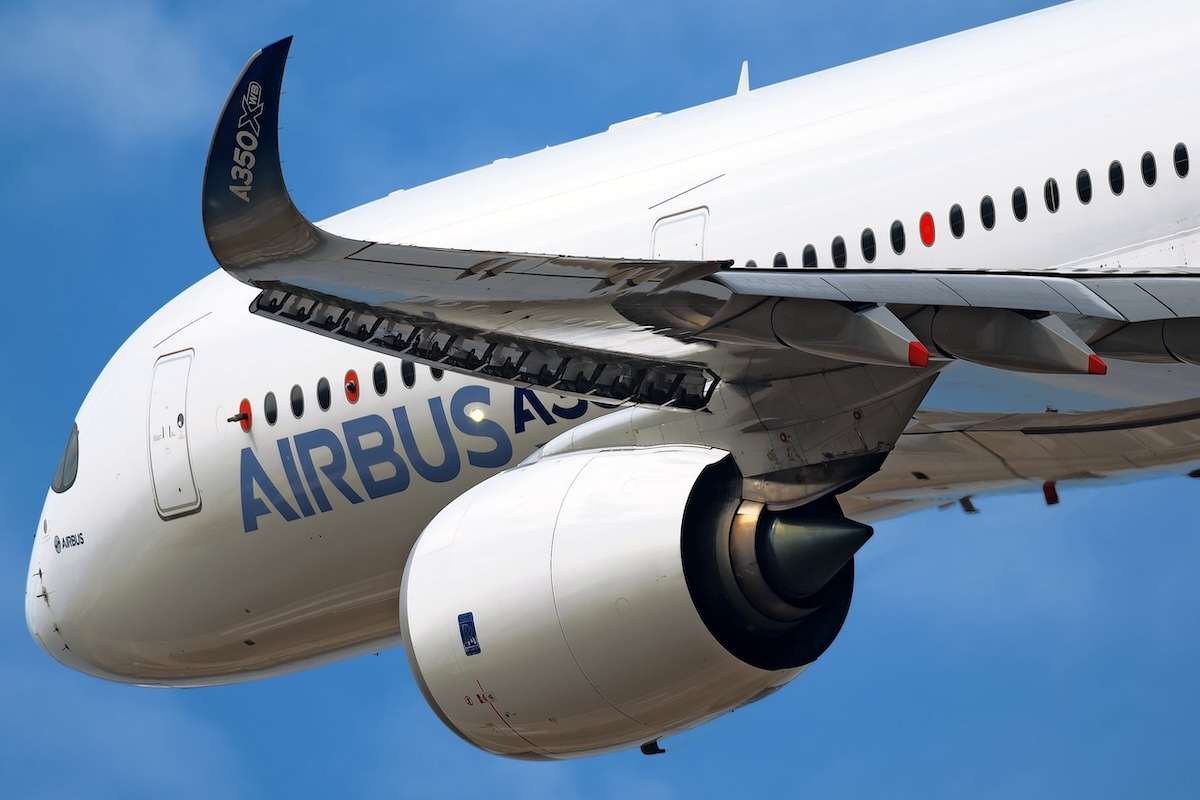
Philippine Airlines is set to deepen its commitment to the Airbus A350 family with a top-up purchase of 10 more jets, expected to arrive this month.
In line with a contract to be signed for the Boeing 787 Dreamliner, a total of 10 A350s are expected to be included in a doubling-down moment for the airline post-restructuring and since joining the oneworld alliance.
Flagged in early June, Philippine Airlines’ pursuit of more aircraft hasn’t been kept quiet as it aims to secure the capacity it needs for the coming decades early, to avoid long wait times and be limited in its ability to meet demand in 10 years’ time.
The A350 portion of the deal is expected to include 10 jets and, when paired with 10 Dreamliners, will add 20 new widebody aircraft to the backlog. However, this deal, which is not yet final, is subject to change, with the final unit count yet to be signed.
Philippine Airlines & The A350
The A350 family already operates extensively with Philippine Airlines, with the A350-900 having served for an extended period, whereas the A350-1000 is the newer model, acting as the flagship, having only taken delivery of the jet in December 2025.
The initial order for the A350-1000 was intended to directly replace the Boeing 777-300ER, and it became the flagship product for serving dense long-haul routes, including those to North America. Thanks to a stream of deliveries, the reality of deployment is being realised.
It’s the A350-900s that are important for the airlines’ medium-haul flying. This aircraft has been around far longer, with fleet data showing that the A350-900s, of which just two are present, are 7.7 years old.
While the family is ultimately important for the airline, it still only has just four A350 jets to its name, that’s 2 in the A350-900, and 2 delivered A350-1000s, which gives a fair amount of room for growth and a need to scale in order to meet the strong demand in and out of its home country.
Once executed, the A350 deal, likely to be signed at the Farnborough Airshow this July, would lift the backlog for widebodies and be enough for the long-haul network to rely on this family as the primary widebody jet, even if the Boeing 787 has a role in more niche-oriented flights.
A Replacement For The 777-300ER?
The airlines’ A350-1000 contract, from the outset, was pitched as a direct replacement for the Boeing 777-300ER, with a view to deployment across transpacific and other long-haul routes. These 777s are approaching 20 years by the time the bulk of the high-capacity Airbus widebody arrives, and thus will need to exit not just because of age but also due to their older cabins.
The A350-1000, and this trickles down to the broader A350 family, offers better metrics than the outgoing 777 jets, with generally lower fuel burn per seat and emissions that can be significantly reduced. In the high-capacity variants case, a similar capacity point allows for an optimised configuration that doesn’t lose out heavily on seats.
In effect, by Philippine Airlines going for more A350s, with the view of shoring up efforts to replace some of its older widebodies like the 777, this base has technically been covered. Therefore, more jets allow for the retirement of other aircraft present.
Philippine Airlines has 11 Airbus A330s to its name, and away from the 777, this is the only other previous-generation jet in its fleet. These A330s are pivotal for regional and medium-haul flying, and the 787, often considered an alternative to the A330ceo, is being ordered, but the new A350 batch will also help support renewal.
Ultimately, 10 more Airbus A350s open up room not just for strict replacement but also to address the business’s burning need to commit to more widebody jets to ensure it has enough capacity deep into the coming decades.
With programs selling out thanks to airlines all holding the same view, many are being forced to make significant investments earlier than they would have liked, so they can secure their place in the coming years. While for some this poses a risk, the consensus is that pre-planning will see the benefits outweigh the risks if all pans out.

ABOUT THE AUTHOR
Daniel Fowkes is a Melbourne-based aviation analyst and journalist with over a decade of industry experience. As founder of Dj’s Aviation, he delivers trusted analysis on aircraft, airline strategy and global aviation trends for djsaviation.net
Related Articles




Stay Informed
Get the latest aviation news, analysis and route updates delivered to your inbox.
We respect your privacy. Unsubscribe at any time.
Enjoyed this story?
Make us your go-to for aviation news
Add us as a preferred source on Google and see our latest stories first in Top Stories.
Add Us On Your News FeedRelated articles
· Airlines
Allegiant Air Buys Six More 737-8s From Boeing
Daniel Fowkes
26/10/2026
· Airlines
Emirates vs Qatar Airways: The Gulf Superhub Rivalry Compared
Bryan Shelmon
26/10/2026
· Airlines
Riyadh Air Is Moving Away From Riyadh
Daniel Fowkes
26/10/2026
· Airlines
Emirates Isn’t Worried At All
Daniel Fowkes
25/10/2026