

Over the last week, Airbus revealed that its newest A380-800 will return to flying, albeit with a catch: it won’t be with passenger airlines or in scheduled service.
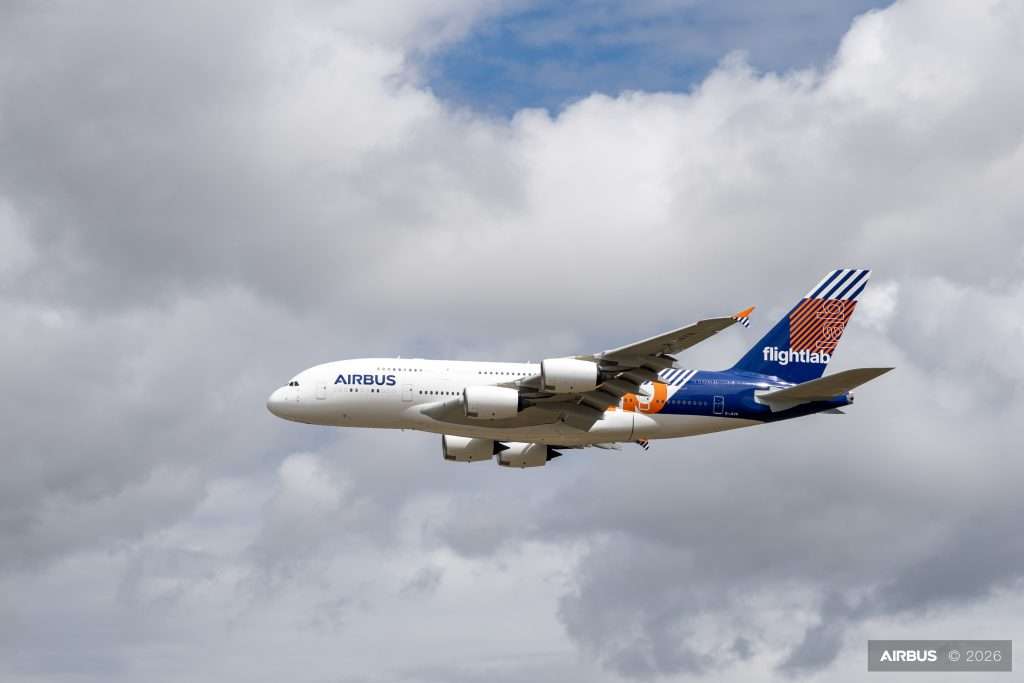
The former Malaysia Airlines Airbus A380-800 MSN114 instead has been repainted in the new distinctive FlightLab livery. It will remain in-house at Airbus as preparations ramp up for its role as a future propulsion demonstrator.
While the A380’s role across the industry continues to diminish following a brief resurgence after the COVID-19 pandemic, this aircraft will help influence the design of Airbus’s next-generation single-aisle aircraft and beyond.
Ex-Malaysia Airlines A380 Finds a New Home
MSN114 first flew in October 2012 and was delivered to Malaysia Airlines in 2013 as 9M-MNF. The aircraft was withdrawn from service relatively early in its operational life as the Kuala Lumpur-based carrier parted ways with the superjumbo.
Following its withdrawal from service, and with a limited second-hand market present for the quad-engined aircraft, the jet spent years in storage in France, but instead of heading to the scrapyard for parts to support the remaining models in service, the company that built the jet has taken it back to shape the future of travel.
MSN114 returned to the air in July, when it was ferried from Tarbes, where it had been in long-term storage, to Shannon in Ireland. While in Ireland, the aircraft underwent work and emerged with its new paint scheme, first teased at the Farnborough Airshow.

The Airbus FlightLab scheme features a different colour palette, with dark blue, light blues, and orange across the fuselage and engine nacelles. The aircraft has now returned to France, with a low pass over Toulouse before work continues to prepare it.
With a second chance at life, albeit without passengers, the Airbus FlightLab programme will allow the manufacturer to run flight tests to evaluate technologies under current operating conditions across platforms from several families.
The former Malaysia Airlines aircraft, deemed no longer necessary by the airline, will instead become one of the biggest pieces in the European manufacturer’s jigsaw as it shapes the future.
Airbus Has Selected an A380 for CFM RISE Open Fan Testing
Under the new livery and mission, Airbus has earmarked the A380 as the first testbed to support its partnership with CFM International for the RISE Open Fan flight-testing campaign.
The 50-50 engine partnership between GE Aerospace and Safran Aircraft Engines has been launched to develop the technologies for what could become a new generation of engines adopted on commercial airframes. The studies are part of efforts to squeeze more efficiency from engines, meet sustainability targets, and ensure the new generation of aircraft is, from a cost standpoint, an upgrade on what’s present today.
The demonstrator differs from more conventional airframes. Rather than an enclosed fan, the Open Fan concept uses an unducted architecture with a large effective fan diameter. CFM has flagged that the programme aims for up to 20% lower fuel consumption and CO2 emissions than today’s most efficient engines.
Airbus and CFM confirmed in 2022 that the RISE demonstrator would be flight-tested on an A380; now that the superjumbo is painted and being primed, work can finally begin with ground testing and then airborne validation.
Current plans position the Open Fan demonstrator as the No. 2 engine on the left wing, with major modifications beginning in 2027 and official first-flight trials targeted for 2029. The A380, while large, was selected specifically for its four-engine configuration, making it better suited to testing experimental systems.
Installing the Open Fan on one inboard position would still leave three conventional Rolls-Royce Trent 900 engines available; those three engines provide thrust margins on a more conventional basis and still allow engineers to gather data from whatever new powerplant is installed, with an additional safety margin.
Although the size of the Airbus A380 has concerned some operators, the aircraft’s physical clearance between the engine, wing, and fuselage makes it an ideal platform for the Open Fan design, with its large, exposed fan.

ABOUT THE AUTHOR
Daniel Fowkes is a Melbourne-based aviation analyst and journalist with over a decade of industry experience. As founder of Dj’s Aviation, he delivers trusted analysis on aircraft, airline strategy and global aviation trends for djsaviation.net
Related Articles




Stay Informed
Get the latest aviation news, analysis and route updates delivered to your inbox.
We respect your privacy. Unsubscribe at any time.
Enjoyed this story?
Make us your go-to for aviation news
Add us as a preferred source on Google and see our latest stories first in Top Stories.
Add Us On Your News Feed